
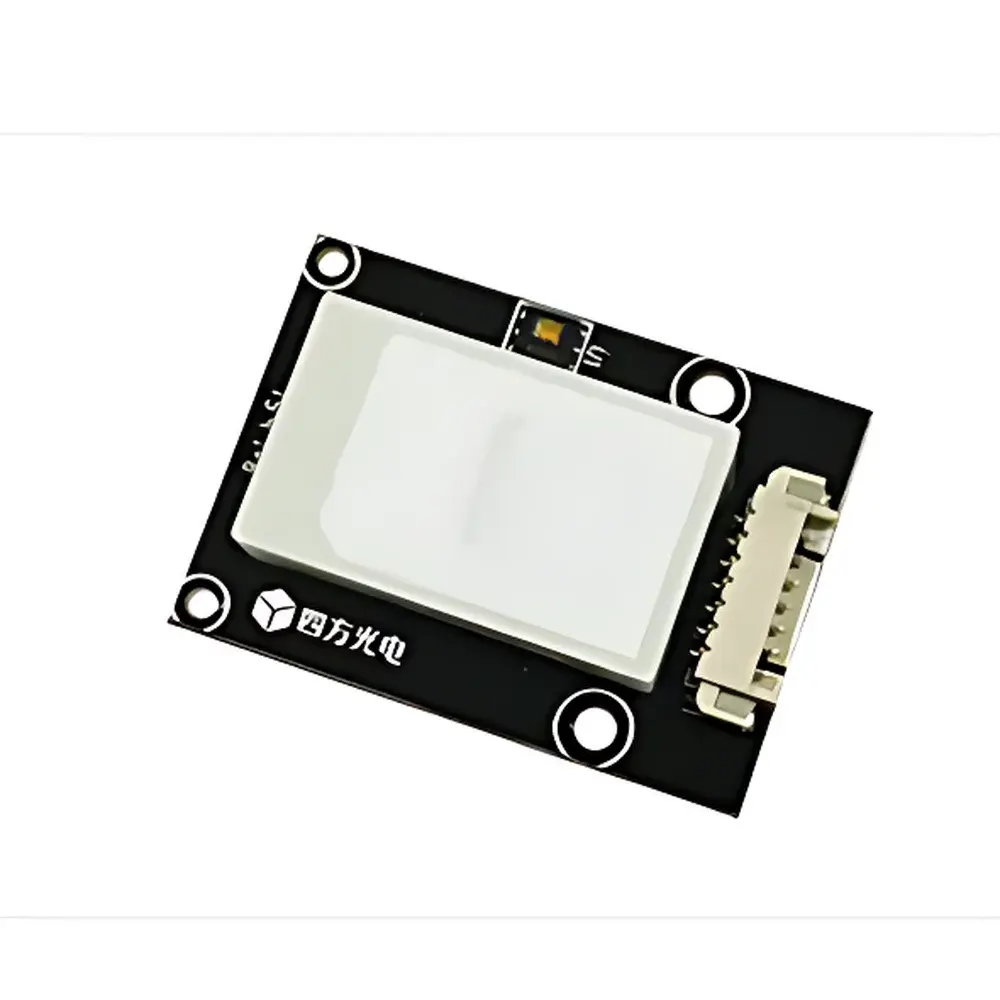
Cubic CB-HCHO-V4 Electrochemical Formaldehyde Sensor
| Brand | Cubic |
|---|---|
| Origin | Hubei, China |
| Manufacturer Type | Authorized Distributor |
| Country of Origin | China |
| Model | CB-HCHO-V4 |
| Detection Principle | Electrochemical |
| HCHO Range | 0–1 ppm |
| VOC/TVOC Range | 0–10 ppm (ethanol-equivalent) |
| HCHO Accuracy | ±30 ppb or ±10% (whichever is greater) @ 25±2°C, 50±10% RH |
| Resolution | HCHO: 1 ppb |
| VOC/TVOC | 0.01 ppm |
| Response Time (T90) | 50 s @ 25±2°C, 50±10% RH |
| Warm-up Time | 100 s |
| Operating Temp | −10 to +50°C |
| Operating Humidity | 15–95% RH (non-condensing) |
| Storage Conditions | −20 to +50°C, 15–95% RH (non-condensing) |
| Supply Voltage | DC 3.5–5.5 V |
| Current Consumption | <15 mA |
| Communication Interfaces | UART-TTL (3.3 V), I²C (reserved), PWM (reserved) |
| Dimensions | 23 × 32 × 8 mm (W×H×D) |
| Lifetime | Up to 6 years |
| Cross-sensitivity to Ethanol | <1% |
| Long-term Stability | Engineered for industrial-grade drift control |
Overview
The Cubic CB-HCHO-V4 is a fourth-generation electrochemical formaldehyde (HCHO) sensor engineered for reliable, low-concentration gas detection in indoor air quality (IAQ) monitoring systems. Based on amperometric electrochemical transduction, the sensor employs a dual-working-electrode configuration with proprietary electrolyte encapsulation to enhance selectivity and mitigate baseline drift. Its core measurement principle relies on the oxidation of formaldehyde at a catalytic working electrode, generating a current proportional to analyte concentration—linearly calibrated across 0–1 ppm HCHO. Unlike optical or metal-oxide semiconductor (MOS) alternatives, this electrochemical architecture delivers superior specificity to HCHO in complex volatile organic compound (VOC) matrices, while simultaneously resolving ethanol-equivalent VOC and total VOC (TVOC) signals via embedded signal processing algorithms. The integrated digital temperature and humidity sensor enables real-time compensation across the full operational range (−10 to +50°C, 15–95% RH non-condensing), ensuring metrological consistency in residential, commercial, and HVAC-integrated environments.
Key Features
- Sub-ppb resolution: 1 ppb HCHO detection limit, supporting compliance with stringent IAQ guidelines (e.g., WHO 0.1 ppm 30-min exposure limit)
- Dual-channel electrochemical cell with patented electrolyte containment, reducing ethanol cross-interference to <1% — critical for accurate HCHO quantification near alcohol-based disinfectants or cleaning agents
- Simultaneous analog/digital output of three independent parameters: HCHO (0–1 ppm), VOC (0–10 ppm ethanol-equivalent), and TVOC (0–10 ppm ethanol-equivalent)
- Onboard temperature and relative humidity sensing with adaptive compensation algorithms, eliminating need for external environmental probes
- Robust long-term stability: <2% signal drift per year under continuous operation; rated service life up to 6 years under typical IAQ conditions
- Multiple interface options: UART-TTL (3.3 V logic), I²C (hardware-reserved), and PWM (firmware-configurable) — enabling seamless integration into embedded microcontroller platforms
- Compact form factor (23 × 32 × 8 mm) optimized for space-constrained OEM applications including portable detectors, smart air purifiers, and duct-mounted HVAC controllers
Sample Compatibility & Compliance
The CB-HCHO-V4 is validated for use in ambient indoor air matrices containing low-molecular-weight aldehydes, alcohols, ketones, and aromatic hydrocarbons typical of residential and office environments. It demonstrates negligible response to CO₂, CO, NO₂, SO₂, and O₃ at concentrations encountered in normal IAQ scenarios. While not certified to ISO 16000-23 or EN 15251 as a standalone instrument, its performance characteristics align with requirements for Class 3 sensors per ISO 16000-27 (indoor air — formaldehyde measurement). The sensor module complies with RoHS 2011/65/EU and REACH SVHC regulations. For GMP/GLP-aligned deployments, firmware supports configurable data logging intervals and timestamped output — compatible with audit-trail-capable host systems meeting FDA 21 CFR Part 11 data integrity expectations when implemented with appropriate system-level controls.
Software & Data Management
The sensor outputs calibrated digital values via UART (default) or I²C, with ASCII-formatted frames containing timestamped HCHO, VOC, and TVOC readings alongside temperature and humidity metadata. Cubic provides an open communication protocol document (v2.1) and reference firmware libraries for ARM Cortex-M and ESP32 platforms. Host-side implementations may incorporate rolling-average filtering, outlier rejection, and auto-zeroing routines during periods of stable background air. Raw electrochemical current data is accessible in diagnostic mode for advanced calibration traceability. No proprietary cloud platform is required; all data remains under end-user control — facilitating integration into custom BMS, IoT edge gateways, or regulatory-compliant local storage architectures.
Applications
- Air purifier feedback control: Enables closed-loop modulation of fan speed and filter regeneration cycles based on real-time HCHO load
- Smart HVAC and fresh-air controllers: Provides input for demand-controlled ventilation (DCV) strategies compliant with ASHRAE Standard 62.1
- Portable IAQ monitors: Powers handheld or desktop units targeting consumer, rental-property inspection, and post-renovation verification use cases
- OEM integration in smart home hubs, thermostats, and wall-mounted environmental stations
- Research-grade indoor exposure studies requiring multi-analyte, low-power, field-deployable sensing nodes
FAQ
What is the recommended calibration interval for the CB-HCHO-V4?
Factory calibration is performed using NIST-traceable formaldehyde gas standards. For critical applications, annual recalibration against a known HCHO source (e.g., permeation tube or dynamic dilution system) is advised. Field zeroing using clean ambient air is supported via command interface.
Does the sensor require external power regulation?
Yes — a stable DC supply between 3.5 V and 5.5 V with ≤50 mV ripple is required. An onboard LDO ensures consistent biasing of the electrochemical cell and ASIC.
Can the CB-HCHO-V4 distinguish formaldehyde from other aldehydes like acetaldehyde?
It exhibits high selectivity to HCHO over C₂–C₄ aldehydes due to electrode catalyst formulation and dual-channel differential measurement; however, quantitative speciation requires GC-MS or FTIR confirmation.
Is the sensor suitable for outdoor deployment?
No — it is designed exclusively for indoor ambient air. Condensation, particulate loading, and UV exposure degrade performance and invalidate warranty.
How is long-term drift managed in firmware?
Host firmware may implement baseline tracking during low-HCHO periods (<5 ppb for ≥2 hours), applying gradual offset correction within ±10 ppb bounds to preserve dynamic range integrity.
Related Products







