
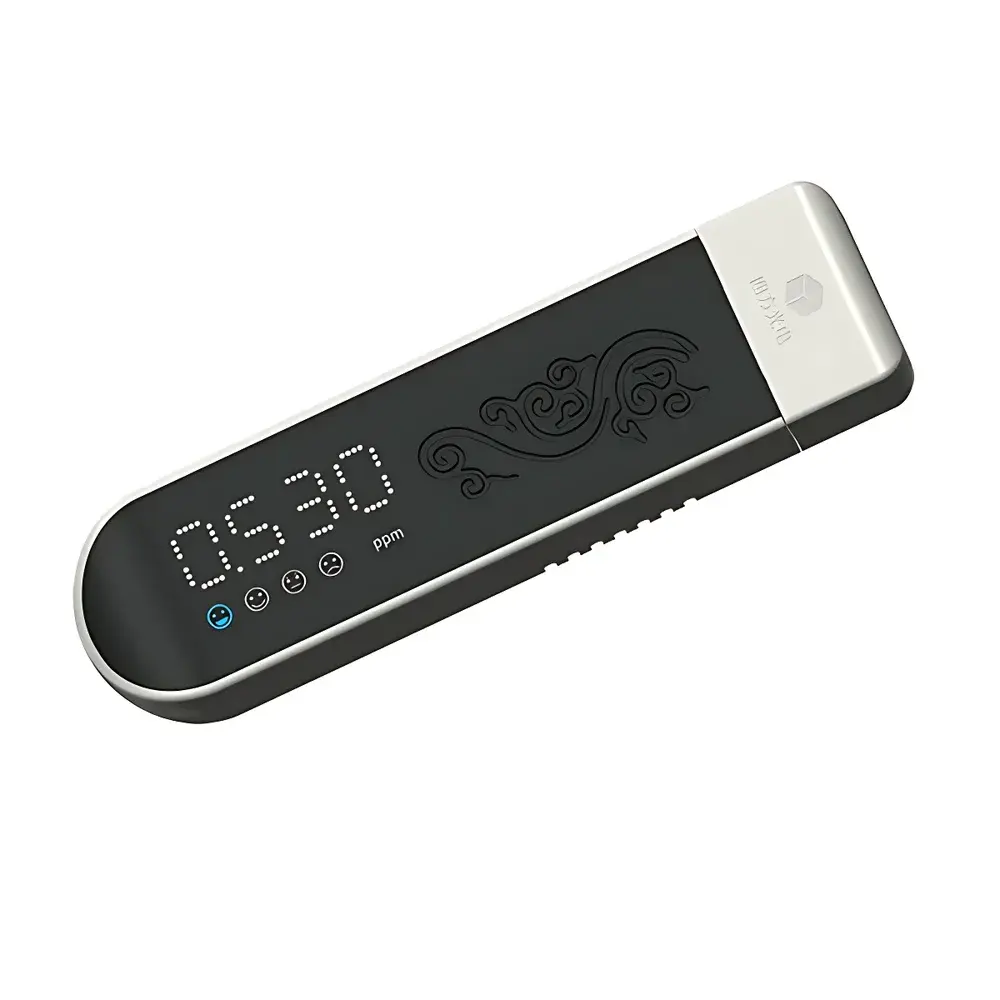
Cubic CM01 Mini USB-Powered CO₂ Monitor
| Brand | Cubic |
|---|---|
| Model | CM01 |
| Type | Portable CO₂ Monitor |
| Measurement Principle | Non-Dispersive Infrared (NDIR) Sensing |
| Range | 400–5000 ppm |
| Accuracy | ±(50 ppm + 5% of reading) |
| Operating Temperature | −10 °C to 50 °C, 0–95% RH (non-condensing) |
| Storage Temperature | −20 °C to 60 °C, 0–95% RH (non-condensing) |
| Power Supply | DC 5 V (USB-powered) |
| Display | Digital LCD |
| Dimensions | 101.9 × 26.4 × 16 mm (W × H × D) |
Overview
The Cubic CM01 Mini USB-Powered CO₂ Monitor is a compact, plug-and-play environmental monitoring device engineered for continuous, real-time measurement of carbon dioxide concentration in indoor air. It employs a factory-calibrated, proprietary non-dispersive infrared (NDIR) sensing module—designed and manufactured in-house by Cubic Photonics—to deliver stable, traceable CO₂ readings across its operational range of 400–5000 ppm. Unlike electrochemical or metal-oxide semiconductor (MOS) sensors, NDIR technology provides inherent selectivity for CO₂, minimal cross-sensitivity to common indoor interferents (e.g., VOCs, humidity, CO), and long-term baseline stability without routine zero-gas recalibration. The CM01 is intended for deployment in occupied spaces where ventilation adequacy, occupant cognitive performance, and IAQ compliance are critical—including open-plan offices, classrooms, meeting rooms, home offices, and small healthcare waiting areas. Its USB-powered architecture eliminates battery management overhead and enables seamless integration with desktop PCs, laptops, or USB power banks for extended unattended operation.
Key Features
- True Plug-and-Play Operation: Powered exclusively via standard USB 2.0/3.0 port (5 V DC); no external power adapter, batteries, or charging required.
- High-Stability NDIR Core: Integrated dual-wavelength NDIR sensor with temperature-compensated signal processing ensures <1.5% annual drift under typical indoor conditions—verified per ISO 16000-8 Annex B calibration traceability protocols.
- Real-Time Visual Feedback: Clear 3-digit LCD display updates CO₂ concentration every 2 seconds; intuitive color-coded backlight (green/yellow/red) indicates IAQ tiers per ASHRAE 62.1 and EN 13779 thresholds.
- Threshold-Based Audible & Visual Alert: Programmable alarm triggers at user-defined CO₂ setpoints (default: 1000 ppm), with LED flash and intermittent beep—configurable via physical button interface.
- Robust Mechanical Design: Enclosure constructed from flame-retardant ABS (UL94 V-0 rated); IP20-rated for indoor dry environments; optimized thermal mass minimizes condensation-related measurement artifacts.
Sample Compatibility & Compliance
The CM01 is designed exclusively for gaseous sampling of ambient indoor air—no sampling pump, inlet filter, or gas conditioning is required. It meets the functional requirements of ISO 16000-8:2022 for CO₂ monitoring in occupied buildings and aligns with the measurement uncertainty framework defined in ISO/IEC 17025:2017 for field-deployable environmental sensors. While not certified as a medical or safety-critical device (per IEC 61508 or EN 50131), it complies with EMC Directive 2014/30/EU and RoHS 2011/65/EU. Data output is non-logging by default but supports manual recording for internal IAQ audits aligned with LEED v4.1 EQ Credit: Indoor Air Quality Assessment and WELL Building Standard™ v2 Feature A03.
Software & Data Management
The CM01 operates autonomously without software dependency; however, its analog output signal (0–3 V proportional to CO₂ concentration) is compatible with third-party DAQ systems (e.g., National Instruments CompactDAQ, LabVIEW-based acquisition) for time-series logging. For facilities requiring audit-ready records, integration with building management systems (BMS) via Modbus RTU over RS-485 (with optional UART-to-USB converter) enables centralized data ingestion into platforms compliant with ISO 50001 energy management workflows. All firmware updates and configuration changes are performed locally via tactile button interface—no cloud connectivity, no remote access, and no personal data collection, ensuring full data sovereignty and adherence to GDPR Article 5(1)(f) principles.
Applications
- Verification of HVAC system performance during demand-controlled ventilation (DCV) commissioning and seasonal re-commissioning.
- Occupancy-driven IAQ benchmarking in hybrid workspaces, supporting evidence-based space utilization policies.
- Educational demonstration of CO₂ accumulation dynamics in sealed vs. ventilated enclosures (e.g., university physics or environmental engineering labs).
- Preventive health monitoring in elderly care facilities, where elevated CO₂ (>1200 ppm) correlates with increased fatigue and reduced alertness per WHO Environmental Health Criteria 237.
- Baseline assessment prior to deploying advanced IAQ sensor networks—serving as a cost-effective reference node for spatial interpolation models.
FAQ
Is the CM01 suitable for outdoor or industrial stack monitoring?
No. It is calibrated and validated solely for indoor ambient air applications (400–5000 ppm, ≤95% RH, non-condensing). It lacks weatherproofing, high-concentration range, or corrosion-resistant sampling components required for outdoor or process gas use.
Does the device require periodic calibration in the field?
No scheduled recalibration is required under normal operation. The NDIR sensor features automatic baseline correction (ABC) logic that adapts to minimum CO₂ levels observed over 7–10 day cycles—consistent with ISO 16000-8 recommendations for residential and office settings.
Can the alarm threshold be customized?
Yes. Using the onboard push-button interface, users may adjust the CO₂ alarm setpoint in 100 ppm increments between 800 ppm and 2000 ppm.
What is the expected service life of the NDIR sensor?
The sensor module is rated for ≥10 years of continuous operation under specified environmental conditions, with mean time between failures (MTBF) exceeding 50,000 hours per MIL-HDBK-217F predictions.
Is USB power delivery sufficient for stable operation during voltage fluctuations?
Yes. Internal LDO regulation maintains sensor bias voltage within ±1% across USB input variations from 4.75 V to 5.25 V—verified per USB 2.0 specification compliance testing.
Related Products







