
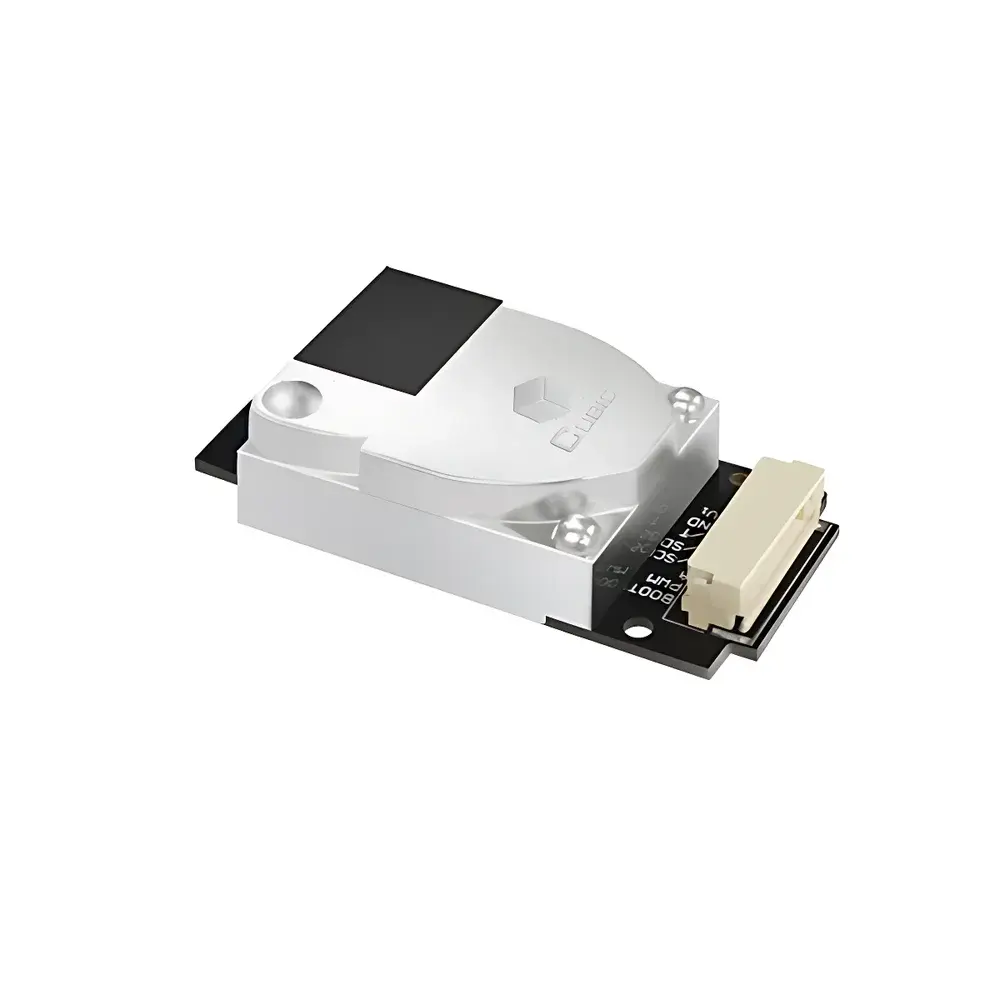
Cubic CM1106SD Single-Channel NDIR CO₂ Sensor
| Brand | Cubic |
|---|---|
| Origin | Hubei, China |
| Manufacturer Type | Authorized Distributor |
| Country of Origin | China |
| Model | CM1106SD |
| Price | USD 42 (FOB) |
| Detection Principle | Non-Dispersive Infrared (NDIR) |
| Measurement Range | 0–5000 ppm CO₂ (standard configuration) |
| Accuracy | ±(50 ppm + 3% of reading) @ 25°C, 1 atm |
| Response Time (T90) | < 90 s |
| Operating Temperature | –10°C to +50°C |
| Operating Humidity | 0–95% RH (non-condensing) |
| Power Supply | 5.0 VDC ±5% |
| Average Current Consumption | < 25 mA |
| Output Interface | Analog (0.4–2.0 V DC proportional to CO₂ concentration) + UART (TTL level) |
| Warm-up Time | < 60 s |
| Dimensions | 33 × 22 × 18 mm |
| Weight | ~12 g |
| Lifetime | > 15 years (typical sensor core) |
Overview
The Cubic CM1106SD is a compact, single-channel non-dispersive infrared (NDIR) carbon dioxide sensor engineered for high-reliability integration into residential and light-commercial indoor air quality (IAQ) control systems. Unlike electrochemical or metal-oxide semiconductor (MOS) alternatives, the CM1106SD employs a dual-wavelength NDIR optical architecture—featuring a dedicated CO₂ absorption band at 4.26 µm and a reference channel—to deliver stable, selective, and drift-resistant measurements across variable ambient conditions. Its monolithic optical path design eliminates moving parts and calibration drift associated with mechanical choppers or filter wheels, supporting long-term operation without field recalibration. The sensor is optimized for continuous duty in HVAC&R equipment where space constraints, power budgets, and thermal stability are critical design parameters.
Key Features
- True single-channel NDIR detection with integrated thermopile detector and IR source, enabling high signal-to-noise ratio and immunity to cross-sensitivity from CO, CH₄, NO₂, and VOCs
- Full-temperature compensation via embedded matrix-based algorithm, calibrated across –10°C to +50°C using on-board temperature and humidity sensors
- Ultra-fast stabilization: achieves operational readiness in under 60 seconds from cold start, minimizing system boot latency in smart thermostats and demand-controlled ventilation (DCV) controllers
- Plug-and-play interface: standardized 6-pin header with analog voltage output (0.4–2.0 V DC) and optional UART (TTL-level, 9600 bps default), eliminating soldering requirements during PCB assembly
- Low-power architecture: average current draw <25 mA at 5.0 VDC enables battery-backed or energy-harvested deployment in wireless IAQ nodes
- Robust mechanical design: IP50-rated housing with reinforced ABS+PC enclosure; qualified per IEC 60068-2 environmental stress profiles for vibration, thermal shock, and humidity cycling
Sample Compatibility & Compliance
The CM1106SD is designed for direct sampling of ambient indoor air without external filtration or conditioning—provided relative humidity remains below 95% RH (non-condensing). It complies with RoHS 2011/65/EU and REACH SVHC regulations. While not certified as a standalone safety device per EN 50194 or UL 2075, its performance characteristics align with ASTM D6245-22 (Standard Practice for Using Indoor CO₂ Concentrations to Evaluate Demand-Controlled Ventilation) and support compliance with ASHRAE Standard 62.1–2022 for ventilation rate procedure calculations. When integrated into OEM systems, the sensor contributes to functional safety architectures meeting IEC 61508 SIL-1 requirements for IAQ feedback loops.
Software & Data Management
The sensor supports both analog and digital communication modes. The UART interface provides access to real-time CO₂ concentration (ppm), internal temperature (°C), relative humidity (%RH), sensor status flags (e.g., fault, warm-up complete), and firmware version. Cubic supplies an open-protocol command set (ASCII-based) compatible with common microcontroller platforms (ARM Cortex-M, ESP32, PIC). Raw data logging and trend analysis can be implemented via host-side firmware adhering to ISO/IEC 17025 traceability principles when used in GLP-aligned environmental monitoring workflows. No proprietary cloud platform or vendor lock-in is required.
Applications
- Residential and commercial HVAC controllers implementing demand-controlled ventilation (DCV)
- OEM integration into wall-mounted air quality monitors and smart thermostats
- Embedded sensing in duct-mounted fresh-air intake modules and heat recovery ventilators (HRVs)
- Portable IAQ meters for building commissioning and post-occupancy evaluation (POE)
- In-vehicle cabin air quality modules for EVs and premium ICE platforms
- Edge-node sensors in LoRaWAN- or NB-IoT–enabled building management systems (BMS)
FAQ
Is the CM1106SD suitable for outdoor CO₂ monitoring?
No. It is calibrated and validated exclusively for indoor ambient air applications. Exposure to rain, condensation, or particulate-laden outdoor air may compromise optical window integrity and measurement stability.
Does the sensor require periodic recalibration?
No field recalibration is required under normal operating conditions. The factory calibration is retained for >15 years due to hermetically sealed optical cavity and zero-drift NDIR architecture.
Can multiple CM1106SD units be daisy-chained on one UART bus?
No—each unit uses a fixed UART address. For multi-sensor networks, use individual UART lines or implement an I²C-to-UART bridge with address translation.
What is the recommended airflow rate across the sensing port?
Natural convection is sufficient; forced airflow >0.1 m/s is unnecessary and may induce thermal noise. Avoid laminar flow impingement directly onto the optical window.
Is the analog output ratiometric to supply voltage?
No—the 0.4–2.0 V output is absolute and internally regulated; it remains stable across ±5% variation in VCC.
Related Products







