
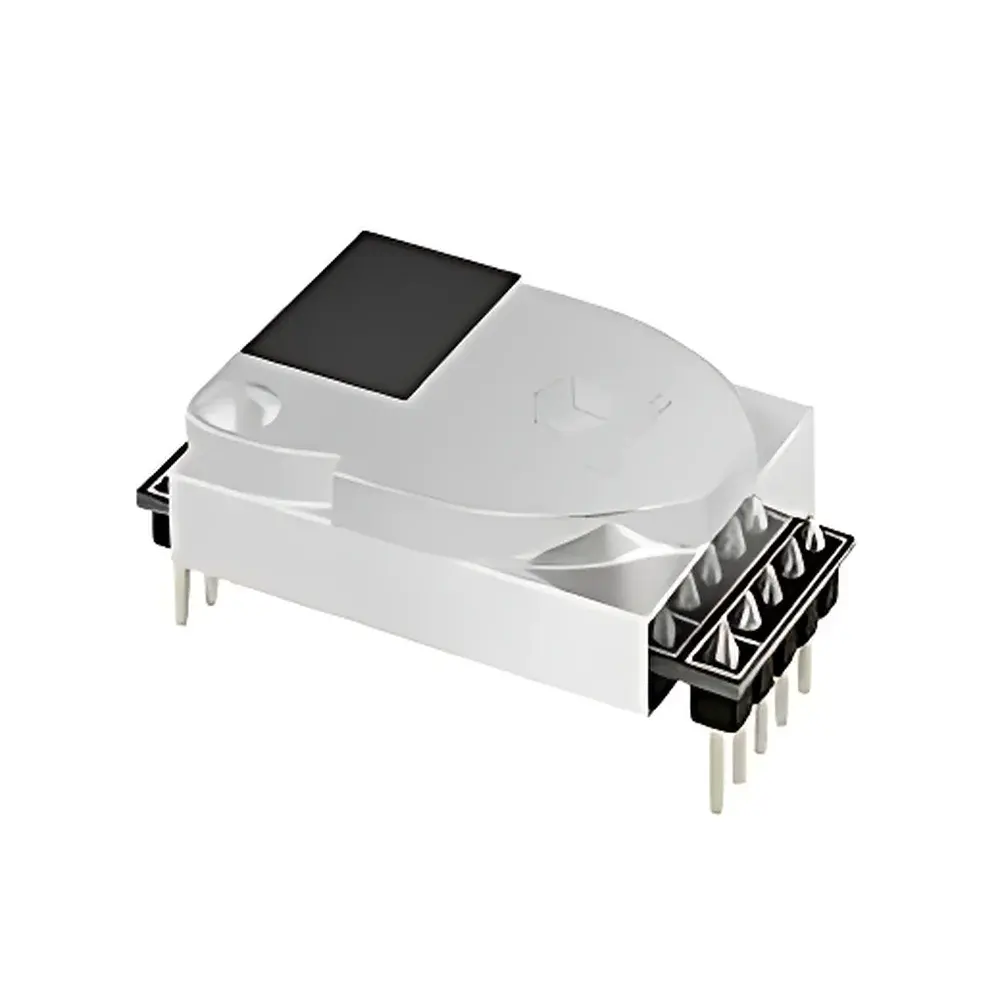
Cubic CM1106SL-N Ultra-Low-Power Single-Channel CO₂ Sensor
| Brand | Cubic |
|---|---|
| Origin | Hubei, China |
| Manufacturer Type | Authorized Distributor |
| Country of Origin | China |
| Model | CM1106SL-N |
| Detection Principle | NDIR (Non-Dispersive Infrared) |
| Measurement Range | 0–5000 ppm CO₂ |
| Accuracy | ±(50 ppm + 5% of reading) at 25°C ± 2°C |
| Operating Temperature | −10°C to +50°C |
| Operating Humidity | 0–95% RH (non-condensing) |
| Storage Temperature | −30°C to +70°C |
| Supply Voltage | DC 5 V ± 0.1 V (ripple < 50 mV) |
| Average Current Consumption | 12 µA @ 5-min measurement interval |
| Output Interface | UART TTL (3.3 V / 5 V compatible) |
| Dimensions (L×W×H) | 33 × 19.7 × 9.4 mm (excluding pins) |
Overview
The Cubic CM1106SL-N is an ultra-low-power, single-channel carbon dioxide (CO₂) sensor engineered for long-term, battery-operated environmental monitoring applications where energy efficiency and measurement stability are critical. Built upon Cubic’s proven non-dispersive infrared (NDIR) detection platform, the CM1106SL-N leverages a thermopile-based optical architecture with a proprietary dual-wavelength reference design to deliver high selectivity against common interferents—including water vapor, methane, and volatile organic compounds—without requiring consumable filters or chemical reagents. Unlike electrochemical or metal-oxide semiconductor (MOS) sensors, NDIR technology ensures inherent long-term stability, minimal zero drift, and immunity to poisoning effects. The CM1106SL-N is specifically optimized for intermittent duty-cycle operation, achieving an industry-leading average current draw of just 12 µA when configured for a 5-minute measurement interval—enabling multi-year deployment on standard coin-cell batteries in wireless IoT nodes, portable air quality monitors, smart HVAC controllers, and demand-controlled ventilation (DCV) systems.
Key Features
- Ultra-low power consumption: 12 µA average current at 5-minute sampling interval, supporting >5 years of operation on CR2032 batteries under typical DCV use cases.
- NDIR-based detection with integrated temperature and humidity compensation: Full-range matrix correction algorithm applied across −10°C to +50°C and 0–95% RH (non-condensing), ensuring consistent accuracy without external calibration hardware.
- High specificity: Optical bandpass filtering and dual-wavelength referencing eliminate cross-sensitivity to CO, CH₄, NO₂, SO₂, and alcohols—critical for indoor air quality (IAQ) compliance with ASHRAE 62.1 and EN 13779.
- Compact SMD form factor: 33 × 19.7 × 9.4 mm footprint (excluding pins), designed for seamless integration into space-constrained PCB layouts without thermal shielding or airflow ducting.
- Robust mechanical and electrical architecture: Hermetically sealed optical chamber, gold-plated contacts, and conformal coating-ready design meet IPC-A-610 Class 2 requirements for industrial-grade reliability.
- UART TTL digital interface: Compatible with both 3.3 V and 5 V logic levels; supports configurable baud rates (default 9600 bps), frame format (8N1), and optional CRC checksum for data integrity verification.
Sample Compatibility & Compliance
The CM1106SL-N is intended for gaseous CO₂ measurement in ambient air and ventilated indoor environments. It is not rated for direct exposure to corrosive gases, condensing humidity, particulate-laden airstreams, or explosive atmospheres (ATEX/IECEx). The sensor complies with RoHS Directive 2011/65/EU and REACH Regulation (EC) No. 1907/2006. Its NDIR measurement principle aligns with ISO 8573-1:2010 Annex C for trace gas analysis methodology and supports validation protocols required under ISO/IEC 17025 for accredited environmental testing laboratories. While not certified to UL 2075 or EN 50131 for life-safety alarm applications, its output stability and repeatability meet the performance thresholds referenced in ASHRAE Guideline 24-2022 for CO₂-based occupancy sensing and ventilation control.
Software & Data Management
The CM1106SL-N communicates via ASCII-based UART protocol, enabling plug-and-play integration with microcontrollers (e.g., ARM Cortex-M0+, ESP32, Nordic nRF52), RTOS-based gateways, and Linux edge devices. Cubic provides a documented command set—including read CO₂ concentration, query firmware version, trigger forced calibration, and retrieve internal diagnostics (temperature, ADC raw values)—all accessible without proprietary drivers. For system-level validation, the sensor supports periodic self-test routines that verify LED drive current, detector responsivity, and signal-to-noise ratio (SNR) against factory baseline thresholds. When deployed in regulated environments, timestamped CO₂ readings can be logged with audit-trail metadata (sensor ID, firmware revision, CRC status) to satisfy GLP-aligned data integrity requirements per FDA 21 CFR Part 11 if paired with compliant host firmware.
Applications
- Smart building automation: Integration into BACnet/IP or Modbus-enabled HVAC controllers for demand-controlled ventilation (DCV) per ASHRAE Standard 62.1-2022.
- Portable IAQ monitors: Battery-powered handheld or wearable devices targeting WHO indoor air quality guidelines and EU Directive 2009/125/EC eco-design requirements.
- Educational and research platforms: Low-cost, repeatable CO₂ source tracking in classroom experiments, greenhouse gas flux studies, and urban microclimate mapping networks.
- Medical device ancillaries: Auxiliary CO₂ sensing in non-invasive respiratory support equipment, incubator air management, and laboratory fume hood occupancy detection.
- Consumer electronics: Embedded air quality feedback in smart thermostats, air purifiers, and connected home hubs requiring CE/FCC Class B EMC compliance.
FAQ
Does the CM1106SL-N require field calibration?
No. The sensor is factory-calibrated against NIST-traceable CO₂ standards and incorporates automatic baseline correction during periods of stable ambient air (e.g., overnight in unoccupied rooms). Manual calibration is optional and only recommended after extended exposure to CO₂ concentrations >10,000 ppm.
Can it operate reliably in high-humidity environments?
Yes—within 0–95% RH (non-condensing). Internal humidity compensation uses a co-located capacitive RH sensor and pre-characterized dew-point correction coefficients embedded in firmware.
Is the UART interface compatible with Raspberry Pi or Arduino?
Yes. The 3.3 V / 5 V tolerant UART_TTL interface works natively with Raspberry Pi GPIO (3.3 V logic) and Arduino Uno/Nano (5 V logic) without level-shifting circuitry.
What is the expected operational lifetime?
Typical service life exceeds 15 years under continuous operation at 25°C, based on accelerated aging tests per IEC 60721-3-3 Class 3K5. No consumables or user-serviceable parts are required.
Does Cubic provide technical support for custom firmware integration?
Yes—application notes, UART protocol specification sheets, sample code (C/C++, Python), and schematic review services are available to qualified OEM partners under NDA.
Related Products







