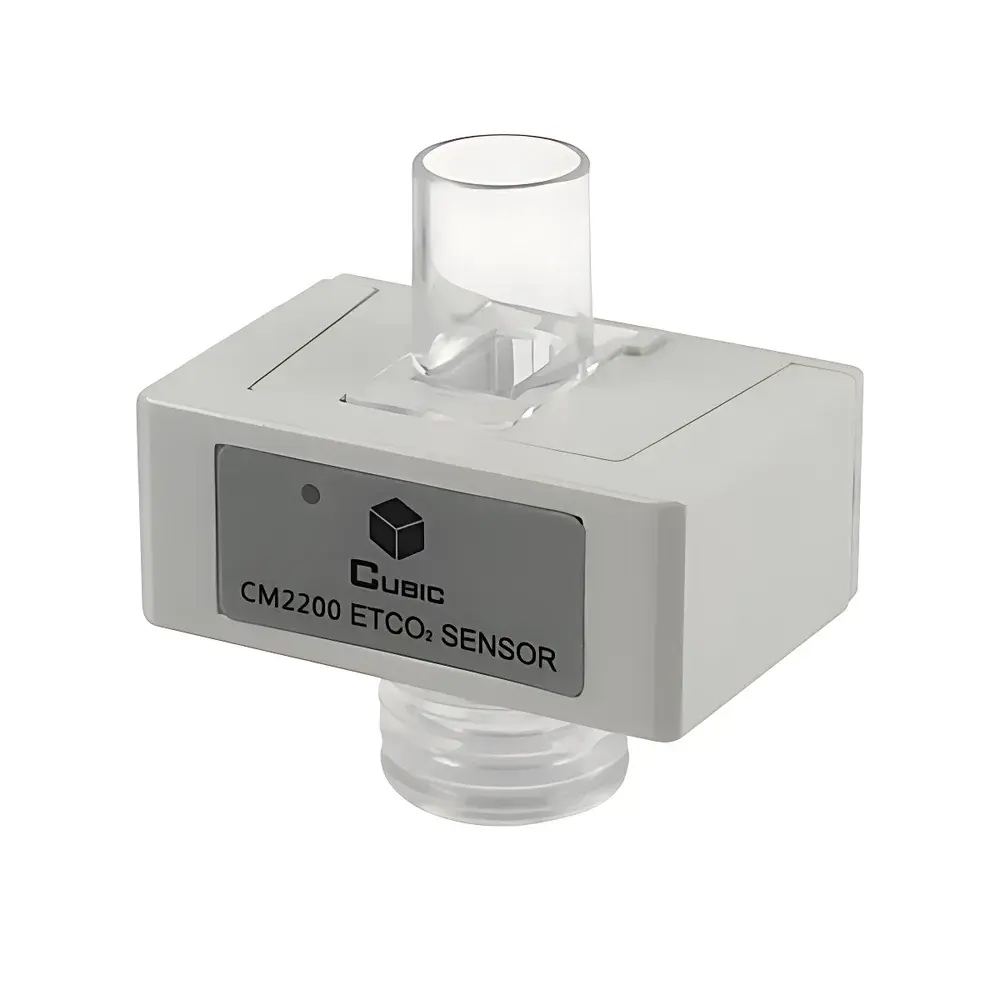
Cubic CM2200 Mainstream End-Tidal CO₂ Module
| Brand | Cubic |
|---|---|
| Origin | Hubei, China |
| Model | CM2200 |
| Detection Principle | Non-Dispersive Infrared (NDIR) |
| ETCO₂ Range | 0–150 mmHg (0–20 kPa at 760 mmHg) |
| ETCO₂ Resolution | 0.1 mmHg (0–49 mmHg), 0.2 mmHg (50–150 mmHg) |
| ETCO₂ Accuracy | ±2 mmHg (0–40 mmHg), ±5% of reading (41–70 mmHg), ±8% of reading (71–100 mmHg), ±10% of reading (100–150 mmHg) |
| Respiratory Rate Range | 2–150 breaths/min |
| Respiratory Rate Accuracy | ±1 breath/min |
| Communication Interface | TTL / RS-232 |
| Operating Conditions | 0°C–45°C, 10–90% RH (non-condensing) |
| Storage Conditions | −40°C–70°C, <90% RH (non-condensing) |
| Dimensions | 52 × 23 × 36 mm (W×H×D) |
Overview
The Cubic CM2200 Mainstream End-Tidal CO₂ Module is a compact, high-performance gas sensing solution engineered for real-time, continuous monitoring of end-tidal carbon dioxide (ETCO₂) and respiratory rate (RR) in clinical and point-of-care environments. It employs proprietary non-dispersive infrared (NDIR) detection technology — a well-established, interference-resistant optical method that measures CO₂ concentration based on characteristic absorption at 4.26 µm wavelength. Unlike sidestream sampling, the CM2200 operates in mainstream configuration: the optical cell is placed directly in the patient’s breathing circuit, enabling minimal sample transport delay and eliminating the need for gas aspiration, water traps, or capillary tubing. This architecture supports high-fidelity capnography with sub-second response time and stable signal integrity across dynamic ventilation patterns — including high-frequency breathing up to 150 breaths per minute.
Key Features
- True mainstream architecture: Integrated optical path mounted directly in the ventilator or anesthesia breathing circuit, delivering immediate CO₂ waveform acquisition without sampling lag or condensation-related drift.
- Dual-LED status indication: Real-time visual feedback via independent red/green LEDs for operational readiness and alarm conditions — optimized for integration into multi-parameter patient monitors and portable resuscitation devices.
- Hot-swap compatibility: Designed for plug-and-play deployment with standardized mechanical and electrical interfaces; no recalibration or firmware reconfiguration required upon module replacement.
- Robust environmental tolerance: Validated for continuous operation across 0°C–45°C ambient temperature and 10–90% relative humidity (non-condensing), meeting IEC 60601-1 essential performance requirements for medical electrical equipment.
- Low-power, embedded interface: TTL and RS-232 serial output options enable seamless integration with microcontroller-based host systems, supporting configurable baud rates and ASCII/HEX data framing protocols.
Sample Compatibility & Compliance
The CM2200 is intended for use with adult, pediatric, and neonatal breathing circuits operating under standard hospital-grade humidification and pressure conditions (up to 40 cmH₂O peak inspiratory pressure). Its NDIR sensor exhibits high selectivity for CO₂ in the presence of common anesthetic agents (e.g., sevoflurane, isoflurane, desflurane), water vapor, and O₂, minimizing cross-sensitivity artifacts. The module complies with electromagnetic compatibility (EMC) requirements per IEC 60601-1-2:2014 and meets basic safety provisions outlined in IEC 60601-1:2012. While not certified as a standalone Class II medical device, it is designed to support final system-level compliance with FDA 510(k), CE Marking (MDD 93/42/EEC or MDR 2017/745), and ISO 80601-2-55 for capnography functionality when integrated into validated monitoring platforms.
Software & Data Management
The CM2200 outputs calibrated, time-stamped ETCO₂ (mmHg/kPa) and respiratory rate (breaths/min) values via asynchronous serial communication. Host systems may implement waveform reconstruction using timestamped concentration samples at ≥100 Hz native acquisition rate. Firmware supports configurable data reporting modes (e.g., continuous streaming, event-triggered burst, or polled query), enabling alignment with clinical data archiving standards such as HL7 v2.x or IEEE 11073-10471. Audit trail capabilities — including sensor initialization timestamps, calibration history flags, and error code logging — can be implemented at the host level to satisfy GLP/GMP documentation requirements and FDA 21 CFR Part 11 electronic record controls where applicable.
Applications
- Critical care ventilators and anesthesia workstations requiring high-temporal-resolution capnography for procedural verification (e.g., endotracheal tube placement, CPR quality assessment).
- Transport and field-deployable life support systems where low power consumption, compact form factor, and resistance to motion artifact are essential.
- Integrated patient monitors for perioperative, emergency department, and ICU settings demanding reliable ETCO₂ trending alongside SpO₂, NIBP, and ECG.
- Research-grade respiratory physiology instrumentation used in preclinical studies evaluating CO₂ kinetics, dead space analysis, and ventilatory efficiency metrics.
FAQ
What is the difference between mainstream and sidestream CO₂ measurement?
Mainstream modules like the CM2200 place the optical cell directly in the breathing circuit, yielding zero sampling delay and eliminating moisture-related signal attenuation. Sidestream systems aspirate gas through tubing to a remote analyzer, introducing latency and requiring water removal mechanisms.
Does the CM2200 require periodic calibration?
The module is factory-calibrated and designed for long-term stability; however, system-level verification using certified gas mixtures (e.g., 5% CO₂ in N₂) is recommended prior to clinical deployment and at intervals defined by institutional quality assurance protocols.
Can the CM2200 operate in high-humidity environments typical of heated humidified circuits?
Yes — its optical path incorporates anti-condensation surface treatment and thermal management to maintain measurement fidelity under sustained exposure to 100% relative humidity at 37°C, provided ambient condensation is prevented per specified storage and operating conditions.