
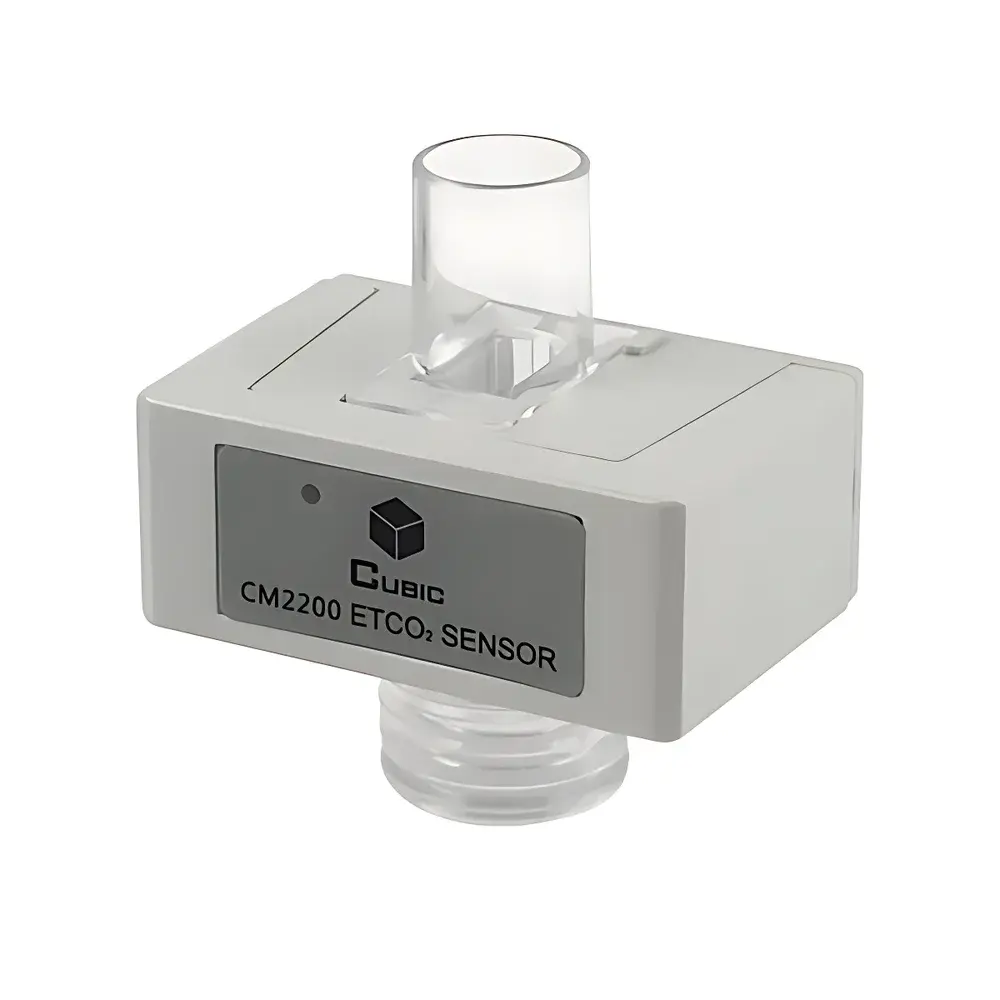
Cubic CM2201 End-Tidal CO₂ (ETCO₂) Sensor Module
| Brand | Cubic |
|---|---|
| Origin | Hubei, China |
| Manufacturer Type | Authorized Distributor |
| Origin Category | Domestic (China-made) |
| Model | CM2201 |
| Price | USD 700 (FOB) |
| Detection Principle | Non-Dispersive Infrared (NDIR) |
| Measurement Range | 0–150 mmHg |
| Resolution | 0.1 mmHg |
| Accuracy | ±2 mmHg (0–40 mmHg), ±5% of reading (41–70 mmHg), ±8% (71–100 mmHg), ±10% (100–150 mmHg) |
| Respiratory Rate Range | 0–150 BPM |
| Respiratory Rate Accuracy | ±1 BPM |
| Short-Term Drift | ≤0.8 mmHg (4 h) |
| Long-Term Drift | Maintains Specified Accuracy over 120 h |
| Supply Voltage | 5.00 V ±5% |
| Avg. Current Draw | <120 mA |
| Peak Current | <250 mA |
| Warm-up Time to Display | ≤15 s |
| Time to Full-Spec Accuracy | ≤2 min (at 25°C) |
| Barometric Pressure Compensation | 400–850 mmHg |
| Operating Temp. | 0–45°C, 10–90% RH (non-condensing) |
| Storage Temp. | −40–70°C, <90% RH (non-condensing) |
| Interface | RS232, 19200-N-8-1 |
| Dimensions | 52 × 23 × 36 mm |
Overview
The Cubic CM2201 End-Tidal CO₂ (ETCO₂) Sensor Module is a medical-grade NDIR (Non-Dispersive Infrared) gas sensing solution engineered for continuous, real-time measurement of end-tidal carbon dioxide concentration in respiratory gas streams. Designed for integration into critical care devices—including patient monitors, anesthesia workstations, and ventilators—the CM2201 delivers clinically relevant capnography data with high signal fidelity and waveform integrity. Its core optical architecture leverages proprietary infrared absorption spectroscopy at the 4.26 µm CO₂ absorption band, combined with temperature-stabilized dual-wavelength detection and advanced digital signal processing to minimize cross-sensitivity to water vapor and other common anesthetic gases (e.g., N₂O, sevoflurane). The module operates on the principle of Beer-Lambert law-based quantification, calibrated traceably against NIST-traceable CO₂ standards across its full 0–150 mmHg range. It meets essential functional safety requirements for Class IIa medical devices under IEC 60601-1 and supports compliance pathways for FDA 510(k) and CE marking when embedded by OEMs.
Key Features
- High-fidelity capnogram output: Delivers stable, low-noise ETCO₂ waveforms with sub-second response time (T90 < 200 ms), enabling reliable detection of apnea, airway obstruction, and circuit disconnection events.
- Robust environmental compensation: Integrated barometric pressure sensor (400–850 mmHg range) and temperature-compensated algorithm ensure accuracy across altitude-varying clinical environments—from sea-level operating rooms to high-altitude field hospitals.
- Plug-and-play integration: Requires only a single 5 V DC power supply and RS232 serial interface (19200-N-8-1); no external calibration hardware or firmware updates needed during device lifecycle.
- Maintenance-free operation: Solid-state NDIR design eliminates consumables, moving parts, or electrochemical cells—reducing total cost of ownership and supporting >5-year operational reliability per IEC 60601-1 clause 15.3.2.
- OEM-optimized mechanical form factor: Compact 52 × 23 × 36 mm footprint with standardized mounting holes and gas inlet/outlet ports compatible with mainstream adult, pediatric, and neonatal mainstream and sidestream sampling adapters.
Sample Compatibility & Compliance
The CM2201 is validated for use with humidified and non-humidified respiratory gas samples across all physiological age groups—from neonates (tidal volumes ≥15 mL) to adults—when paired with appropriate sampling interfaces meeting ISO 80601-2-55:2018 requirements for capnographs. It exhibits minimal interference from water vapor (RH ≤90%), oxygen (up to 100%), nitrous oxide (<70%), and volatile anesthetics (sevoflurane, isoflurane, desflurane) within specified clinical exposure limits. The module complies with electromagnetic compatibility standards per IEC 60601-1-2:2014 (Class B emissions, Level 3 immunity), and its electrical isolation meets reinforced insulation requirements per clause 8.8.3. It is supplied with full technical documentation—including traceable calibration reports, RoHS/REACH declarations, and biocompatibility summaries (ISO 10993-1:2018, USP Class VI)—to support regulatory submissions under FDA 21 CFR Part 820, EU MDR Annex II, and China NMPA Technical Review Guidelines for Gas Analyzers.
Software & Data Management
The CM2201 communicates via ASCII-protocol RS232, outputting synchronous frames containing ETCO₂ (mmHg), inspired CO₂ (mmHg), respiratory rate (BPM), and status flags (e.g., sensor fault, flow detection, calibration lockout). No proprietary drivers are required; standard UART libraries in C/C++, Python, or LabVIEW enable seamless integration into host firmware. Optional firmware upgrades (delivered via secure bootloader) support configurable averaging windows, alarm thresholds, and timestamped data logging—facilitating audit-ready records compliant with GLP/GMP data integrity principles (ALCOA+). While the module itself does not store historical data, its deterministic timing and CRC-protected packet structure ensure lossless transmission for downstream storage in HIPAA- or GDPR-compliant systems.
Applications
- Critical care monitoring: Real-time ETCO₂ trending in ICU ventilators and transport monitors for confirmation of endotracheal tube placement and CPR quality assessment per AHA 2020 guidelines.
- Anesthesia delivery systems: Integration into modular anesthesia machines for intraoperative capnography, dead-space analysis, and CO₂ rebreathing detection.
- Point-of-care diagnostics: Embedded in portable respirometry analyzers for metabolic studies and pulmonary function screening.
- Medical device R&D: Reference-grade sensor platform for validating novel capnographic algorithms, AI-driven waveform classifiers, and closed-loop ventilation control systems.
- Education and simulation: Used in high-fidelity manikins and training platforms requiring physiologically accurate CO₂ waveform generation and feedback.
FAQ
Does the CM2201 require periodic recalibration in the field?
No. The module is factory-calibrated with NIST-traceable reference gases and features long-term drift stability verified over 120 hours. Recalibration is not required under normal operating conditions per ISO 80601-2-55 Annex D.
Can it be used in sidestream configurations?
Yes—when coupled with a certified sidestream adapter (e.g., 2.5 mm ID sampling line, 50–150 mL/min flow rate) and configured for appropriate sample draw delay compensation.
Is the sensor compatible with ISO/IEC 11146-compliant optical alignment protocols?
While not an optical instrument per se, its internal IR source and detector alignment is performed using automated interferometric verification during final test, ensuring consistent beam path geometry and minimizing sensitivity drift.
What certifications does the CM2201 hold as a component?
It carries CE marking per MDD 93/42/EEC (now legacy), RoHS 2011/65/EU, REACH SVHC compliance, and full IEC 60601-1-2:2014 EMC test reports. Full regulatory dossier support is provided to OEMs for end-device certification.
How is barometric pressure compensation implemented?
An integrated MEMS absolute pressure sensor continuously measures ambient pressure and feeds real-time correction factors into the CO₂ concentration algorithm, ensuring mmHg output remains accurate regardless of local atmospheric conditions.







