
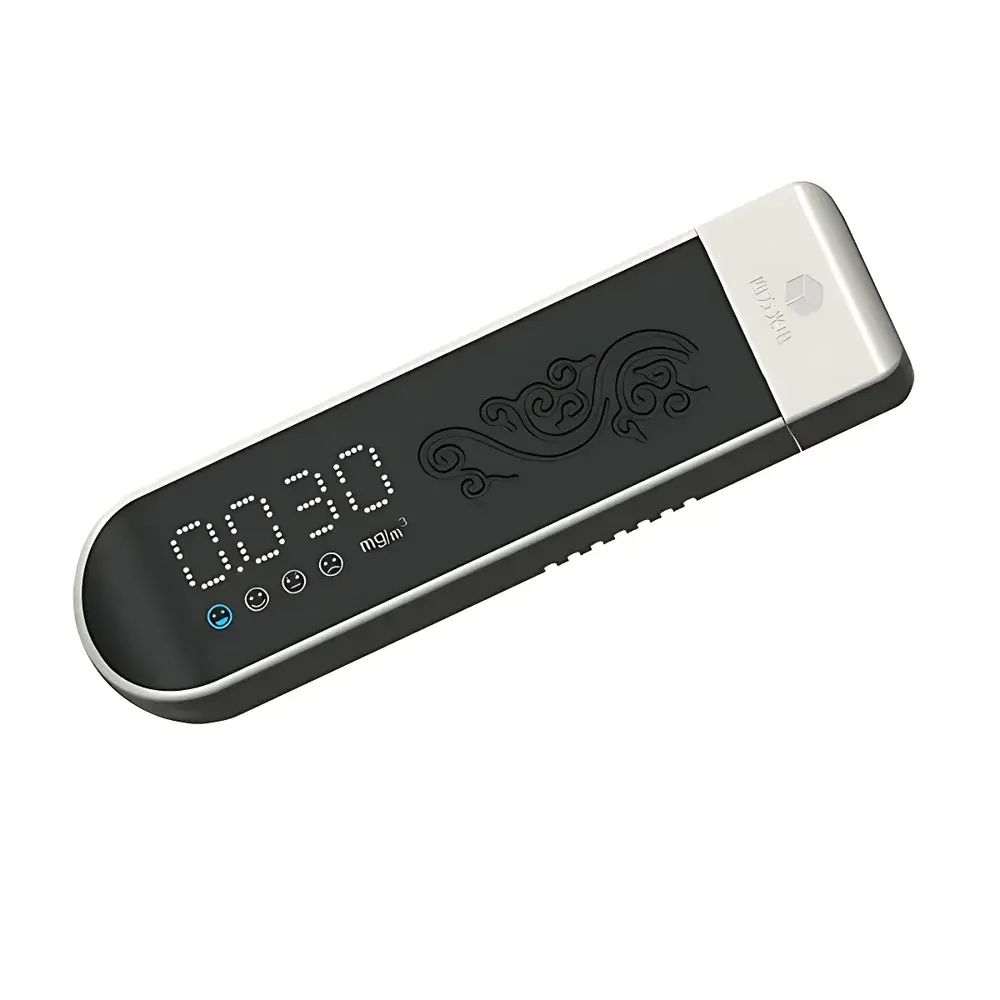
Cubic FM01 Mini Formaldehyde Analyzer
| Brand | Cubic |
|---|---|
| Origin | Hubei, China |
| Manufacturer Type | Authorized Distributor |
| Country of Origin | China |
| Model | FM01 |
| Detection Principle | Electrochemical Sensor |
| Measurement Range | 0–1 mg/m³ |
| Resolution | 0.001 mg/m³ |
| Accuracy | ≤ 0.1 mg/m³: ±0.03 mg/m³ |
| > 0.1 mg/m³ | ±25% of reading |
| Repeatability | < ±3% RSD (typical, per ISO 16000-23) |
| Response Time (T90) | < 60 s |
| Operating Temperature | 0–40 °C |
| Operating Humidity | 15–95% RH (non-condensing) |
| Storage Temperature | −20–50 °C |
| Power Supply | DC 5 V ±0.1 V |
| Current Consumption | ≤ 300 mA |
| Communication Interface | USB-A |
| Dimensions | 101.9 × 26.4 × 16 mm (W × H × D) |
| Compliance | Meets requirements for indoor air quality screening per ISO 16000-23 and GB/T 18883–2022 |
Overview
The Cubic FM01 Mini Formaldehyde Analyzer is a compact, USB-powered electrochemical gas detection instrument engineered for reliable, real-time monitoring of formaldehyde (HCHO) concentration in indoor air environments. It operates on a high-selectivity electrochemical sensing principle, utilizing a proprietary nanostructured membrane electrode that minimizes cross-sensitivity to common volatile organic compounds (VOCs), ethanol, and other aldehydes. Unlike optical or semiconductor-based sensors, the FM01’s electrochemical cell delivers stable baseline performance with built-in temperature compensation and auto-multi-point calibration routines—ensuring trace-level accuracy across variable ambient conditions. Designed for deployment in residential, educational, and light commercial settings, the FM01 supports rapid qualitative and semi-quantitative assessment of formaldehyde exposure against internationally recognized health benchmarks, including WHO Indoor Air Quality Guidelines (0.1 mg/m³, 30-min average) and China’s GB/T 18883–2022 standard (0.08 mg/m³).
Key Features
- Electrochemical sensor with nanostructured catalytic membrane for enhanced selectivity against ethanol and other VOC interferences
- Real-time display of formaldehyde concentration (mg/m³) and WHO/Green/Amber/Red air quality grading on integrated LED screen
- Acoustic alarm triggered automatically when concentration exceeds user-configurable thresholds (default: ≥0.1 mg/m³)
- USB-A plug-and-play interface enabling direct connection to Windows/macOS/Linux hosts without external power adapters or drivers
- High-resolution measurement capability down to 0.001 mg/m³, supporting detection near occupational exposure limits (OELs)
- Onboard temperature and humidity compensation algorithms calibrated per ISO 16000-23 test protocols (25 ± 2 °C, 50 ± 10% RH reference condition)
- Rugged, pocket-sized form factor (101.9 × 26.4 × 16 mm) optimized for field use, spot checks, and HVAC commissioning support
Sample Compatibility & Compliance
The FM01 is validated for gaseous sampling in undiluted ambient air—no pre-concentration, scrubbing, or dilution required. It complies with the functional performance criteria outlined in ISO 16000-23 (Indoor air — Part 23: Determination of formaldehyde — Active sampling using electrochemical sensors) for screening-grade applications. While not intended for regulatory-grade compliance reporting under ISO 16000-3 or EPA TO-11A, the device meets technical prerequisites for preliminary indoor air quality (IAQ) audits, post-renovation verification, and occupational hygiene surveys where rapid turnaround and portability are prioritized. Its measurement uncertainty profile (±0.03 mg/m³ at low range; ±25% above 0.1 mg/m³) aligns with typical requirements for Tier-2 IAQ assessments as defined by ASHRAE Guideline 44P and CIBSE TM23.
Software & Data Management
The FM01 communicates via CDC ACM-class USB serial protocol, allowing seamless integration with third-party data acquisition platforms (e.g., LabVIEW, Python pySerial, MATLAB Instrument Control Toolbox). Cubic provides optional Windows-compatible configuration software for threshold adjustment, unit switching (ppb/mg/m³), and firmware updates. All measurements include timestamped metadata (UTC time, temperature, RH), supporting basic audit trails suitable for GLP-aligned documentation. While the device does not implement FDA 21 CFR Part 11-compliant electronic signatures or full audit logging, its deterministic response behavior and factory calibration certificate (traceable to NIM-certified standards) support ISO/IEC 17025 laboratory workflows when used as a secondary screening tool.
Applications
- Residential IAQ verification following new furniture installation, carpet laying, or renovation activities
- Classroom and daycare center environmental health monitoring programs
- Pre-occupancy testing of newly constructed or refurbished office spaces
- Field validation of activated carbon filter efficiency in air purifiers and HVAC systems
- Educational demonstrations of indoor pollutant dynamics and sensor technology principles
- Support for building commissioning reports aligned with LEED IEQ Credit 3.2 or WELL Building Standard W05
FAQ
Is the FM01 certified to any international metrological standards?
The FM01 sensor module is type-tested per ISO 16000-23 Annex B and calibrated against NIM-traceable formaldehyde gas standards. Full instrument certification (e.g., MID, CE Class I) is not applicable, as it is classified as a non-legal metrology screening device.
Can the FM01 be used outdoors or in high-humidity environments?
It is rated for operation up to 95% RH (non-condensing) and temperatures from 0–40 °C. Prolonged exposure to condensation, rain, or dew will compromise sensor longevity and is not recommended.
Does the device require periodic recalibration?
Yes. Cubic recommends annual verification using zero air and 0.2 mg/m³ formaldehyde challenge gas. Field recalibration is supported via USB-connected software and requires certified span gas.
What is the expected sensor lifetime under normal indoor use?
Typical operational lifespan is 24 months when exposed to average indoor formaldehyde levels ( 0.5 mg/m³ may reduce service life.
Is raw sensor output accessible for custom integration?
Yes. The USB interface exposes ASCII-formatted telemetry packets (e.g., “HCHO=0.042;T=23.1;RH=48.7”) at 1 Hz, enabling OEM integration into smart building dashboards or IoT gateways.







