
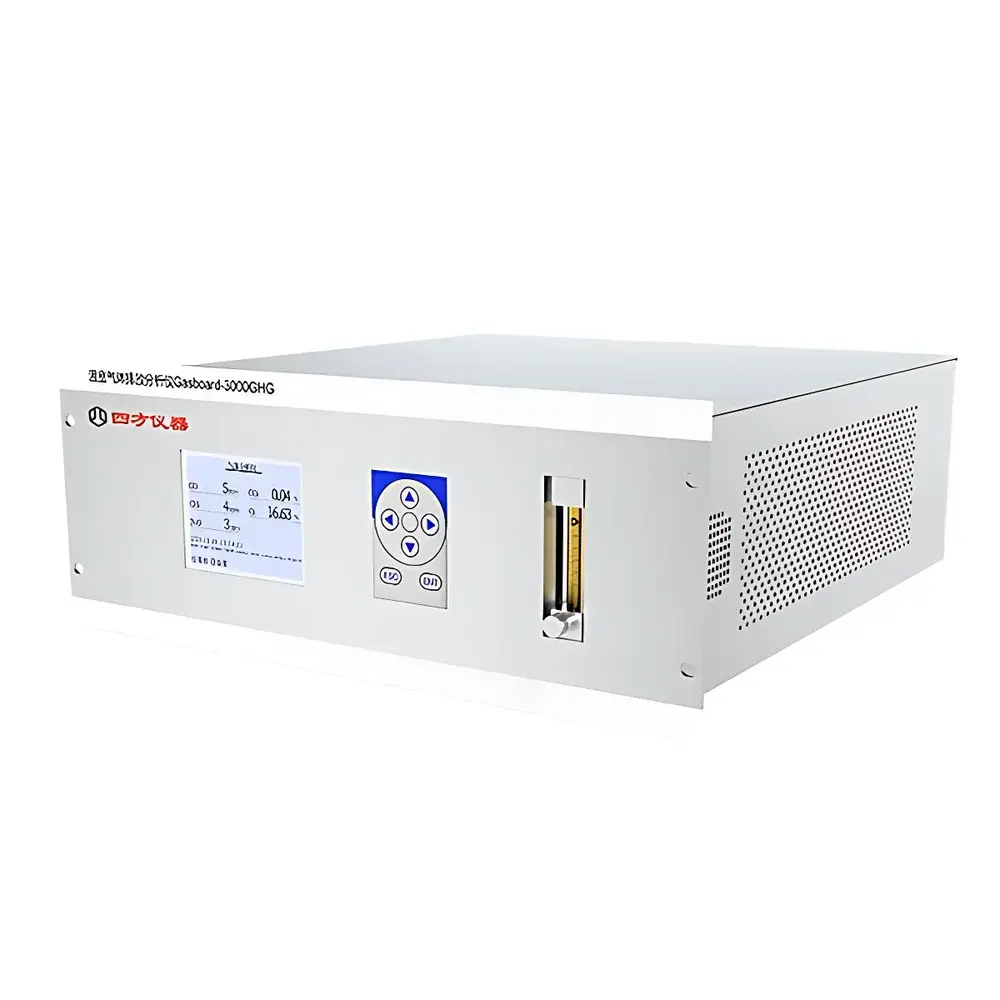
CUBIC Gasboard-3000GHG Industrial Kiln Flue Gas Greenhouse Gas Analyzer
| Brand | CUBIC INSTRUMENTS |
|---|---|
| Origin | Hubei, China |
| Model | Gasboard-3000GHG |
| Detection Principle | Micro-flow NDIR (CO₂/CH₄/N₂O/CO), Dual-beam NDIR (CO₂ high-range & CO mid-high range), Electrochemical (O₂) |
| Accuracy | ±1% F.S. (micro-flow NDIR), ±2% F.S. (dual-beam NDIR & ECD) |
| Measured Gases | CO₂, CH₄, N₂O, CO, O₂ |
| Response Time | T₉₀ < 25 s |
| Repeatability | ≤ ±1% |
| Flow Rate | 0.7–1.2 L/min |
| Sample Pressure | 2–50 kPa |
| Output | RS-485/RS-232, 4–20 mA |
| Power | 100–240 VAC, max 300 W (heating), stable 100 W |
Overview
The CUBIC Gasboard-3000GHG is an industrial-grade, continuous emissions monitoring system (CEMS)-compatible flue gas analyzer engineered for precise, multi-component greenhouse gas (GHG) quantification in high-temperature, high-dust combustion environments—specifically designed for integration into cement kilns, sintering furnaces, blast furnace stoves, non-ferrous metal smelters, and coal-fired boiler stacks. It employs a hybrid optical–electrochemical detection architecture grounded in non-dispersive infrared (NDIR) spectroscopy principles: micro-flow NDIR for low-concentration GHG measurement (CO₂, CH₄, N₂O, CO down to 200 ppm), dual-beam NDIR for robust high-range CO₂ (up to 100%) and mid-to-high-range CO (up to 5%), and electrochemical sensing for paramagnetic O₂ determination. Unlike conventional single-beam NDIR systems, the proprietary half-chamber micro-flow design—protected under international patent PCT/CN2018100767 and Chinese invention patent ZL201710720122.1—enables real-time differential reference compensation within a monolithic optical path, significantly suppressing zero drift induced by ambient temperature fluctuation, optical aging, and moisture-laden sample matrices. This architecture ensures long-term baseline stability (<±1% F.S. drift over 30 days) without requiring frequent zero/span calibration—a critical requirement for unattended stack monitoring under GLP-compliant environmental compliance protocols.
Key Features
- Simultaneous, continuous measurement of five regulated stack gases: CO₂, CH₄, N₂O, CO, and O₂—fully aligned with IPCC Tier 2/Tier 3 reporting requirements and EU MRV (Monitoring, Reporting, Verification) Annex IV specifications.
- Patented micro-flow NDIR sensor module with integrated half-chamber reference cell—eliminates need for external reference gas or dual independent optical paths, reducing mechanical complexity and improving resistance to condensation and particulate fouling.
- Configurable sensor architecture: users may select micro-flow NDIR for ultra-low-range GHG quantification (e.g., CH₄ at 0–1000 ppm, resolution 1 ppm) or dual-beam NDIR for high-concentration CO₂ (0–100%) and CO (0–5%) with enhanced signal-to-noise ratio under variable flow conditions.
- Robust sample conditioning interface: accepts raw flue gas at 2–50 kPa pressure; requires only inline particulate filtration (<1 µm) and condensate removal—no active cooling or chemical scrubbing needed for standard operation.
- Comprehensive diagnostics: embedded self-test routines monitor detector responsivity, heater integrity, flow sensor linearity, and electrochemical cell health—generating IEC 61508-compliant fault codes for predictive maintenance scheduling.
- Dual-output architecture: isolated 4–20 mA analog channels (user-configurable per gas) plus RS-485 Modbus RTU and RS-232 ASCII protocol support for seamless integration into DCS, SCADA, and EPA-certified data acquisition systems (e.g., EPA Method 205-compliant DAHS).
Sample Compatibility & Compliance
The Gasboard-3000GHG is validated for direct sampling from industrial combustion sources operating at exhaust temperatures up to 200 °C (with optional heated sample line). Its optical design inherently rejects interference from H₂O vapor absorption bands through spectral deconvolution and dynamic baseline correction—critical for wet-stack applications such as lime kilns and waste incinerators. The analyzer meets EN 15267-3 (QAL1 certification framework) for automated measuring systems, supports ISO 14064-1 GHG inventory verification workflows, and complies with key regulatory data integrity requirements including EPA 40 CFR Part 75 Appendix A (for CO₂ mass emission rate calculation), ASTM D6522 (standard test method for CO in flue gas), and ISO 21258 (determination of CO₂ in combustion exhaust). All firmware and configuration logs retain immutable timestamps and user audit trails, satisfying FDA 21 CFR Part 11 electronic record retention criteria when deployed in regulated manufacturing environments.
Software & Data Management
CUBIC’s proprietary GasVision™ software suite provides full remote commissioning, real-time waveform visualization, and automated calibration validation reports compliant with ISO/IEC 17025 Clause 7.7. Raw sensor outputs are processed using factory-calibrated multivariate regression models—not simple peak-height interpolation—accounting for cross-sensitivity between overlapping IR absorption bands (e.g., CO and N₂O near 4.5 µm). Data export formats include CSV (time-stamped per-second records), XML (EPA-compatible DAS format), and encrypted SQLite databases with SHA-256 hash integrity verification. Optional cloud gateway module enables TLS 1.2-secured MQTT transmission to AWS IoT Core or Azure IoT Hub for centralized fleet monitoring and AI-driven anomaly detection across multi-site operations.
Applications
- Cement clinker production: Continuous monitoring of calcination CO₂ and thermal NOₓ precursor CO in precalciner and rotary kiln exhausts per EU CBAM reporting guidelines.
- Primary aluminum smelting: Quantification of PFC emissions (CF₄, C₂F₆) via CH₄ channel cross-calibration and anode effect detection through rapid CO transients.
- Iron ore sintering plants: Real-time O₂ trim control combined with CO/CO₂ ratio analysis for optimizing coke rate and reducing carbon intensity.
- Nitric acid production: N₂O concentration tracking at tail-gas abatement units to verify catalytic decomposition efficiency (>90% N₂O removal).
- Refinery FCC units: High-frequency CO monitoring during regenerator soot burn-off cycles to prevent thermal runaway and optimize air blower sequencing.
FAQ
Does the Gasboard-3000GHG require periodic zero/span calibration with certified gases?
No—its half-chamber micro-flow NDIR architecture provides inherent zero stability. Field verification is performed via built-in span check using internal reference cells; certified gas calibration is recommended only annually or after sensor replacement.
Can it operate continuously in high-humidity flue gas without desiccant traps?
Yes—proprietary optical compensation algorithms and hydrophobic filter housing enable stable operation at dew points up to 60 °C; however, liquid water ingress must be prevented via proper probe orientation and drain trap installation.
Is the analyzer compatible with EPA Method 9 opacity monitoring integration?
Not directly—it does not measure opacity, but its analog outputs can be synchronized with third-party opacity monitors via shared 4–20 mA trigger signals for composite CEMS reporting.
What is the maximum allowable particulate loading for uninterrupted operation?
With the standard 1 µm sintered metal filter, continuous operation is supported up to 10 g/Nm³ total suspended particulates (TSP); for slag-rich steelmaking off-gas, optional ceramic candle filters extend tolerance to 50 g/Nm³.
Does the system support MODBUS TCP for Ethernet-based DCS integration?
The base model includes RS-485 Modbus RTU; MODBUS TCP requires the optional Ethernet communication module (part no. GB-3000GHG-ETH), which also adds SNMP v3 network management and HTTPS firmware update capability.







