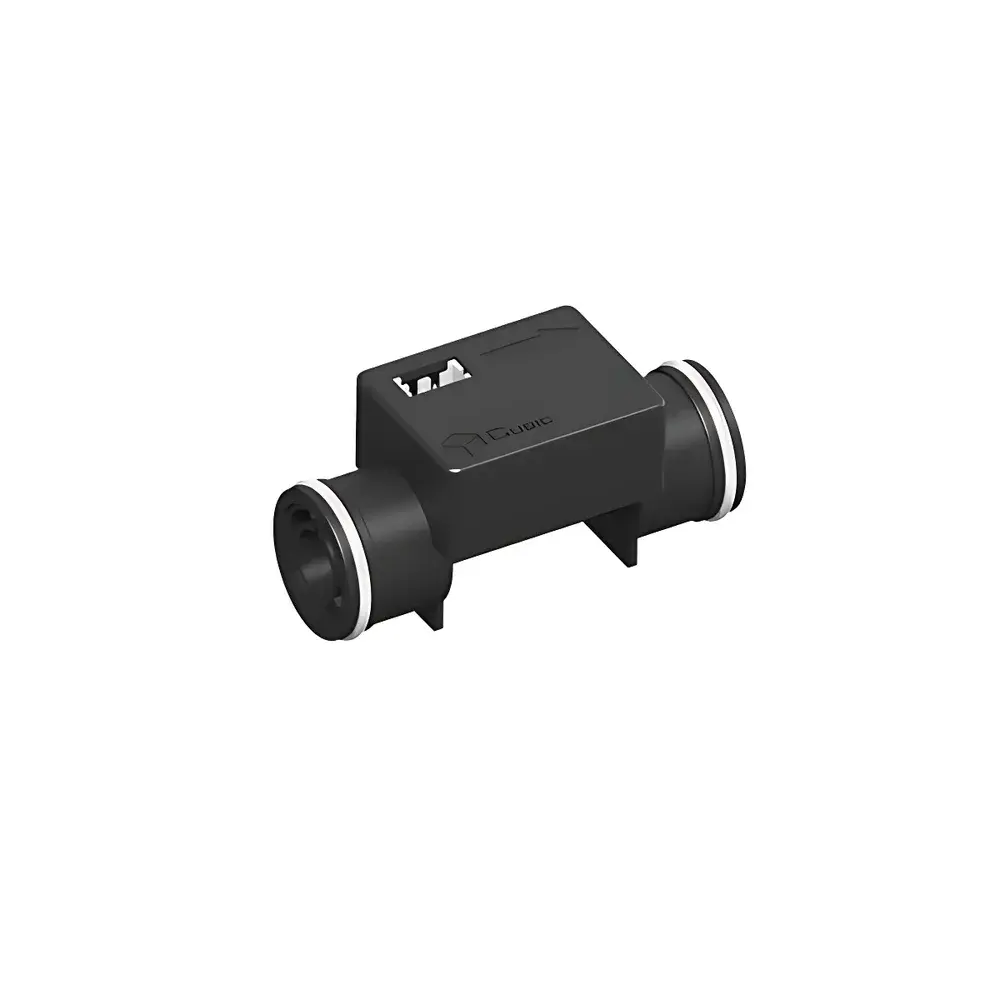
Cubic Gasboard-8500FS-L40 Ultrasonic Oxygen Flowmeter
| Brand | Cubic |
|---|---|
| Origin | Hubei, China |
| Model | Gasboard-8500FS-L40 |
| Measurement Principle | Ultrasonic Transit-Time |
| Flow Range | 0–40 L/min |
| O₂ Concentration Range | 0–100% vol |
| O₂ Accuracy | ±3% FS @ 5–45°C |
| Flow Accuracy | ±2% FS |
| O₂ Resolution | 0.1% |
| Flow Resolution | 0.01 L/min |
| O₂ Response Time (T63) | ≤0.1 s (at ≥10 L/min) |
| Flow Response Time (T63) | <10 ms (at ≥10 L/min) |
| Operating Temp | 5–50°C |
| Humidity Range | 0–95% RH (non-condensing) |
| Communication Interfaces | UART-TTL, I²C, Optional Analog Output |
Overview
The Cubic Gasboard-8500FS-L40 Ultrasonic Oxygen Flowmeter is an integrated five-parameter sensor engineered for precision monitoring in clinical and biomedical gas delivery systems. It employs dual-path ultrasonic transit-time measurement to determine volumetric flow rate of oxygen-enriched gas streams without mechanical obstruction or pressure drop—ensuring long-term stability and eliminating sensor drift associated with thermal or electrochemical sensing elements. Simultaneously, it delivers real-time, synchronized measurements of oxygen concentration (0–100% vol), absolute atmospheric pressure, ambient temperature, and relative humidity—all compensated across full operating ranges. Designed specifically for high-flow, humidified oxygen therapy applications—including ventilators, high-flow nasal cannula (HFNC) systems, and portable oxygen concentrators—the device meets the stringent dynamic response and reliability requirements of ISO 80601-2-69 (medical ventilators) and IEC 60601-1 (general safety and essential performance).
Key Features
- Ultrasonic transit-time flow measurement: Non-invasive, no moving parts, zero pressure loss, and immunity to particulate accumulation or condensate interference.
- Simultaneous multi-parameter output: Synchronized acquisition of O₂ concentration, volumetric flow, temperature, humidity, and barometric pressure—enabling comprehensive gas state characterization.
- Full-range environmental compensation: Embedded algorithms apply real-time correction for temperature- and humidity-induced density variations, ensuring traceable accuracy under variable clinical conditions.
- Sub-10 ms flow response time (T63): Meets dynamic control loop requirements for closed-loop oxygen titration and adaptive ventilation modes.
- Drift-free operation over 10+ years: No consumables, no recalibration intervals, and no zero-point drift—validated per IEC 61508 SIL2 functional safety guidelines for continuous-use medical sensors.
- Robust industrial-grade housing: IP65-rated enclosure with medical-grade biocompatible materials compliant with ISO 10993-5 cytotoxicity testing.
Sample Compatibility & Compliance
The Gasboard-8500FS-L40 is validated for use with humidified oxygen (up to 100% RH, non-condensing), medical air, nitrogen-oxygen mixtures, and other binary gas blends commonly deployed in respiratory care. Its ultrasonic path design accommodates condensate-tolerant operation without signal attenuation or measurement hysteresis. The sensor complies with electromagnetic compatibility (EMC) requirements per IEC 60601-1-2:2014 and meets essential electrical safety standards under IEC 60601-1:2012. Firmware supports audit-trail-capable data logging aligned with FDA 21 CFR Part 11 principles when integrated into validated host systems. All calibration references are traceable to NIST-certified gas standards and primary flow benches accredited to ISO/IEC 17025.
Software & Data Management
Data output is delivered via UART-TTL (3.3 V logic) and I²C interfaces at configurable baud rates (up to 115.2 kbps), supporting both polled and interrupt-driven acquisition. An optional analog output (0–5 V or 4–20 mA) is available for legacy system integration. The onboard firmware implements CRC-16 error checking and packet framing to ensure data integrity during transmission. Host-side SDKs (C/C++, Python) provide APIs for real-time parameter extraction, diagnostic status reporting (e.g., signal-to-noise ratio, transducer health flag), and firmware update capability via bootloader protocol. When deployed in regulated environments, timestamped sensor logs can be exported in CSV or JSON format with embedded metadata (device ID, firmware version, UTC timestamp, environmental context)—facilitating GLP/GMP-aligned record retention and retrospective analysis.
Applications
- Closed-loop oxygen delivery control in ICU ventilators and transport respirators
- Real-time flow and FiO₂ verification in high-flow nasal cannula (HFNC) systems
- Gas blending verification in portable oxygen concentrators and anesthesia machines
- Performance validation of humidification modules in respiratory humidifiers
- Preclinical inhalation toxicology studies requiring precise binary gas dosing
- Manufacturing line testing of medical gas delivery devices per ISO 13485 quality management requirements
FAQ
Does this sensor require periodic recalibration?
No. The ultrasonic transit-time architecture eliminates zero drift and sensitivity degradation. Factory calibration is stable for the rated service life (≥10 years) under specified operating conditions.
Can it operate reliably in fully saturated, humidified oxygen streams?
Yes. The acoustic path geometry and signal processing algorithm are designed to maintain measurement fidelity at up to 95% RH (non-condensing); condensate management is addressed via sloped internal channel design and hydrophobic transducer coatings.
Is the oxygen concentration measurement affected by background gas composition?
The O₂ reading is derived from paramagnetic or electrochemical cross-sensitivity-corrected ultrasonic density inference—not direct spectroscopic detection. For binary O₂/N₂ or O₂/air mixtures, accuracy remains within ±3% FS; for ternary or variable-composition gases, optional gas-specific calibration matrices can be loaded via firmware update.
What regulatory documentation is provided with the device?
Each unit ships with a Certificate of Conformance (CoC), factory calibration report (including raw transit-time data and uncertainty budgets), and technical file excerpts covering design verification (DV), process validation (PV), and EMC test summaries per IEC 60601-1-2.