
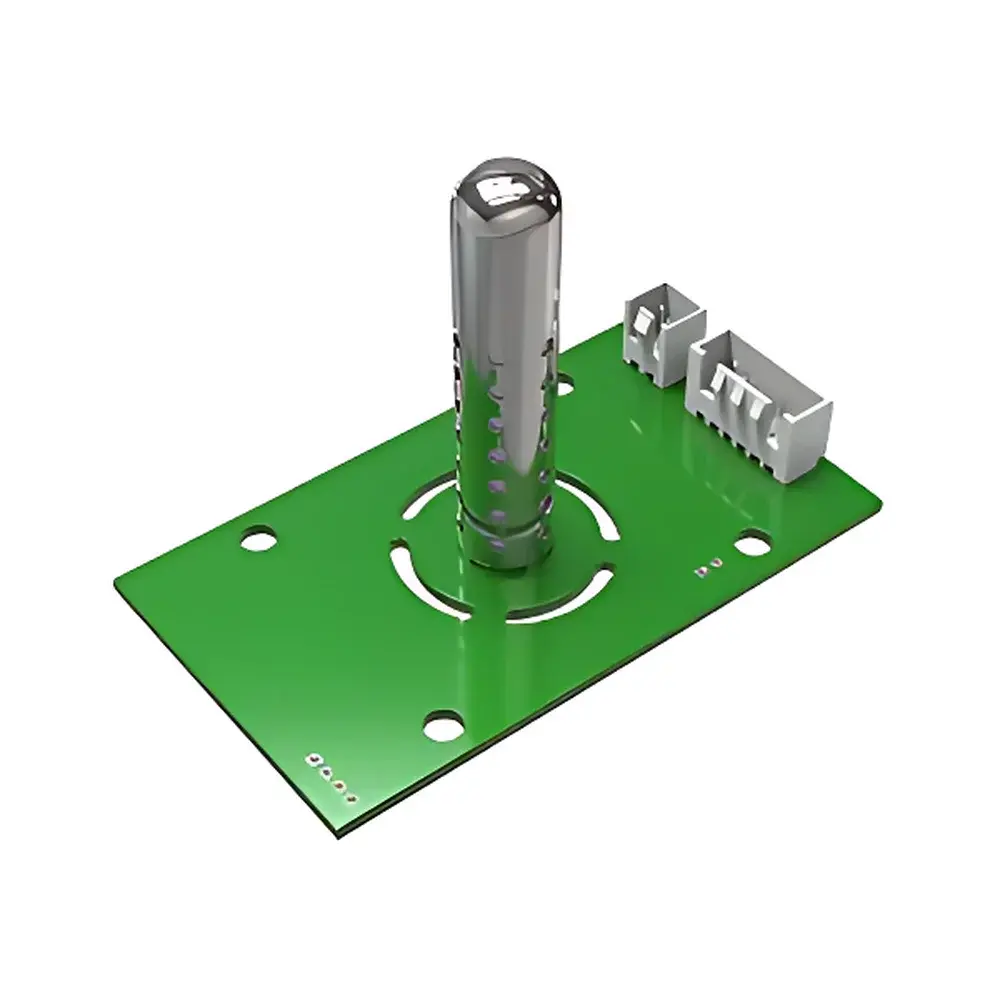
Cubic Gasboard-8500Z Zirconia-Based Oxygen Sensor
| Brand | Cubic |
|---|---|
| Origin | Hubei, China |
| Model | Gasboard-8500Z |
| Detection Principle | Zirconia Electrochemical |
| Measurement Range | 0.1–25.0 vol.% O₂ |
| Accuracy | ±2% FS |
| Resolution | 0.01% O₂ |
| Response Time | <1 s |
| Operating Temperature | 10–50 °C |
| Operating Humidity | 5–85% RH (non-condensing) |
| Storage Conditions | −20–60 °C, 0–95% RH (non-condensing) |
| Supply Voltage | DC 12 V ±0.5 V |
| Output Interface | UART TTL (3.3 V logic level) |
| Dimensions | 70 × 40 × 15.3 mm (W×H×D) |
| Surface Temperature Limit | <150 °C (internal sensor element up to <350 °C) |
| Inlet Flow Mode | Free Diffusion |
| Cross-Sensitivity | Negligible (zirconia-selective for O₂) |
Overview
The Cubic Gasboard-8500Z is a high-stability, electrochemical oxygen sensor engineered for continuous ambient and process-level O₂ monitoring in demanding environmental and industrial applications. It operates on the principle of high-temperature zirconia (ZrO₂) solid electrolyte conduction—where oxygen ions migrate across a stabilized zirconia ceramic membrane under a thermal gradient, generating a Nernst voltage proportional to the logarithm of the partial pressure ratio between reference air (typically internal or ambient) and sample gas. This thermodynamically grounded measurement mechanism ensures intrinsic selectivity for molecular oxygen without reliance on catalytic reactions, eliminating cross-sensitivity to CO, CO₂, CH₄, NOₓ, SO₂, and most common interferents. Designed specifically for low-flow, diffusion-limited environments—including high-altitude installations where ambient O₂ partial pressure drops significantly—the Gasboard-8500Z maintains full accuracy across its 0.1–25.0 vol.% O₂ range, making it suitable for hypoxic environment surveillance, controlled atmosphere storage, medical gas line verification, and combustion air optimization.
Key Features
- Zirconia-based sensing element with integrated reference electrode and heater control—ensuring stable Nernst potential generation at optimal operating temperature (~650 °C internally, surface <150 °C).
- True diffusion-mode sampling: no pump or external flow regulation required; ideal for battery-powered, embedded, or space-constrained deployments.
- High signal-to-noise ratio and low drift (<1.5% FS/month typical), enabled by precision-matched electrode geometry and hermetically sealed ceramic housing.
- Fast dynamic response (<1 second T₉₀) due to minimized diffusion path length and optimized electrode microstructure.
- Wide operational envelope: functional from 10–50 °C ambient and 5–85% RH (non-condensing), with extended storage tolerance (−20–60 °C, 0–95% RH).
- Low-power DC 12 V ±0.5 V supply interface with 3.3 V UART TTL digital output—compatible with standard microcontroller units (MCUs), PLCs, and IoT edge gateways without level-shifting.
Sample Compatibility & Compliance
The Gasboard-8500Z is validated for use in clean, non-corrosive, non-condensing gaseous environments. It is not rated for exposure to halogenated compounds, siloxanes, heavy hydrocarbons, or acidic vapors (e.g., HCl, HF), which may degrade the zirconia electrolyte or electrode integrity over time. The sensor complies with RoHS Directive 2011/65/EU and meets CE marking requirements for electromagnetic compatibility (EN 61326-1) and safety (EN 61010-1). While not certified to ATEX or IECEx for hazardous area use, its passive diffusion architecture and absence of ignition sources render it suitable for Zone 2/Class I, Division 2 installations when integrated into appropriately rated enclosures. For regulatory traceability, each unit carries a unique serial number and calibration certificate referencing ISO/IEC 17025-accredited procedures (per Cubic’s internal QA system).
Software & Data Management
The sensor outputs calibrated O₂ concentration data via ASCII-formatted UART frames at configurable baud rates (default: 9600 bps), enabling seamless integration into custom firmware stacks or third-party SCADA platforms. Cubic provides a Windows-based configuration utility (Gasboard PC Tool v2.1) supporting real-time monitoring, zero/span adjustment, firmware updates, and log export in CSV format. All communication includes CRC-8 checksum validation to ensure data integrity. When deployed in regulated environments (e.g., pharmaceutical cleanrooms or medical device manufacturing), the UART protocol supports timestamped readings and audit-ready logging—facilitating alignment with FDA 21 CFR Part 11 requirements when paired with compliant host software featuring electronic signatures and change-tracking capabilities.
Applications
- High-altitude environmental monitoring stations (e.g., Tibetan Plateau, Andean research outposts) requiring accurate O₂ partial pressure assessment under reduced atmospheric pressure.
- Controlled-atmosphere packaging (CAP) and modified-atmosphere packaging (MAP) quality assurance systems for food, pharmaceuticals, and electronics.
- Medical oxygen concentrator and ventilator feedback loops for real-time O₂ delivery verification.
- Industrial furnace and boiler combustion air management to optimize fuel efficiency and reduce NOₓ emissions.
- Indoor air quality (IAQ) monitoring networks in laboratories, server rooms, and underground facilities where O₂ depletion poses safety risks.
- Integration into portable gas analyzers and multi-gas detection platforms as a primary O₂ channel.
FAQ
Does the Gasboard-8500Z require periodic calibration? How often?
Yes—recommended initial calibration upon installation and biannual recalibration thereafter under stable operating conditions; more frequent calibration is advised if exposed to extreme thermal cycling or contaminant-laden gas streams.
Can this sensor operate continuously at 50 °C ambient temperature?
Yes—its specified operating range extends to 50 °C; however, prolonged exposure above 45 °C may slightly accelerate long-term baseline drift; active thermal management of the host enclosure is recommended in such cases.
Is the UART output compatible with Raspberry Pi or Arduino platforms?
Yes—direct connection is possible using 3.3 V logic-level UART pins; no level shifter required. Example Arduino libraries and Python scripts are available via Cubic’s GitHub repository (public access, MIT license).
What is the expected service life under normal indoor conditions?
Typical operational lifetime exceeds 24 months when operated within specifications and protected from condensation, dust ingress, and chemical contamination.
Does the sensor include temperature compensation?
Yes—integrated NTC thermistor enables real-time ambient temperature correction of the Nernst equation output, ensuring consistent accuracy across the full 10–50 °C operating range.







