
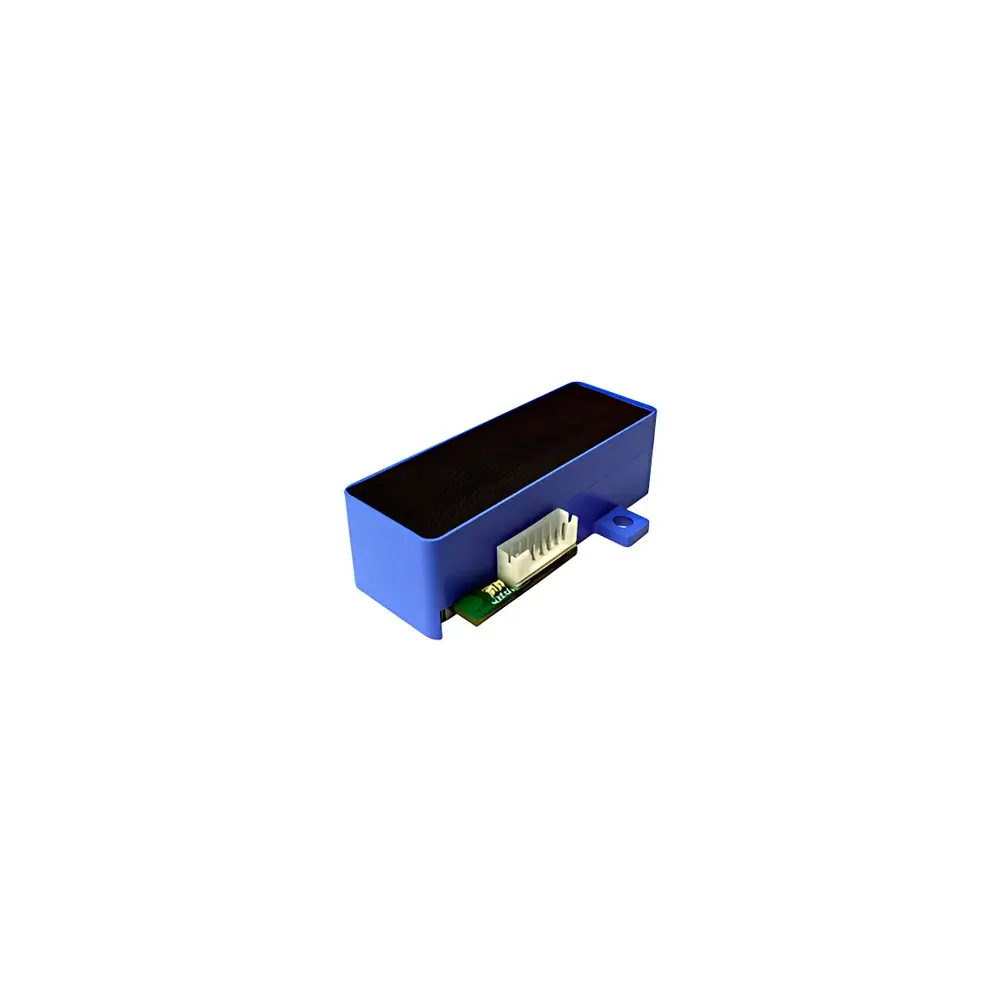
Cubic GLDS-SF6 NDIR-Based Sulfur Hexafluoride (SF6) Gas Leak Detection Sensor
| Brand | Cubic |
|---|---|
| Origin | Hubei, China |
| Manufacturer Type | Authorized Distributor |
| Country of Origin | China |
| Model | GLDS-SF6 |
| Price | USD 420 (FOB) |
| Detection Principle | Non-Dispersive Infrared (NDIR) |
| Target Gas | Sulfur Hexafluoride (SF6) |
| Measurement Range | 0–1500 ppm |
| Alarm Threshold | Adjustable (Default: 1000 ppm) |
| Resolution | 1 ppm |
| Accuracy | ±2% FS @ 25°C |
| Repeatability | ≤±1% FS |
| Response Time (T90) | <30 s (Diffusion Mode) |
| Warm-up Time | <15 s |
| Operating Temperature | −20 to +60°C |
| Operating Humidity | 0–95% RH (non-condensing) |
| IP Rating | IP54 |
| Expected Service Life | ≥10 years |
| Dimensions | 63.2 × 38.5 × 19.23 mm |
| Compliance | DLT 1555–2016 |
Overview
The Cubic GLDS-SF6 is a fixed-mount, non-dispersive infrared (NDIR) gas sensing module engineered for continuous, real-time detection of sulfur hexafluoride (SF6) in industrial and utility environments. SF6 is widely employed as an electrical insulation and arc-quenching medium in high-voltage switchgear, circuit breakers, gas-insulated substations (GIS), and power transmission infrastructure. Due to its global warming potential (GWP) over 23,500× that of CO₂ and atmospheric persistence exceeding 3,200 years, regulatory frameworks—including IEC 62271-1, IEEE C37.122, and China’s DLT 1555–2016—mandate rigorous leak monitoring and emissions tracking. The GLDS-SF6 sensor operates on dual-wavelength NDIR spectroscopy, utilizing a dedicated absorption band near 10.55 µm where SF6 exhibits strong, unique vibrational-rotational absorption. This optical architecture eliminates interference from common background gases (e.g., CO₂, CH₄, H₂O vapor) and ensures high selectivity without chemical filter degradation or catalytic poisoning—critical advantages over electrochemical or metal-oxide semiconductor (MOS) alternatives.
Key Features
- High-selectivity NDIR detection with built-in temperature and pressure compensation for stable output across environmental fluctuations
- Factory-calibrated with traceable reference gas; supports zero-point auto-compensation to minimize baseline drift over time
- Fast T90 response (<30 s) under diffusion sampling mode, enabling timely alarm activation in enclosed GIS compartments or control rooms
- Ruggedized housing rated IP54 for reliable operation in dusty, humid, or intermittently wet substation and indoor switchroom environments
- Low-power consumption design compatible with 12–24 VDC supply; optimized for integration into centralized SCADA, BMS, or dedicated SF6 monitoring systems
- Compact form factor (63.2 × 38.5 × 19.23 mm) facilitates retrofit installation in space-constrained enclosures without mechanical modification
Sample Compatibility & Compliance
The GLDS-SF6 is validated for use in ambient air matrices typical of indoor electrical infrastructure: non-corrosive, non-explosive atmospheres with particulate load ≤1 mg/m³ and dew point ≤15°C. It is not intended for direct installation in pressurized SF6 gas lines or high-velocity ducts without appropriate sampling probe and flow conditioning. The sensor complies with China’s DL/T 1555–2016 “Technical Specification for SF6 Leakage Detection in Gas-Insulated Metal-Enclosed Switchgear”, which defines performance thresholds for sensitivity, repeatability, and alarm reliability in GIS applications. While not certified to ATEX or IECEx for hazardous area use, its intrinsic safety profile supports deployment in Zone 2/Class I Division 2 locations when integrated with appropriately rated system-level barriers per IEC 60079-11.
Software & Data Management
The GLDS-SF6 outputs analog (4–20 mA or 0–5 VDC) and digital (UART TTL/RS485 Modbus RTU) signals, enabling seamless integration with programmable logic controllers (PLCs), distributed control systems (DCS), or third-party data acquisition platforms. When deployed in networked SF6 monitoring systems, sensor data supports automated log generation aligned with ISO 50001 energy management requirements and internal GMP/GLP audit trails. Firmware supports configurable alarm hysteresis, damping filters, and event-triggered data snapshots—features essential for root-cause analysis during leak investigations. All calibration events and diagnostic status flags (e.g., low signal-to-noise ratio, temperature out-of-range) are timestamped and exportable for regulatory reporting under China’s Environmental Protection Tax Law and State Grid Corporation’s asset lifecycle management protocols.
Applications
- Continuous SF6 concentration monitoring in GIS bays, dead-tank circuit breakers, and ring-main units (RMUs)
- Leak verification during commissioning, maintenance, and post-repair testing per IEC 60480 and GB/T 8905
- Integration into SF6 recycling and purification systems for process endpoint determination
- Environmental compliance monitoring at substation perimeters and transformer yards under local emission reporting mandates
- Supporting predictive maintenance programs by trending baseline drift and response decay over multi-year service intervals
FAQ
Is the GLDS-SF6 suitable for outdoor mounting?
No. While IP54-rated, the sensor is designed for indoor or sheltered environments. Prolonged UV exposure, rain ingress, or thermal cycling beyond −20 to +60°C may compromise optical window integrity and long-term calibration stability.
Does it require periodic span calibration?
Yes. Annual calibration using certified SF6 standard gas (e.g., 500 ppm in N₂) is recommended per DL/T 1555–2016 Clause 6.4.3 to maintain ±2% FS accuracy.
Can it detect SF6 decomposition products such as SOF₂ or SO₂F₂?
No. The GLDS-SF6 is specific to intact SF₆. Detection of arc-byproduct gases requires complementary sensors (e.g., electrochemical SO₂ or UV-DOAS modules).
What is the expected calibration interval under continuous operation?
Under stable environmental conditions and routine zero-checks, the manufacturer specifies a maximum 12-month calibration cycle. Field validation against reference instruments is advised prior to critical outage windows.
Is Modbus RTU communication compatible with standard industrial gateways?
Yes. The RS485 interface adheres to Modbus RTU v1.1 protocol with configurable slave ID, baud rate (9600–115200), and parity settings—fully interoperable with Siemens, Schneider, and Rockwell automation ecosystems.







