
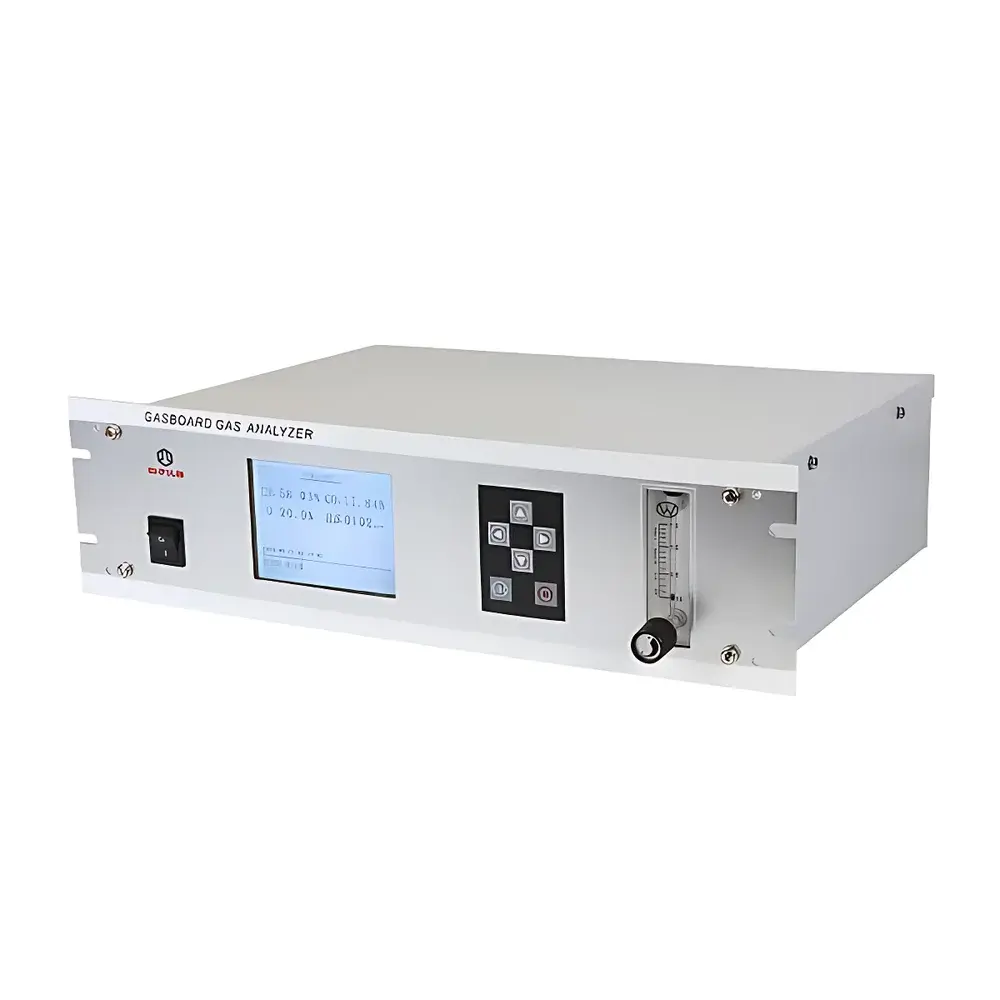
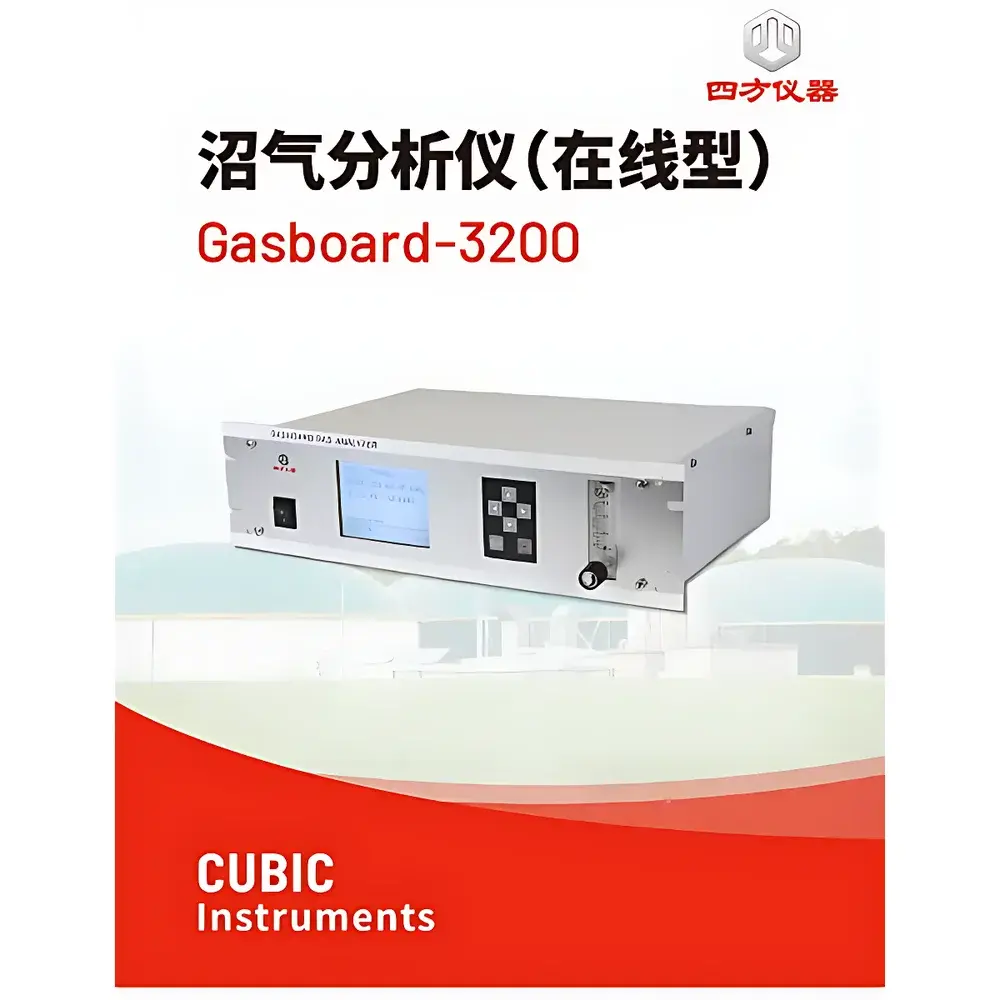
CUBIC INSTRUMENTS Gasboard-3200 Online Biogas Analyzer
| Brand | CUBIC INSTRUMENTS |
|---|---|
| Origin | Hubei, China |
| Model | Gasboard-3200 |
| Measurement Range | CH₄: (0–100)%, CO₂: (0–50)%, H₂S: (0–9999) ppm, O₂: (0–25)% |
| Resolution | CH₄/CO₂/O₂: 0.01% |
| H₂S | 1 ppm |
| Response Time | T₉₀ < 10 s (NDIR) |
| Principle | Non-Dispersive Infrared (NDIR) + Long-Life Electrochemical Detection (ECD) |
Overview
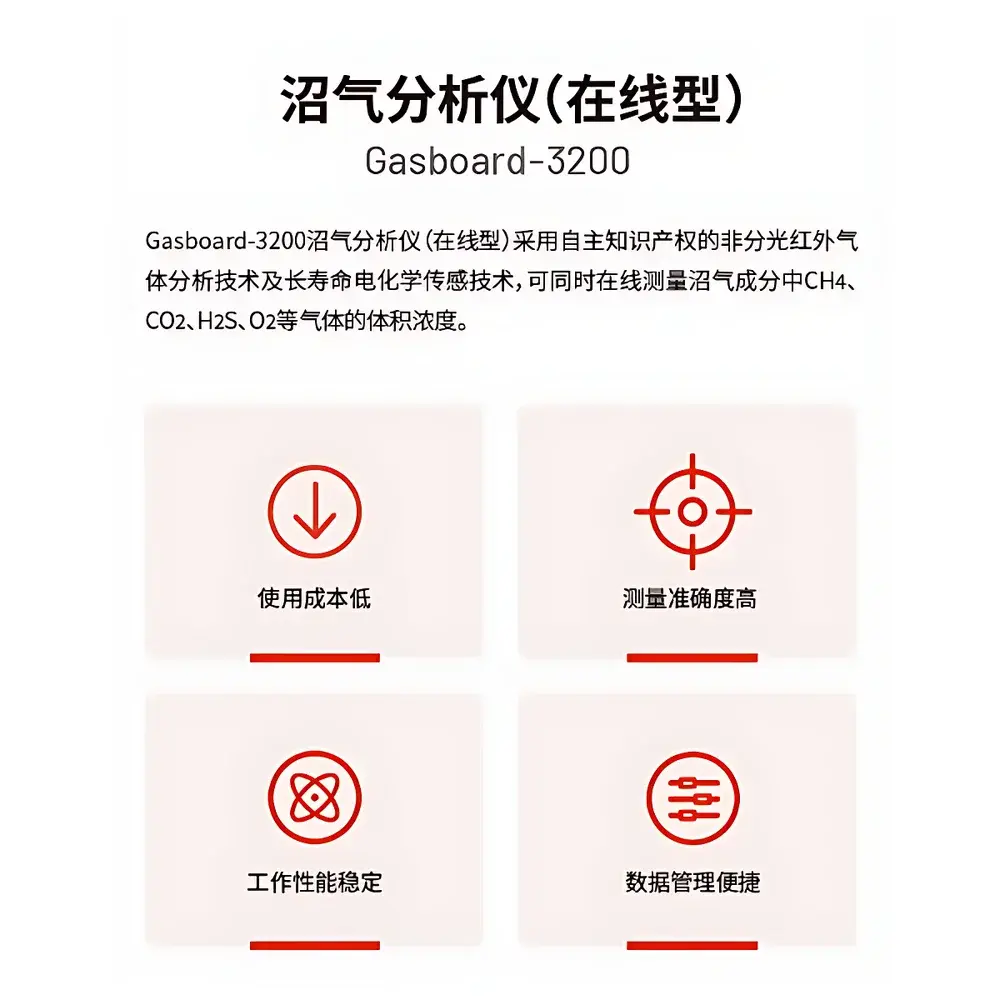
The CUBIC INSTRUMENTS Gasboard-3200 is a continuous-emission, extractive-type online biogas analyzer engineered for real-time, multi-component gas concentration monitoring in anaerobic digestion facilities, landfill gas recovery systems, and wastewater treatment plants. It employs dual-sensing architecture: non-dispersive infrared (NDIR) spectroscopy for high-selectivity quantification of methane (CH₄) and carbon dioxide (CO₂), and long-life electrochemical detection (ECD) for precise, stable measurement of oxygen (O₂) and hydrogen sulfide (H₂S). Unlike offline sampling methods or chromatographic systems requiring carrier gases and consumables, the Gasboard-3200 operates continuously with minimal maintenance—enabling uninterrupted process control, biogas quality compliance verification, and safety-critical H₂S exposure monitoring. Its compact industrial enclosure supports wall-mount or panel-integrated installation in Class 1 Div 2 environments, and its calibrated output signals meet functional safety requirements for integration into SCADA and DCS platforms.
Key Features
- Multi-gas simultaneous analysis: CH₄, CO₂, O₂, and H₂S measured in real time with no cross-sensitivity between channels—validated per ISO 16949-based sensor interference testing protocols.
- Dual-sensor architecture: NDIR modules feature temperature-stabilized optical paths and dual-wavelength referencing to suppress drift; ECD sensors incorporate PTFE hydrophobic membranes and low-degradation catalyst formulations for >24-month operational life under typical biogas conditions.
- Integrated zero-gas management: Built-in air pump enables automated atmospheric zero calibration without external gas cylinders—reducing operational overhead and eliminating calibration gas logistics.
- Robust sample conditioning: Accepts raw biogas at 2–50 kPa inlet pressure and 0.7–1.2 L/min flow rate; requires only particulate filtration and condensate removal upstream—no active drying or chemical scrubbing needed.
- Self-diagnostic firmware: Continuously monitors sensor baseline stability, signal-to-noise ratio, and heater performance; reports fault codes via serial interface and LCD display for predictive maintenance planning.
- Industrial-grade I/O: Standard RS-485 (Modbus RTU) and RS-232 interfaces; isolated 4–20 mA analog outputs for each gas channel; configurable alarm relays for H₂S > 10 ppm or O₂ < 19.5%.
Sample Compatibility & Compliance
The Gasboard-3200 is validated for use with untreated biogas streams containing up to 60% relative humidity and trace siloxanes (< 0.1 ppmv), provided upstream mechanical filtration (≤5 µm) and liquid knock-out are implemented. It complies with EN 15267-3 (QAL1 certification framework for automatic measuring systems), meets EMC Directive 2014/30/EU, and conforms to RoHS 2011/65/EU. While not intrinsically safe, its enclosure rating (IP65) and electrical isolation support deployment in non-hazardous zones adjacent to biogas handling infrastructure. Data integrity aligns with GLP principles: all calibrations, zero checks, and diagnostic events are timestamped and stored locally for audit trail generation.
Software & Data Management
The embedded firmware supports configuration via ASCII command set over serial interface or local keypad/LCD navigation. Optional PC software (Gasboard Control Suite v3.x) enables remote parameter setting, trend logging (1-second resolution), CSV export, and report generation compliant with ISO 5814 (water quality — determination of dissolved oxygen). All analog outputs include linearization per NIST-traceable calibration curves. Audit logs retain ≥30 days of operational history—including calibration timestamps, sensor health status, and alarm activation records—supporting FDA 21 CFR Part 11 readiness when paired with validated IT infrastructure.
Applications
- Real-time optimization of anaerobic digesters: CH₄/CO₂ ratio trending informs feedstock loading rate adjustments and pH control strategies.
- Landfill gas-to-energy (LFGTE) plant monitoring: Continuous H₂S tracking ensures compliance with turbine inlet specifications (typically < 5 ppmv) and protects downstream combustion equipment.
- Wastewater treatment plant biogas upgrading: O₂ monitoring prevents explosive mixture formation during membrane or PSA separation; CO₂ depletion rate assessment validates scrubber efficiency.
- Research & development labs: Extractive sampling from gas bags or headspace vials enables reproducible batch characterization under controlled temperature/humidity conditions.
- Biogas grid injection compliance: Meets EN 16723-1 requirements for calorific value estimation (via CH₄ %) and sulfur compound limits prior to pipeline entry.
FAQ
What sample conditioning is required upstream of the Gasboard-3200?
A particulate filter (≤5 µm) and coalescing water trap are mandatory; active drying or chemical scrubbing is not required due to the robustness of NDIR optics and hydrophobic ECD membranes.
Can the instrument be calibrated using certified gas standards?
Yes—span calibration is supported with certified CH₄/N₂, CO₂/N₂, O₂/N₂, and H₂S/N₂ mixtures; zero calibration uses ambient air via the internal pump.
Is the Gasboard-3200 suitable for Class I Division 1 hazardous locations?
No—it is rated IP65 for non-hazardous or Class I Division 2 areas only; explosion-proof enclosures or remote sampling configurations are required for higher-risk zones.
How often is recalibration recommended under continuous operation?
Zero calibration every 24 hours (automated) and span calibration every 30–90 days depending on gas matrix stability and regulatory requirements.
Does the device support Modbus TCP or Ethernet/IP?
No—only RS-485 (Modbus RTU) and RS-232 are natively supported; protocol conversion gateways may be used for higher-layer network integration.





