
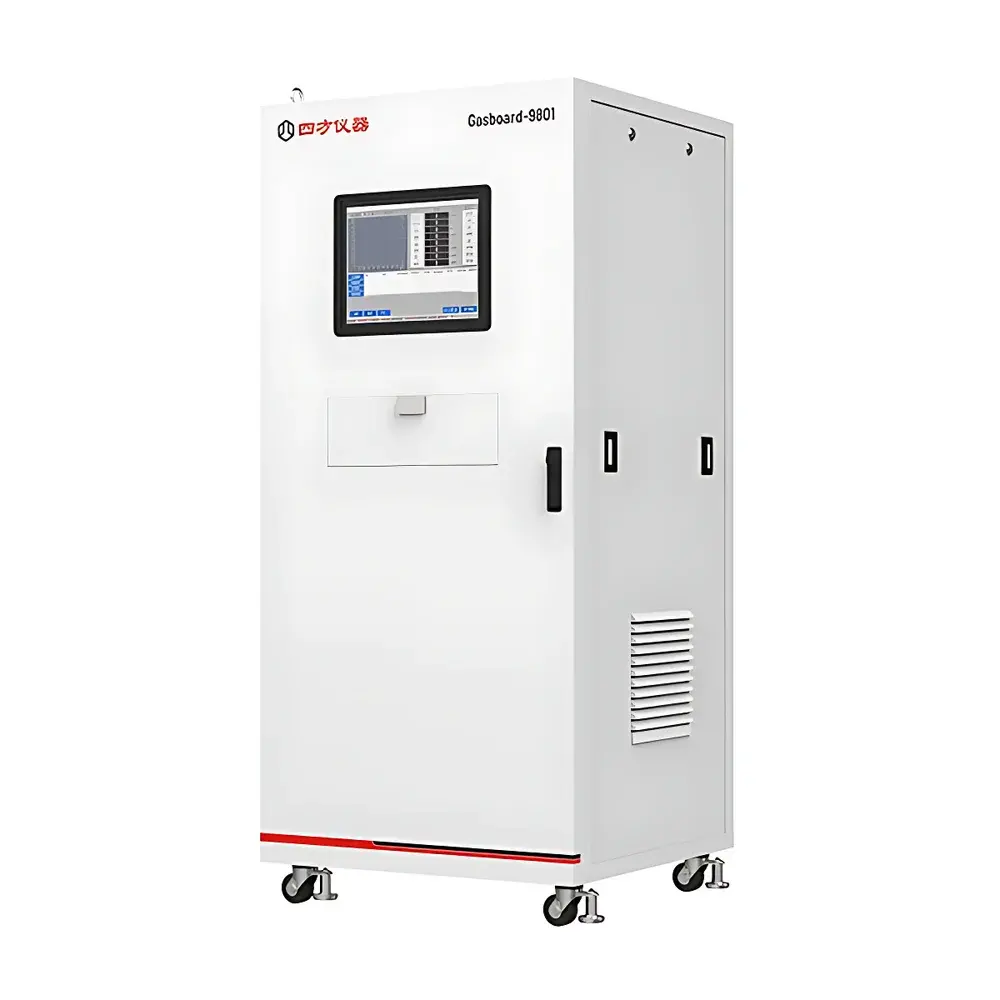
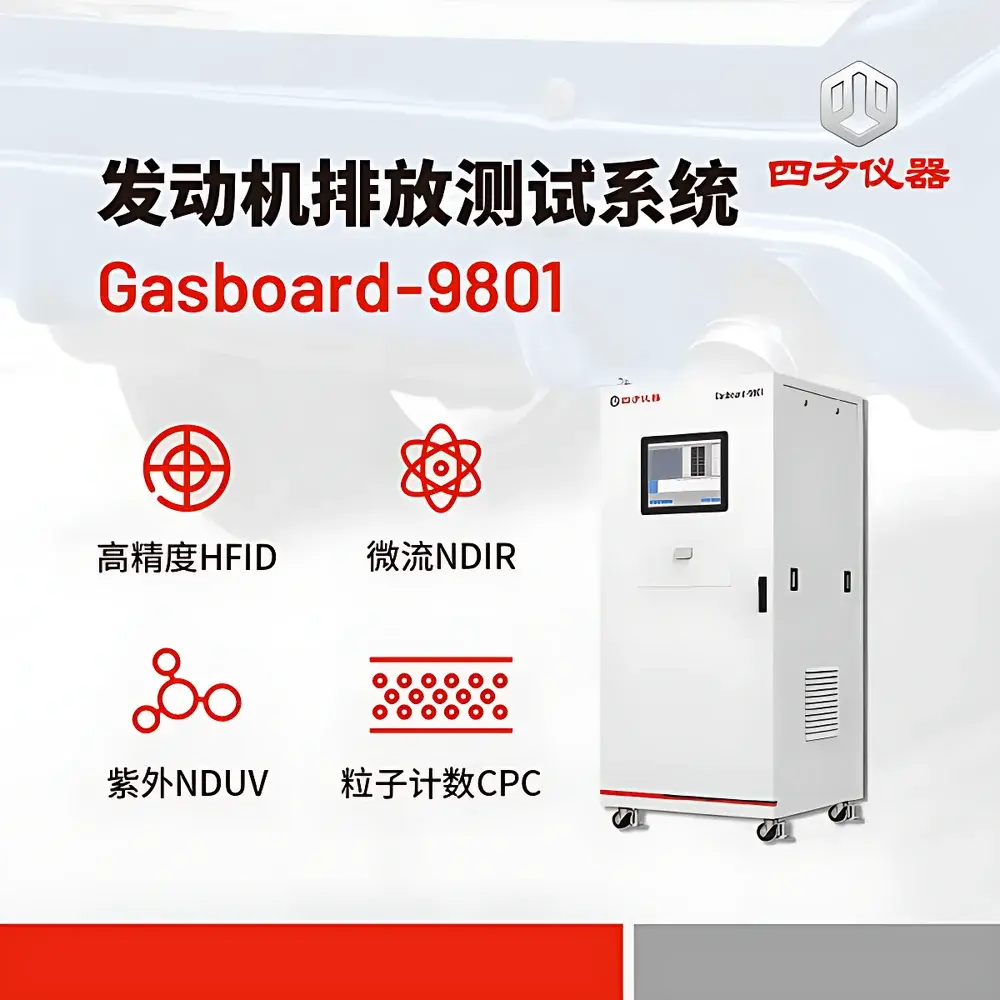
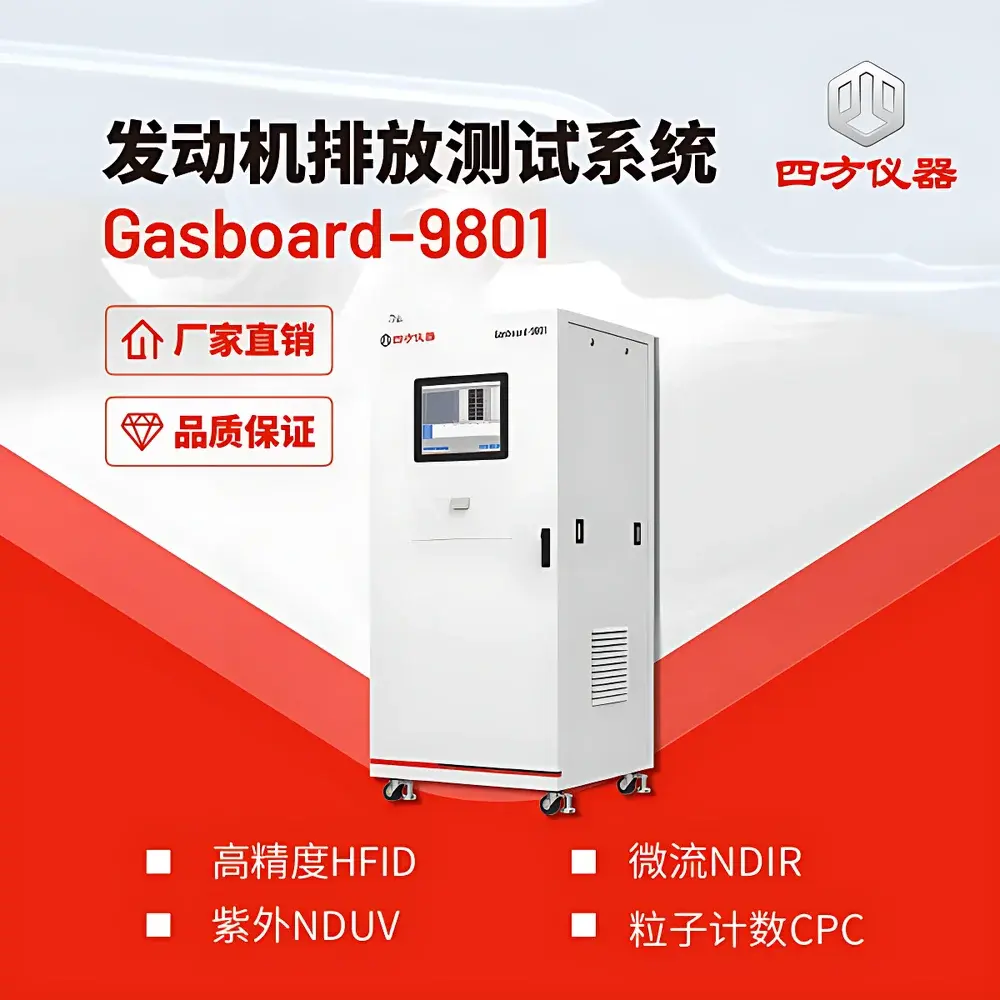
CUBIC INSTRUMENTS Gasboard-9801 Heavy-Duty Vehicle Engine Emission Testing System
| Brand | CUBIC INSTRUMENTS |
|---|---|
| Origin | Hubei, China |
| Model | Gasboard-9801 |
| Instrument Type | Online Analyzer |
| Detection Principle | Non-Dispersive Infrared (NDIR), Non-Dispersive Ultraviolet (NDUV), Chemiluminescence Detection (CLD), Flame Ionization Detection (FID) |
| Measured Gases | THC, CH₄, NOₓ, CO, CO₂, O₂ |
| Maximum Permissible Error | ≤±2.0% of Reading Span (RS) or ≤±0.3% of Full Scale (FS) |
| Zero Drift | ≤±1% FS / 8 h |
| Span Drift | ≤±1% FS / 8 h |
| Repeatability | ≤±0.5% FS |
| Response Time (T₁₀–₉₀) | <2.5 s |
| Operating Temperature | 5–40 °C |
| Relative Humidity | ≤80% RH |
Overview
The CUBIC INSTRUMENTS Gasboard-9801 Heavy-Duty Vehicle Engine Emission Testing System is an integrated, online-capable analytical platform engineered for regulatory-grade measurement of gaseous exhaust constituents during laboratory-based engine certification and development testing. Designed to meet the stringent requirements of global emissions legislation—including Euro VI, U.S. EPA Tier 4, China’s GB 17691–2018 (National VI), and EU Stage V for non-road mobile machinery—the system employs a modular architecture combining dedicated sampling, conditioning, and multi-gas analysis modules. Its core measurement technologies include Non-Dispersive Infrared (NDIR) for CO, CO₂, and CH₄; Non-Dispersive Ultraviolet (NDUV) and Chemiluminescence Detection (CLD) for NOₓ; and Flame Ionization Detection (FID) with hydrocarbon-specific calibration (HFID/NMC-FID) for total hydrocarbons (THC). This hybrid sensor suite enables simultaneous, high-fidelity quantification of six critical species—THC, CH₄, NOₓ, CO, CO₂, and O₂—across both raw and full-flow dilution exhaust streams.
Key Features
- Multi-principle gas sensing architecture: NDIR (CO, CO₂, CH₄), NDUV/CLD (NOₓ), HFID/NMC-FID (THC) ensures cross-interference mitigation and compound-specific accuracy.
- Wide dynamic range: Configurable measurement spans from sub-ppm levels (e.g., 0–10 ppmC for THC/CH₄) up to high-concentration domains (e.g., 0–25% for O₂), supporting ultra-low emission vehicle (ULEV) and legacy engine testing.
- High temporal resolution: T10–90 response time <2.5 seconds per channel enables real-time tracking of transient engine cycles (e.g., WHSC, WHTC, FTP-75).
- Modular sampling interface: Supports multi-point tailpipe probing, EGR ratio calculation via dual-stream O₂ differential, and integration with constant volume samplers (CVS) or raw exhaust ducts.
- Robust environmental tolerance: Certified operation across 5–40 °C ambient temperature and ≤80% RH, suitable for climate-controlled test cells and mobile laboratory deployments.
- Calibration traceability: Designed to support ISO 17025-compliant calibration protocols using certified reference gases traceable to NIST or equivalent national metrology institutes.
Sample Compatibility & Compliance
The Gasboard-9801 is validated for use in full-flow dilution tunnel testing (e.g., according to ISO 8178, ISO 16183, SAE J1094) as well as raw exhaust analysis under controlled conditions. It complies with key regulatory frameworks governing heavy-duty and non-road mobile engines, including but not limited to: EU Regulation (EU) 2016/1628 (Stage V), UN-ECE R49 and R96, China’s GB 17691–2018 (National VI), and U.S. Code of Federal Regulations Title 40 Part 1065. All gas analyzers are designed to meet the linearity, drift, and repeatability requirements specified in ISO 20011 and EPA 40 CFR Part 1065 Appendix D. The system supports GLP/GMP-aligned data integrity practices through audit-trail-enabled software logging and secure user access controls.
Software & Data Management
Gasboard-9801 operates with CUBIC’s proprietary emission data acquisition and control software, compliant with FDA 21 CFR Part 11 requirements for electronic records and signatures. The software provides real-time visualization of all six gas channels, automatic zero/span validation scheduling, and integrated calculation of derived parameters—including lambda (λ), air-fuel ratio (AFR), and EGR fraction—based on stoichiometric relationships and measured O₂. Raw analog/digital outputs (4–20 mA, RS-485, Ethernet TCP/IP) enable seamless integration into third-party test cell control systems (e.g., AVL PUMA, Horiba MEXA, ETAS INCA). All measurement data are timestamped, stored in CSV and SQL-compatible formats, and support automated report generation aligned with UN-ECE R49 Annex 4B or GB 17691–2018 Annex G templates.
Applications
- Regulatory type-approval testing for heavy-duty diesel and natural gas engines (Euro VI, National VI, EPA Tier 4).
- Production conformity verification (PCV) and in-service conformity (ISC) monitoring programs.
- R&D validation of aftertreatment systems (SCR, DOC, DPF, GPF) under transient and steady-state operating conditions.
- Emissions benchmarking of alternative fuels (LNG, biomethane, hydrogen-blended diesel) and low-carbon combustion strategies.
- Marine propulsion engine testing per IMO MARPOL Annex VI and EU Directive 2016/1628.
- Non-road mobile machinery (NRMM) certification for agricultural, construction, and rail applications.
FAQ
Does the Gasboard-9801 support simultaneous measurement of all six gases without cross-channel interference?
Yes. Each gas module uses spectrally isolated detection principles (e.g., NDIR bandpass filtering, CLD reaction specificity, FID carbon-selective ionization), and signal processing includes algorithmic compensation for known interferences such as H₂O vapor quenching in CLD or CO₂ absorption overlap in NDIR channels.
Can the system be integrated into existing CVS tunnels compliant with ISO 8178?
Yes. The Gasboard-9801 features standardized analog/digital I/O interfaces and supports Modbus RTU/TCP and CAN bus communication protocols, enabling direct integration with major CVS manufacturers’ control systems.
Is the analyzer suitable for measuring ultra-low NOₓ emissions from SCR-equipped engines?
Yes. With configurable NOₓ ranges down to 0–10 ppm and a maximum permissible error of ≤±0.3% FS, the CLD/NDUV subsystem meets the sensitivity and accuracy requirements defined in ISO 16183 Annex C for post-SCR tailpipe testing.
What calibration standards and frequency are recommended?
Initial calibration must be performed using NIST-traceable certified reference gases. Zero/span verification is required before each test sequence; full multi-point linearity verification is recommended every 30 days or per ISO 20011 Section 7.3.2.
Does the system provide compliance-ready reporting for certification submissions?
Yes. The embedded software generates audit-ready PDF and Excel reports containing raw data, calibration logs, uncertainty budgets, and pass/fail status against applicable regulatory limits (e.g., Euro VI NOₓ + NH₃ combined limit), fully traceable to individual test runs and operator credentials.







