
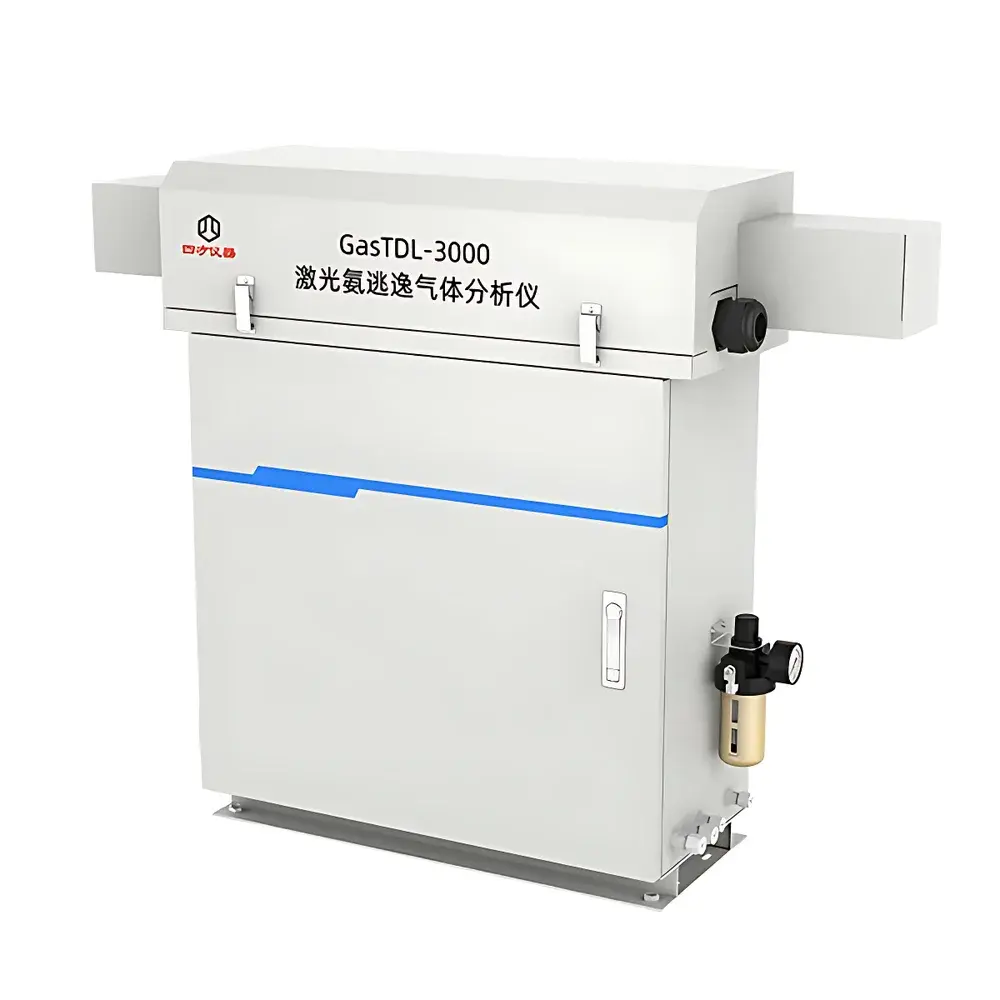
CUBIC INSTRUMENTS GasTDL-3000 Tunable Diode Laser Absorption Spectroscopy (TDLAS) Ammonia Slip Analyzer
| Brand | CUBIC INSTRUMENTS |
|---|---|
| Origin | Hubei, China |
| Model | GasTDL-3000 |
| Measurement Range | 0–10 ppm NH₃ |
| Accuracy | ±1% F.S. |
| Response Time | <30 s |
| Operating Ambient Temperature | −30 °C to +70 °C |
| Resolution | 0.01 ppm |
| Repeatability | ±1% F.S. |
| Power Supply | DC 24 V (heating: AC 220 V) |
| Communication | RS-232 / RS-485 |
| Storage Conditions | −40 °C to +85 °C |
| Ingress Protection | IP65 |
Overview
The CUBIC INSTRUMENTS GasTDL-3000 is a high-stability, in-situ extractive ammonia slip analyzer engineered for continuous, real-time monitoring of residual NH₃ concentration at the outlet of selective catalytic reduction (SCR) and selective non-catalytic reduction (SNCR) systems in coal-fired, biomass, and waste-to-energy power plants. It employs Tunable Diode Laser Absorption Spectroscopy (TDLAS), a physics-based optical measurement principle that exploits the unique near-infrared absorption line of ammonia at ~1531.8 nm. Unlike electrochemical or chemiluminescence methods, TDLAS provides species-specific detection with negligible cross-sensitivity to H₂O, CO₂, NOₓ, SO₂, or particulate matter—critical for reliable operation in flue gas environments where spectral interference and matrix effects are common. The system adopts a close-coupled extractive configuration: the sampling probe is mounted directly on the duct wall, and hot gas is drawn into a high-temperature optical cell without extended heated sample lines. This architecture eliminates condensation-induced NH₃ loss and surface adsorption, ensuring trace-level fidelity and metrological integrity.
Key Features
- True TDLAS-based detection with single-line scanning and wavelength modulation spectroscopy (WMS) for enhanced signal-to-noise ratio and baseline stability
- Multi-pass Herriott-type optical cell enabling effective path lengths >10 m, achieving sub-ppb detection limits and 0.01 ppm resolution over 0–10 ppm range
- Full-path high-temperature conditioning: entire gas path—including probe tip, filter, flow regulator, and measurement cell—maintained at ≥180 °C using integrated ceramic heaters and low-adsorption Inconel 625 and electropolished stainless-steel surfaces
- Zero-drift compensation via integrated span/zero calibration sequence with certified NH₃/N₂ standard gases; supports automated daily or user-triggered calibration
- Ruggedized field enclosure rated IP65, qualified for outdoor installation under ambient conditions from −30 °C to +70 °C without external climate control
- Modular electronics architecture with isolated analog I/O, dual redundant communication ports (RS-232 and RS-485 Modbus RTU), and configurable alarm relays compliant with SIL 2 functional safety requirements
Sample Compatibility & Compliance
The GasTDL-3000 is validated for use with flue gas streams containing up to 20 vol% H₂O, ≤5000 mg/m³ dust loading (post-ESP/FF), and pressure fluctuations ±5 kPa around nominal duct static pressure. It meets EN 15267-3 (QAL1 certification framework for automated measuring systems) and aligns with EPA Method 320 and ISO 14956 for trace NH₃ quantification in industrial emissions. Data acquisition and storage comply with EU Industrial Emissions Directive (IED 2010/75/EU) reporting requirements. Optional audit trail logging and user-access controls support adherence to GLP and GMP documentation standards where process validation is mandated.
Software & Data Management
The embedded firmware supports local data logging (≥30 days at 1-second intervals) and real-time streaming via Modbus TCP or OPC UA (optional). The optional CUBIC Insight™ desktop software enables remote configuration, spectral diagnostics, drift trend analysis, and report generation per EN 14181 Part 3. All calibration events, sensor faults, and parameter changes are time-stamped and stored with operator ID—providing full traceability required for regulatory audits. Data export formats include CSV, PDF summary reports, and XML-compatible emission records compatible with CEMS central databases.
Applications
- Continuous ammonia slip monitoring downstream of SCR/SNCR reactors to optimize reagent injection and minimize catalyst fouling
- Compliance verification against national and regional emission limits (e.g., China’s GB 13223–2011, EU BREF LCP, US EPA NSPS Subpart UUU)
- Process troubleshooting during boiler load transitions, catalyst aging, or ammonia distribution imbalance
- Integration into DCS/PLC networks for closed-loop NH₃ feedforward control strategies
- Long-term performance validation of denitrification system efficiency under varying fuel blends and combustion conditions
FAQ
Does the GasTDL-3000 require periodic optical alignment or laser recalibration?
No. The TDLAS module is factory-aligned and sealed; no field optical adjustment is required throughout its service life.
Can the analyzer operate reliably in high-dust flue gas without frequent filter maintenance?
Yes. The probe incorporates a sintered metal primary filter (5 µm pore size) and automatic back-pulse cleaning triggered by differential pressure monitoring.
Is the system compatible with existing CEMS infrastructure and third-party SCADA platforms?
Yes. Standard Modbus RTU/ASCII over RS-485 ensures interoperability with major CEMS vendors (e.g., Sick, ABB, Thermo Fisher) and supervisory control systems.
What validation documentation is provided for regulatory acceptance?
Each unit ships with factory calibration certificate, QAL1 test report per EN 15267-3, and detailed technical file including uncertainty budget and interference test results.
How is moisture interference mitigated given NH₃’s high solubility in water?
By maintaining the entire gas path above the NH₃ dew point (>180 °C) and using hydrophobic filtration media, condensation is physically prevented—eliminating aqueous-phase partitioning losses.
Related Products







