
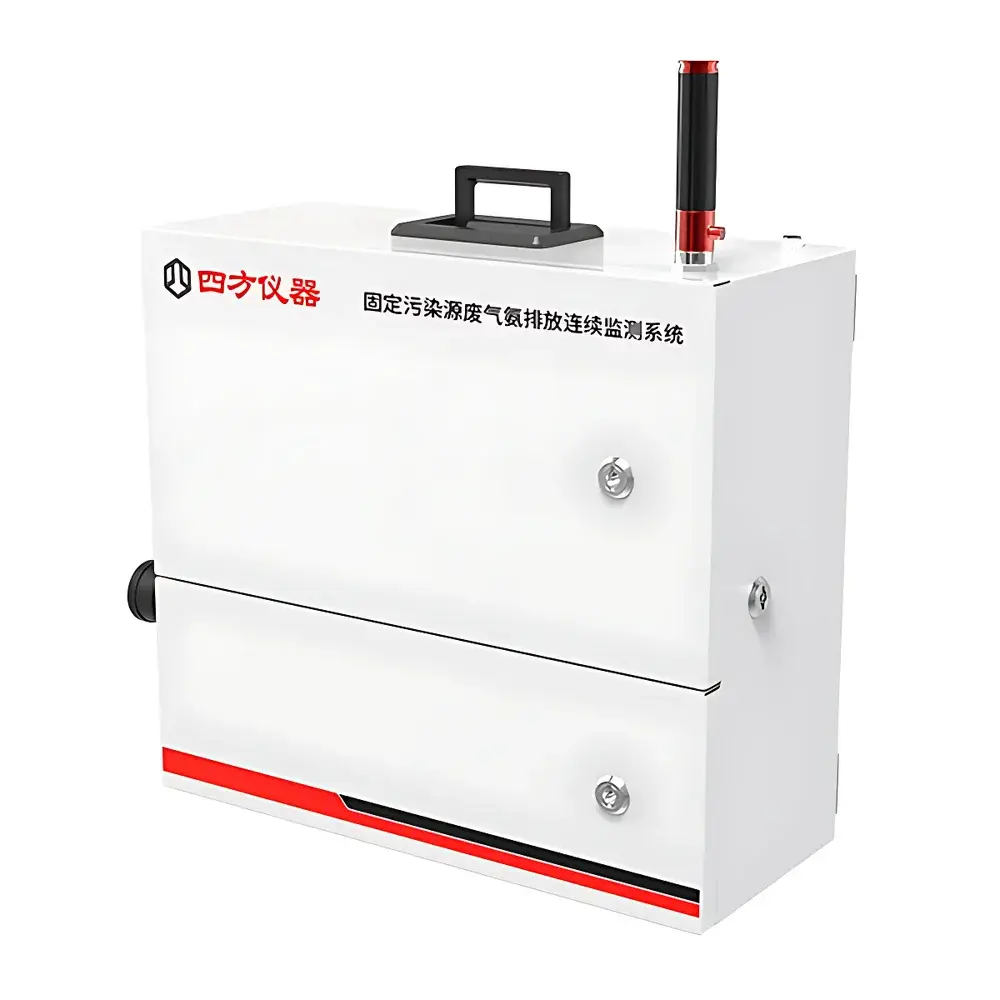
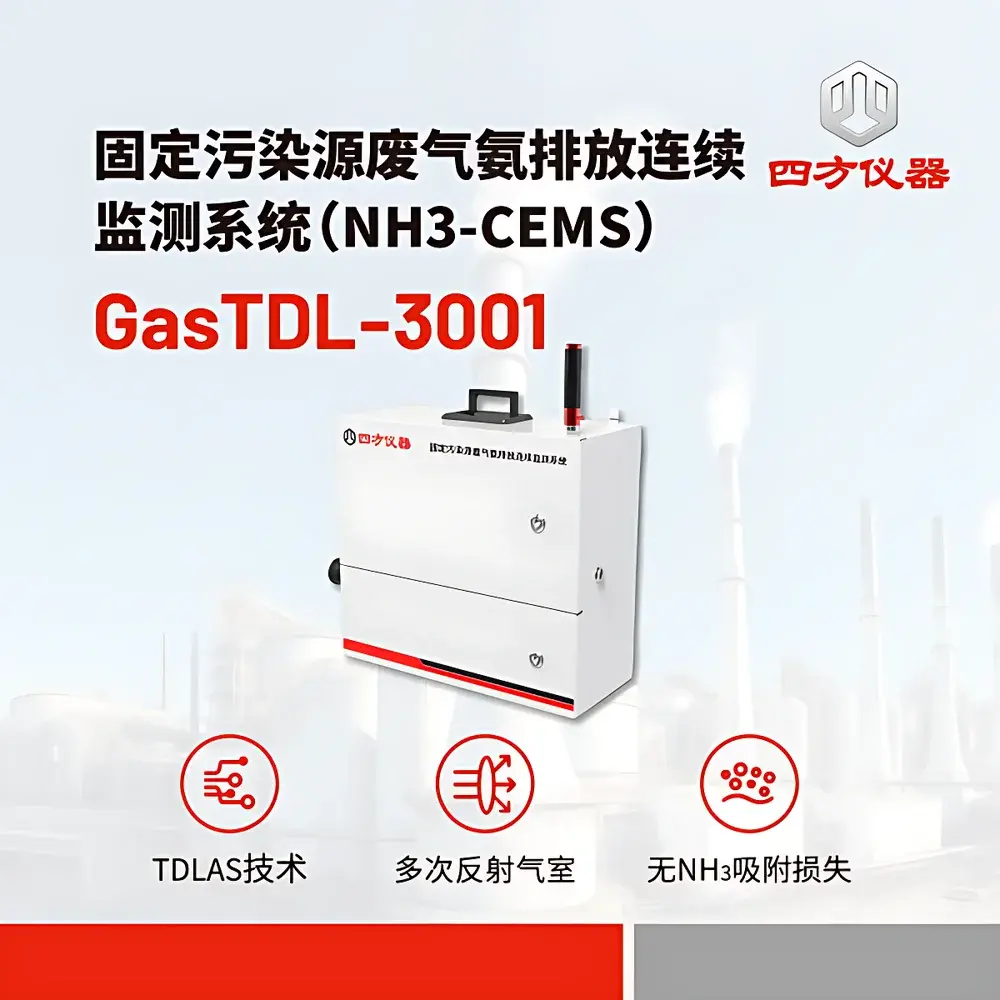
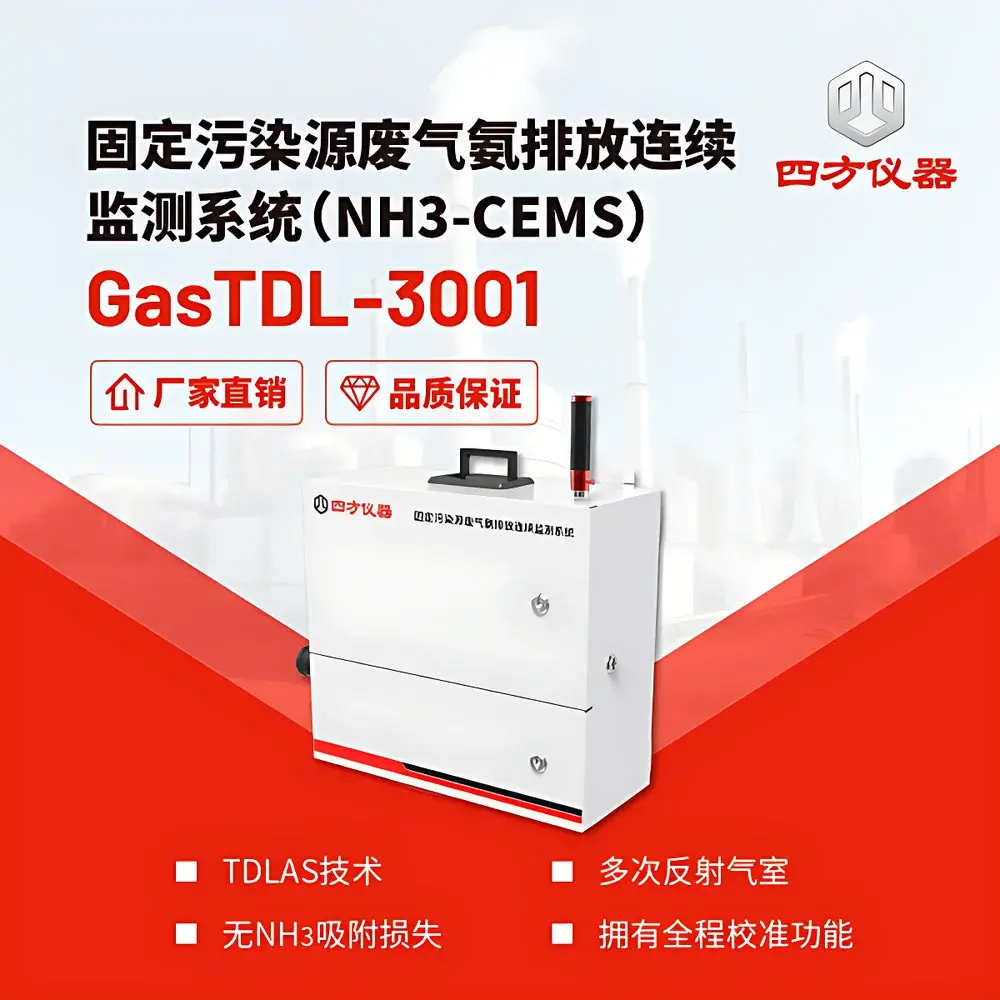
CUBIC INSTRUMENTS GasTDL-3001 Ammonia Slip Online Monitoring System
| Brand | CUBIC INSTRUMENTS |
|---|---|
| Origin | Hubei, China |
| Model | GasTDL-3001 |
| Detection Principle | Tunable Diode Laser Absorption Spectroscopy (TDLAS) |
| Sampling Method | In-situ |
| Measurement Range | 0–10–100 ppm (adjustable) |
| Accuracy | ±1% F.S. |
| Response Time (T90) | ≤30 s |
| Repeatability | ±1% |
| Operating Ambient Temperature | −30 to +60 °C |
| Protection Rating | IP65 or higher |
| Resolution | 0.01 ppm |
| LOD | ±1% F.S. |
| Power Supply | 220 VAC, 50 Hz, 800 W |
| Purge Air | 0.4–0.8 MPa compressed air |
| Communication | 1× RS-232, 1× RS-485 |
| Analog Outputs | 4× 4–20 mA |
| Digital Outputs | 8× relay |
Overview
The CUBIC INSTRUMENTS GasTDL-3001 Ammonia Slip Online Monitoring System is an engineered solution for continuous, real-time quantification of ammonia (NH3) concentration in flue gas streams downstream of selective catalytic reduction (SCR) and selective non-catalytic reduction (SNCR) denitrification systems. It employs Tunable Diode Laser Absorption Spectroscopy (TDLAS), a highly selective optical absorption technique operating on the fundamental vibrational-rotational transition lines of NH3 in the near-infrared region. Unlike extractive NDIR or electrochemical methods, TDLAS eliminates cross-sensitivity to CO, CO2, H2O, NOx, and SO2, ensuring unambiguous NH3 detection even in complex, high-moisture, high-dust industrial exhaust environments. The system adopts an in-situ configuration: the optical probe is mounted directly on the duct wall, with the laser beam traversing the process gas without physical extraction. This architecture minimizes transport delay, eliminates sample conditioning losses, and avoids condensation-induced NH3 adsorption—critical for maintaining measurement fidelity at sub-ppm levels.
Key Features
- In-situ TDLAS architecture: Eliminates sampling lines, filters, and conditioning units; reduces maintenance and calibration drift.
- High-temperature heated optical path: Entire beam path—including probe window and internal optics—is actively heated to ≥180 °C to prevent NH3 condensation and surface adsorption on optical surfaces and flow channels.
- Multi-pass absorption cell integration: Enables extended effective path length (>10 m equivalent) within compact probe housing, enhancing sensitivity and achieving a limit of detection (LOD) of 0.01 ppm (±1% F.S.).
- Full-system calibration capability: Supports zero/span calibration using certified NH3 standard gases introduced directly into the optical path—validating both laser wavelength stability and detector linearity across the full dynamic range.
- Robust mechanical design: IP65-rated enclosure with corrosion-resistant 316L stainless steel probe body; operational over −30 °C to +60 °C ambient extremes without external climate control.
- Background interference immunity: Spectral scanning around targeted NH3 absorption lines (e.g., 6546 cm−1) with second-harmonic detection enables rejection of broadband particulate scattering and spectral overlap from H2O and CO2.
Sample Compatibility & Compliance
The GasTDL-3001 is validated for use in coal-fired, biomass, waste-to-energy, and cement kiln flue gas streams with typical dust loading up to 50 g/Nm³, moisture content up to 15% v/v, and temperatures up to 200 °C. Its in-situ design inherently tolerates pressure fluctuations (±5 kPa) and transient thermal gradients common in SCR ducts. From a regulatory standpoint, the system supports compliance with EPA Method 320 (for NH3), ISO 14956:2021 (ambient air quality—performance criteria), and Chinese HJ 1013–2018 (technical specification for NH3-CEMS). Data integrity features—including timestamped audit logs, user-access controls, and configurable alarm thresholds—align with GLP and GMP data governance expectations for continuous emission monitoring systems (CEMS).
Software & Data Management
The embedded controller runs a deterministic real-time OS with dual-channel data acquisition (laser intensity + absorption signal) and on-board spectral fitting using least-squares Voigt profile deconvolution. Raw spectra and processed NH3 concentration values are logged at 1-second intervals and stored locally for ≥30 days. Standard communication interfaces include RS-232 (for local diagnostics), RS-485 (Modbus RTU for PLC integration), four isolated 4–20 mA analog outputs (configurable per user-defined scaling), and eight programmable relay outputs for alarm staging or interlock signaling. Optional Ethernet/WiFi modules enable secure HTTPS-based remote access, historical trend visualization via web dashboard, and export of CSV/Excel reports compliant with EN 14181 QA/QC requirements.
Applications
- Real-time optimization of NH3 injection rates in SCR/SNCR systems to minimize reagent consumption while meeting NOx removal targets.
- Verification of catalyst performance degradation and early detection of ammonia slip excursions exceeding 2–3 ppm thresholds.
- Stack compliance reporting for environmental permits under EU IED Directive, US Clean Air Act Title V, or China’s GB 13223–2011 emission standards.
- Process troubleshooting during boiler load changes, sootblowing events, or catalyst regeneration cycles.
- Integration into DCS/SCADA platforms for closed-loop control of denitrification efficiency.
FAQ
Does the GasTDL-3001 require periodic zero/span calibration? Why?
Yes. While TDLAS offers superior long-term stability versus conventional sensors, quarterly zero/span verification using traceable NH3 standards is recommended per EN 14181 QAL2 to maintain measurement uncertainty within ±1% F.S. and satisfy regulatory QA/QC protocols.
Can the system operate in high-dust environments without optical fouling?
The probe incorporates an air-purge collar with tangential laminar flow (0.4–0.8 MPa) that creates a positive pressure barrier across the optical window, preventing particulate deposition. Field deployments in coal-fired power plants confirm >12 months between required window cleaning cycles.
Is the measurement affected by water vapor or CO2 in flue gas?
No. TDLAS operates on narrow-line absorption spectroscopy. The system’s spectral analysis algorithm isolates the target NH3 line (e.g., at 1529.5 nm) and mathematically compensates for overlapping H2O and CO2 absorption features using reference spectra acquired during factory characterization.
What safety certifications does the system hold?
The GasTDL-3001 complies with CE marking requirements (EMC Directive 2014/30/EU, Low Voltage Directive 2014/35/EU) and meets ATEX Zone 2 / IECEx Zone 2 classification for non-incendive operation in potentially explosive atmospheres when installed with appropriate conduit sealing.
How is data traceability ensured for regulatory audits?
All calibration events, parameter changes, and alarm triggers are recorded with UTC timestamps, operator ID, and digital signatures in a write-once audit log. Exported datasets include metadata headers confirming instrument serial number, firmware version, and calibration certificate IDs—fully traceable to NIST-traceable gas standards.
Related Products







