
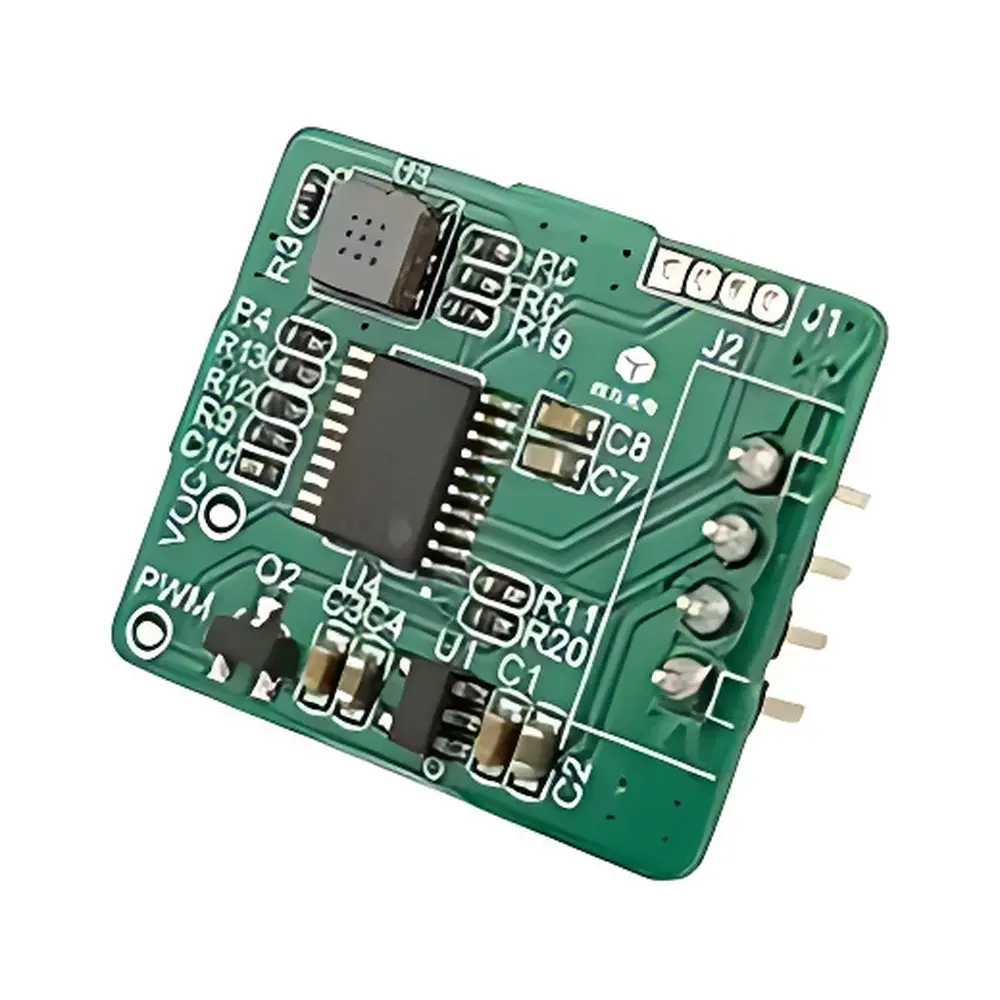
Cubic MS-VOC Volatile Organic Compounds (VOC) Sensor Module
| Brand | Cubic |
|---|---|
| Origin | Hubei, China |
| Manufacturer Type | Authorized Distributor |
| Country of Origin | China |
| Model | MS-VOC |
| Pricing | Available Upon Request |
| Target Gases | Formaldehyde, Benzene, CO, H₂, Ethanol, NH₃, Cigarette Smoke |
| Preheat Time | 180 s |
| Operating Temperature | −10 °C to 50 °C |
| Storage Temperature | −20 °C to 60 °C |
| Response Time | ≤30 s |
| Rated Voltage | DC 5 V ±0.2 V |
| Output Interface | UART (5 V logic) or 0–3 V analog |
| Dimensions | 24 mm × 20 mm × 5 mm |
| Power Design | Constant-power operation |
| Calibration | Factory-calibrated |
| Stability | Long-term baseline stability |
| Power Consumption | Low-power operation |
Overview
The Cubic MS-VOC is a compact, OEM-integrated volatile organic compounds (VOC) sensor module engineered for reliable detection of low-concentration airborne organic vapors in indoor air quality (IAQ), HVAC control, and portable environmental monitoring systems. Based on metal-oxide semiconductor (MOS) sensing technology, the MS-VOC leverages temperature-controlled resistive transduction to detect changes in surface conductivity induced by adsorption of target gas molecules. Its sensing element operates under constant-power biasing, ensuring thermal stability and minimizing drift during extended operation. Unlike electrochemical or PID-based sensors, the MS-VOC offers cost-effective, solid-state detection with no consumables or high-voltage requirements—making it suitable for battery-powered devices and embedded applications where maintenance-free operation over 2+ years is required.
Key Features
- Factory pre-calibrated for formaldehyde, benzene, ethanol, ammonia, hydrogen, carbon monoxide, and cigarette smoke—enabling rapid integration without field recalibration
- Constant-power heating architecture ensures consistent operating temperature across ambient fluctuations, improving repeatability and reducing thermal hysteresis
- Low power consumption (<15 mW typical) supports continuous operation in energy-constrained IoT nodes and wearable IAQ monitors
- Compact footprint (24 × 20 × 5 mm) facilitates integration into space-limited enclosures, including smart thermostats, air purifiers, and duct-mounted controllers
- Robust long-term stability verified through accelerated aging tests; baseline resistance drift <5% over 12 months under controlled storage conditions
- Dual-output interface: configurable UART (TTL 5 V) for digital data streaming or analog 0–3 V output for simple ADC interfacing
Sample Compatibility & Compliance
The MS-VOC is designed for gaseous-phase sampling in non-condensing, non-corrosive environments. It is not intended for use in high-humidity (>90% RH non-condensing), high-dust, or chemically aggressive atmospheres (e.g., chlorine, sulfur dioxide, or strong oxidizers), which may accelerate sensor poisoning or irreversible baseline shift. While the module itself does not carry CE, UKCA, or UL certification, its electrical interface complies with IEC 61000-4 immunity standards when implemented with appropriate PCB-level filtering and isolation. End-system integrators are responsible for validating final product compliance with regional air quality monitoring directives (e.g., EU Indoor Air Quality Guidelines, ASHRAE Standard 62.1) and electromagnetic compatibility (EMC) requirements.
Software & Data Management
The MS-VOC communicates via ASCII-based UART protocol at 9600 bps (default), supporting real-time gas concentration estimation using factory-derived calibration coefficients stored in onboard memory. No proprietary driver is required—raw resistance or normalized output values can be parsed using standard microcontroller UART libraries (e.g., Arduino Serial, STM32 HAL_UART). For analog mode, users must apply linear or polynomial compensation based on reference calibration curves provided in the technical datasheet. The module does not include built-in data logging or cloud connectivity; integration with edge firmware (e.g., ESP-IDF, Zephyr OS) is recommended for timestamped data aggregation, outlier filtering, and MQTT/HTTP telemetry transmission. When deployed in regulated environments (e.g., commercial building management systems), system-level audit trails and calibration history tracking must be implemented externally per ISO/IEC 17025 or ISO 9001 traceability requirements.
Applications
- Indoor air quality monitoring in residential, office, and educational facilities
- Smart HVAC demand-controlled ventilation (DCV) feedback loops
- Real-time VOC detection in air purifiers and dehumidifiers
- OEM integration into handheld IAQ meters and multi-parameter environmental stations
- Occupancy inference and activity monitoring in smart building platforms
- Pre-screening modules for laboratory-grade GC-MS or PID validation workflows
FAQ
Is the MS-VOC sensor certified to any international gas detection standards (e.g., EN 50549, UL 2075)?
No—the MS-VOC is an unenclosed sensor module, not a standalone certified gas alarm device. Final system certification is the responsibility of the equipment manufacturer.
Can the sensor distinguish between individual VOCs (e.g., formaldehyde vs. ethanol)?
No—it provides a composite response to reducing gases; selectivity is limited without multivariate pattern recognition or sensor array fusion.
What is the expected operational lifetime under continuous use?
Typical functional lifetime exceeds 24 months at 25 °C and <70% RH; performance degradation accelerates above 50 °C or in high-volatility solvent environments.
Does the module support automatic baseline correction or humidity compensation?
No—humidity compensation must be applied externally using co-located relative humidity and temperature sensors and published correction algorithms.
Is firmware update capability available over UART?
No—the calibration parameters and operating firmware are fixed at manufacture and not field-upgradable.
Related Products







