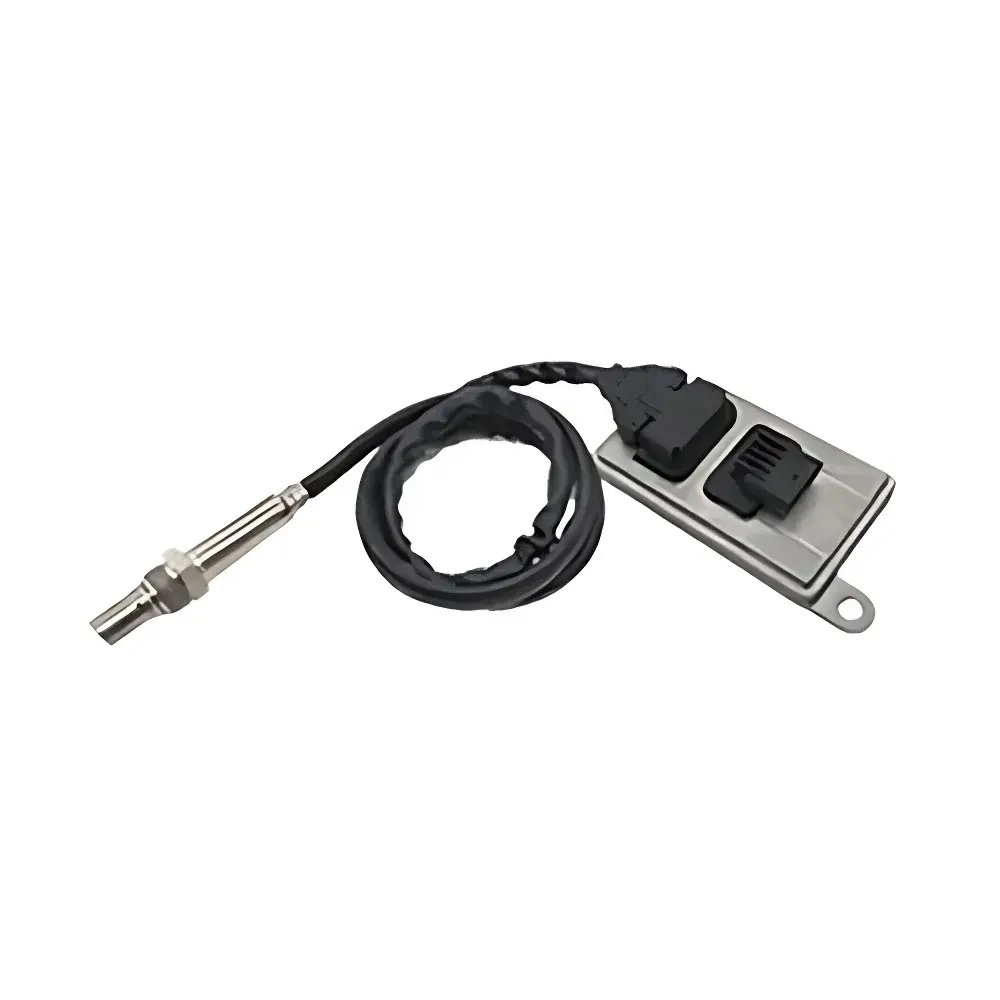
Cubic Nitrogen Oxides (NOx) and Oxygen Sensor
| Brand | Cubic |
|---|---|
| Origin | Hubei, China |
| Manufacturer Type | Authorized Distributor |
| Country of Origin | China |
| Model | NOx/O₂ Dual-Gas Sensor |
| Voltage Range | 16–36 V DC |
| O₂ Measurement Range | 0–21% vol |
| NOx Measurement Range | 0–1500 ppm (NO + NO₂, λ > 1, NH₃-free environment) |
| NOx Accuracy | ±10 ppm (for [NOx] < 100 ppm) |
| Response Time (T₃₃–₆₆%) | NOx: 1200 ms (new generation), 1300 ms (legacy) |
| O₂ | 1000 ms (new), 1100 ms (legacy) |
| Fast Transient Response (T₁₀–₉₀%) | NOx: 100 ms |
| O₂ | 80 ms |
Overview
The Cubic NOx/O₂ Dual-Gas Sensor is an electrochemical gas sensing module engineered for real-time, simultaneous quantification of nitrogen oxides (NO + NO₂) and molecular oxygen (O₂) in high-temperature, high-humidity exhaust streams. Operating on the principle of potentiometric and amperometric electrochemical detection, the sensor employs dual working electrodes housed within a thermally stabilized zirconia-based ceramic cell. The integrated micro-heater ensures rapid light-off (< 60 s at cold start) and maintains optimal operating temperature (≈700 °C) across variable exhaust flow conditions—critical for stoichiometric control in selective catalytic reduction (SCR) systems and three-way catalyst (TWC) feedback loops. Designed specifically for compliance with Euro VI, China VI, and EPA Tier 4 final emission standards, this sensor delivers trace-level resolution in dynamic diesel and gasoline engine exhaust environments where cross-sensitivity to ammonia (NH₃), water vapor, and sulfur compounds must be rigorously minimized.
Key Features
- Dual-gas detection architecture: Independent, co-located O₂ and NOx sensing elements within a single hermetically sealed housing—eliminating inter-channel drift and enabling true differential lambda calculation.
- Integrated heater-sensing unit: Monolithic ceramic substrate with embedded Pt-based heater and electrode structures ensures thermal uniformity, reproducible activation kinetics, and reduced warm-up time (Ton < 60 s at −20 °C ambient).
- IP67-rated stainless-steel housing with ceramic feedthroughs: Resists condensate ingress, thermal shock (−40 °C to +900 °C intermittent), and mechanical vibration per ISO 16750-3.
- Poisoning-resistant electrode formulation: Optimized noble-metal catalyst dispersion and proprietary electrolyte doping mitigate deactivation from phosphorous, zinc, calcium, and hydrocarbon fouling—validated over 5,000 h in accelerated aging tests per SAE J1711.
- Low-power analog output interface: 0–5 V ratiometric signal for NOx and O₂ channels, compatible with standard ECU ADC inputs; supports diagnostic pin for heater status and internal reference voltage monitoring.
Sample Compatibility & Compliance
This sensor is validated for use in diesel-powered on-road vehicles (light- and heavy-duty), gasoline direct-injection (GDI) platforms, off-highway construction and agricultural machinery (Stage V/China IV), and stationary combustion sources including coal-fired boiler flue gas ducts. It meets the functional safety requirements of ISO 26262 ASIL-B for sensor fault detection and reporting. All production units undergo 100% end-of-line calibration against NIST-traceable gas standards (NO, O₂, N₂ balance) and are certified to IEC 61508 SIL2 for industrial process control applications. The device complies with RoHS 2011/65/EU and REACH SVHC restrictions, and its PCB assembly conforms to IPC-A-610 Class 2 standards.
Software & Data Management
The sensor operates as a standalone analog transducer and does not require embedded firmware or host-side drivers. However, when integrated into OEM engine management systems, it supports standardized diagnostic protocols including UDS (ISO 14229-1) services $01 (current data), $06 (on-board monitoring test results), and $19 (read DTC information). Raw output signals are compatible with MATLAB® Simulink® calibration workflows and AVL INCA® measurement environments. For industrial deployment, the sensor’s linear 0–5 V outputs interface directly with PLC-based SCADA systems (e.g., Siemens S7-1200, Rockwell ControlLogix) and support Modbus RTU via external signal conditioning modules. Audit trails for calibration and field replacement are maintained per ISO/IEC 17025 requirements when used in accredited emissions testing laboratories.
Applications
- Real-time closed-loop dosing control of urea-SCR systems in heavy-duty diesel engines.
- Oxygen trim feedback for air-fuel ratio optimization in lean-burn natural gas generators.
- Post-catalyst NOx monitoring for OBD-II readiness checks (SAE J1979-2, OBD-II Mode 06).
- Flue gas desulfurization (FGD) and selective non-catalytic reduction (SNCR) process monitoring in thermal power plants.
- Portable emissions measurement systems (PEMS) used in RDE (Real Driving Emissions) testing per UN GTR 15.
- Aftertreatment system development and validation on engine dynamometers and chassis rollers.
FAQ
What is the recommended mounting orientation for optimal thermal stability?
Vertical installation with connector facing downward is preferred to prevent condensate accumulation in the sensing chamber. Horizontal mounting requires additional heat shielding per SAE J2340 guidelines.
Does the sensor require periodic recalibration in field operation?
No scheduled recalibration is required under normal operating conditions. However, calibration verification using certified span gas (e.g., 500 ppm NO in N₂) is recommended every 12 months or 100,000 km, whichever occurs first, in accordance with ISO 17025 clause 5.9.
Is the sensor compatible with ammonia slip monitoring?
No. This model is explicitly designed for NH₃-free environments. For combined NOx/NH₃ measurement, Cubic offers a separate dual-channel chemiluminescence-based module (Cubic CL-2000 series) compliant with ISO 11469.
What diagnostic capabilities are built into the sensor?
The heater circuit includes open/short detection; the reference electrode monitors baseline drift; and the signal output incorporates a 10-bit diagnostic voltage indicating heater temperature deviation (>±25 °C from setpoint triggers fault flag).