
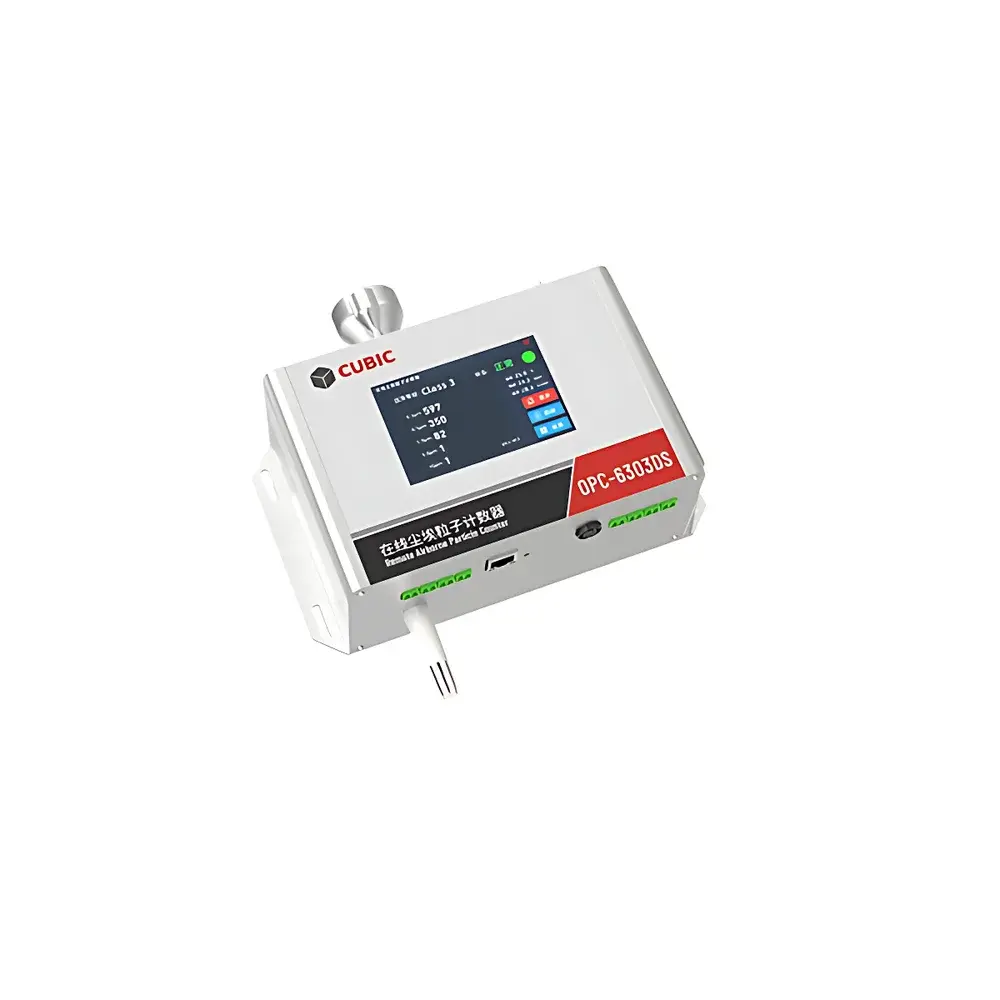
Cubic OPC-6303DS Online Optical Particle Counter
| Brand | Cubic |
|---|---|
| Origin | Hubei, China |
| Model | OPC-6303DS |
| Instrument Type | Online |
| Flow Rate | 2.83 L/min |
| Detection Principle | Light Scattering |
| Particle Size Channels | 0.3, 0.5, 1.0, 2.5, 5.0, 10.0 μm |
| Counting Efficiency | 50% @ 0.3 μm, 100% @ ≥0.5 μm (25±2°C, 50±10% RH) |
| Accuracy Compliance | JJF 1190 |
| Power Supply | DC 12–24 V |
| Operating Temp. | 0–45°C |
| Operating Humidity | 0–95% RH (non-condensing) |
| Display | 3.5-inch color LCD |
| Communication Interfaces | RS485 (standard), RJ45 Ethernet (standard), 4–20 mA output (standard), MQTT/TCP/IP support |
| Data Update Interval | 1 s |
| Warm-up Time | ≤8 s |
| IP Rating | IP44 |
| Lifetime | ≥3 years |
| Optional | Visual/audible alarm module (LED strobe + 110 dB siren) |
Overview
The Cubic OPC-6303DS Online Optical Particle Counter is an industrial-grade, real-time airborne particulate monitoring instrument engineered for continuous environmental and cleanroom surveillance. It operates on the principle of single-particle light scattering—where a focused laser beam interacts with suspended particles in a controlled airflow, generating scattered light pulses proportional to particle size and count. Each pulse is analyzed by high-speed photodetection circuitry and classified into six discrete size bins: 0.3, 0.5, 1.0, 2.5, 5.0, and 10.0 µm. This enables simultaneous quantification of particle concentration per unit volume (default: pcs/m³), supporting compliance-driven applications in pharmaceutical manufacturing, semiconductor fabrication, hospital HVAC validation, and ISO Class 5–8 cleanroom certification. The device features Cubic’s proprietary dust-source intelligent recognition algorithm, which dynamically compensates for optical noise from non-spherical or highly reflective contaminants—enhancing measurement fidelity in mixed-aerosol environments without manual recalibration.
Key Features
- Stable volumetric sampling at 2.83 L/min via precision-controlled diaphragm pump—maintaining flow consistency within ±3% across operating temperature and pressure ranges.
- High-reliability 650 nm industrial laser source with >10,000-hour operational lifetime and thermal drift compensation.
- Real-time multi-channel display of particle counts, ISO cleanliness class (e.g., ISO 14644-1), and configurable threshold alarms on a 3.5-inch TFT color screen.
- Dual-unit flexibility: seamless switching between pcs/m³, pcs/L, and pcs/ft³—critical for international facility audits and cross-regional data harmonization.
- Bilingual UI (English/Chinese) with intuitive navigation, supporting both local operator interaction and remote supervision via web interface.
- Integrated environmental sensing: simultaneous on-board temperature (±1°C) and relative humidity (±8% RH) measurement—enabling correction-aware reporting and dew-point monitoring.
- Robust enclosure rated IP44 for protection against splashing water and solid ingress—suitable for wall-mount or duct-integrated deployment in production corridors and utility tunnels.
Sample Compatibility & Compliance
The OPC-6303DS is validated for use with ambient air, compressed air (oil-free), and HEPA-filtered supply streams. Its counting efficiency meets the metrological requirements defined in JJF 1190–2008, the Chinese national calibration specification for airborne particle counters—covering linearity, resolution, false count rate, and size calibration traceability to NIST-traceable PSL standards. While not certified to ISO 21501-4 or JIS B 9921, its performance envelope aligns with key parameters required for routine monitoring under ISO 14644-1, EU GMP Annex 1 (2022), and FDA Guidance for Industry: Sterile Drug Products Produced by Aseptic Processing (2004). For regulated environments, optional audit-ready data logging (with timestamp, user ID, and event tagging) supports GLP/GMP-aligned record retention when integrated with compliant SCADA or MES platforms.
Software & Data Management
Data export and system integration are supported via multiple industrial protocols: Modbus RTU over RS485 (default), TCP/IP Ethernet (RJ45), and analog 4–20 mA loop output for PLC interfacing. Native MQTT client capability allows secure, lightweight publishing to cloud-based dashboards (e.g., AWS IoT Core, Azure IoT Hub) or on-premise time-series databases such as InfluxDB. Firmware updates are performed via USB or OTA; configuration backups and restore functions ensure reproducible setup across fleet deployments. All communication payloads include CRC checksums and configurable message intervals (1–60 s), minimizing network overhead while preserving temporal resolution for trend analysis. Optional firmware modules enable 21 CFR Part 11-compliant electronic signatures and audit trail generation when paired with authorized authentication servers.
Applications
- Continuous monitoring of ISO Class 5–8 cleanrooms in biopharmaceutical fill-finish suites and API synthesis areas.
- Compressed air quality verification per ISO 8573-1:2010 Class 2–4 particulate requirements.
- Filter integrity testing support—detecting upstream particle surges indicative of HEPA/ULPA degradation.
- Environmental qualification of HVAC systems during commissioning, periodic requalification, and change control events.
- Occupational health surveillance in industrial workshops where PM₂.₅ and PM₁₀ exposure thresholds must be tracked against OSHA PEL or ACGIH TLV guidelines.
- Research-grade aerosol dynamics studies requiring synchronized particle size distribution and meteorological parameter logging.
FAQ
What calibration standards does the OPC-6303DS reference?
The instrument is calibrated using polymeric standard reference materials (PSL spheres) traceable to national metrology institutes. Calibration verification follows JJF 1190 procedures, including size bin accuracy, counting efficiency, and zero-count verification.
Can the device operate unattended for extended periods?
Yes—designed for 24/7 operation with automatic self-diagnostic routines, watchdog timer reset protection, and low-power sleep mode during idle intervals. Mean time between failures (MTBF) exceeds 20,000 hours under nominal conditions.
Is remote firmware update supported over Ethernet?
Yes. Firmware upgrades can be initiated via HTTP POST or MQTT-based OTA commands. Version rollback and signed firmware validation prevent unauthorized modifications.
Does it support alarm relay outputs for building management systems?
Standard models include dry-contact relay outputs (NO/NC) triggered by user-defined particle concentration thresholds. Optional expansion modules add dual-stage alarm logic (warning/alert) with configurable hysteresis.
How is humidity impact mitigated during high-RH sampling?
The internal humidity sensor feeds real-time RH values into the particle counting algorithm to suppress condensation-induced false counts. Additionally, the sample inlet incorporates hydrophobic membrane filtration to minimize water droplet interference without altering particle size distribution.
Related Products







