
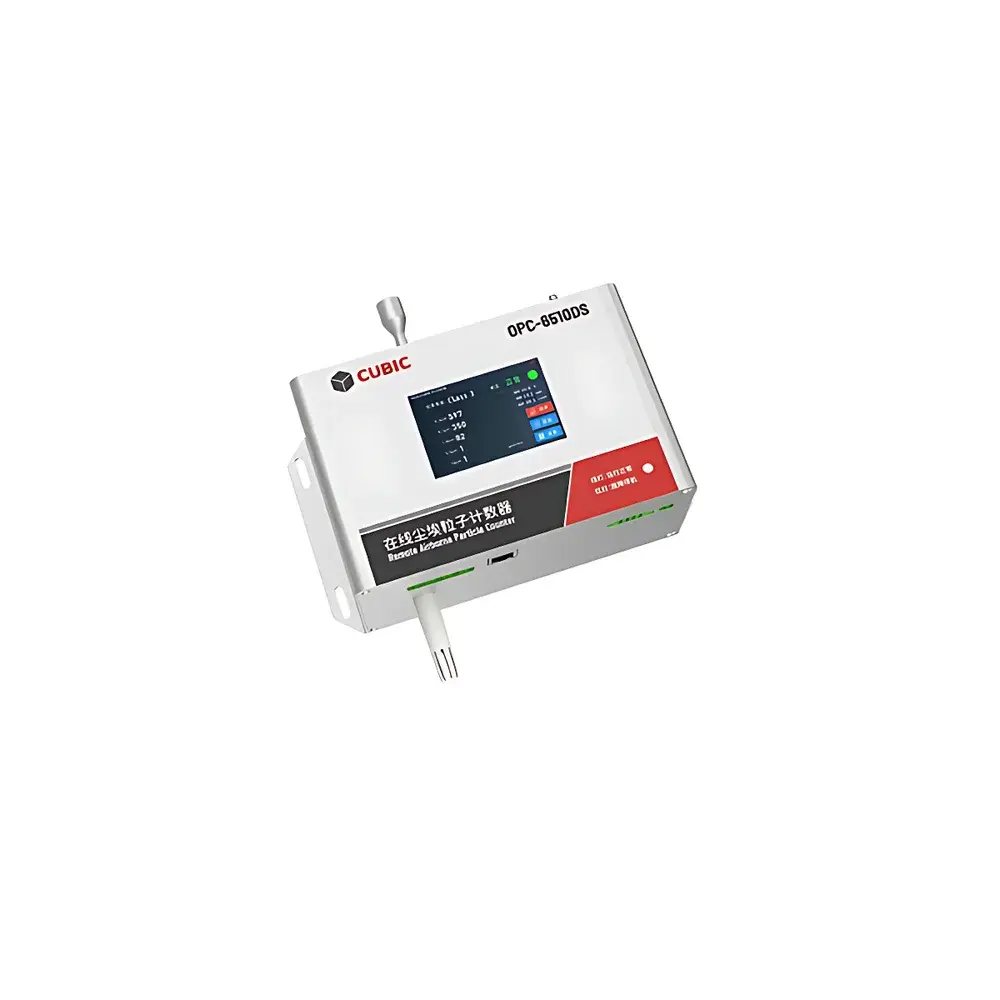
Cubic OPC-6510DS Online Airborne Particle Counter
| Brand | Cubic |
|---|---|
| Origin | Hubei, China |
| Model | OPC-6510DS |
| Instrument Type | Online Particle Counter |
| Flow Rate | 28.3 L/min |
| Channel Sizes | 0.3 µm, 0.5 µm, 1.0 µm, 5.0 µm, 10.0 µm |
| Counting Efficiency | 50% at 0.3 µm |
| Measurement Range | 0–1,000,000 pcs/28.3 L |
| Accuracy Compliance | JJF 1190–2008 |
| Display | 3.5-inch color TFT screen |
| Power Supply | DC 24.0 V ±15%, ≤3 A avg. |
| Communication Interfaces | RS485 (standard), RJ45 Ethernet (standard) |
| Protocol Support | TCP/IP, MQTT |
| Unit Options | pcs/28.3 L or pcs/m³ |
| Operating Temp. | 0–45°C |
| RH | 0–95% non-condensing |
| Storage | −20–60°C, 0–95% RH non-condensing |
| Warm-up Time | ≤8 s |
| Data Update Interval | 1 s |
| Sampling Probe | Isokinetic probe with Ø10 mm internal diameter tubing (≤3 m length) |
| Duty Cycle | Configurable (default: 2 min active / 28 min sleep) |
| Lifetime | ≥3 years |
| Calibration Standard | JJF 1190–2008 |
Overview
The Cubic OPC-6510DS Online Airborne Particle Counter is an industrial-grade, real-time monitoring instrument engineered for continuous measurement of airborne particulate concentration in critical environments. Based on the principle of single-particle optical scattering—where a focused laser beam interrogates individual particles suspended in a laminar airflow—the device quantifies particle number concentrations across five discrete size channels: 0.3 µm, 0.5 µm, 1.0 µm, 5.0 µm, and 10.0 µm. Its 28.3 L/min volumetric flow rate conforms to ISO 21501-4 and USP sampling conventions, enabling statistically robust data acquisition suitable for cleanroom classification (ISO 14644-1), pharmaceutical environmental monitoring, and high-reliability manufacturing process control. The instrument integrates Cubic’s proprietary Dust Source Intelligent Recognition Module, which enhances discrimination between genuine aerosol particles and optical noise or condensation artifacts—improving counting fidelity in dynamic or marginally conditioned environments.
Key Features
- High-stability industrial-class laser diode source with >30,000-hour operational lifetime and minimal intensity drift over temperature
- Constant-flow sampling system with closed-loop mass flow control, maintaining ±2% flow accuracy across pressure and filter-loading variations
- Simultaneous multi-channel counting (five calibrated size bins) with real-time display of particle counts, ISO cleanliness class, and configurable alarm thresholds
- Compliance with JJF 1190–2008 calibration requirements for airborne particle counters—including verification of counting efficiency, size resolution, and false count rate
- Dual-unit reporting (pcs/28.3 L and pcs/m³) with automatic volume normalization based on actual flow and ambient conditions
- Bilingual UI (English/Chinese) and intuitive 3.5-inch color TFT interface with touch-responsive navigation and customizable data views
- Embedded networking stack supporting TCP/IP and MQTT protocols for seamless integration into SCADA, MES, or cloud-based environmental monitoring platforms
- Isokinetic sampling probe compatible with standard Ø10 mm stainless-steel or conductive polymer tubing (up to 3 m), ensuring representative sample aspiration from ducts or cleanroom zones
Sample Compatibility & Compliance
The OPC-6510DS is validated for use with ambient air, compressed air (oil-free, desiccated), nitrogen purge streams, and HVAC supply/return ducts—provided relative humidity remains below 95% non-condensing and no liquid aerosols or corrosive gases are present. It meets the metrological traceability framework defined in JJF 1190–2008 and aligns with the performance criteria of ISO 21501-4:2018 for light-scattering airborne particle counters. While not certified to IEC 61508 or SIL standards, its hardware architecture supports deployment in GMP-regulated facilities when integrated within a documented qualification protocol (IQ/OQ/PQ). Data integrity features—including timestamped records, non-volatile storage of calibration logs, and audit-ready configuration history—facilitate compliance with FDA 21 CFR Part 11 requirements when paired with appropriate electronic record governance policies.
Software & Data Management
Data output is accessible via dual physical interfaces: isolated RS485 (Modbus RTU) for legacy PLC integration and 10/100BASE-TX Ethernet (RJ45) for modern IT infrastructure. All communication supports secure, timestamped packet transmission with configurable reporting intervals (1 s minimum). Raw channel counts, derived cleanliness class (e.g., ISO Class 5), and alarm status are published via MQTT topics under user-defined namespaces, enabling ingestion into time-series databases (e.g., InfluxDB), visualization dashboards (Grafana), or enterprise analytics engines. Local data logging retains up to 30 days of 1-second-resolution measurements in circular buffer memory. Firmware updates are performed via signed binary files over HTTPS or local microSD card, preserving configuration integrity during version transitions.
Applications
- Cleanroom environmental monitoring in semiconductor fabrication, biopharmaceutical aseptic processing, and medical device assembly
- In-line particle surveillance of compressed gas systems used in wafer cleaning, coating processes, or sterile filling lines
- Real-time validation of HEPA/ULPA filter integrity and HVAC system performance during operational qualification
- Particulate emission tracking in battery electrode drying ovens, cathode/anode slurry mixing areas, and dry room environments
- Support for ISO 14644-2 surveillance testing, including scheduled particle count mapping and trend analysis against action/alert limits
FAQ
What calibration standards does the OPC-6510DS comply with?
It is verified and calibrated per JJF 1190–2008, China’s national metrological verification regulation for airborne particle counters, covering counting efficiency, size resolution, false count rate, and flow accuracy.
Can the instrument operate continuously without interruption?
Yes—its default duty cycle (2 min active / 28 min sleep) is configurable; continuous 24/7 operation is supported with adequate thermal management and power stability.
Is remote firmware update supported?
Yes, via HTTPS-based secure download or local microSD card insertion, with digital signature validation to prevent unauthorized modifications.
Does it support integration with Building Management Systems (BMS)?
Yes, through Modbus RTU over RS485 or MQTT over Ethernet, enabling interoperability with major BMS platforms including Siemens Desigo, Honeywell WEBs, and Tridium Niagara.
What maintenance is required to ensure long-term measurement accuracy?
Annual recalibration using NIST-traceable PSL reference aerosols is recommended; optical chamber cleaning and flow sensor verification should be performed per manufacturer guidelines every 6 months in high-dust environments.







