
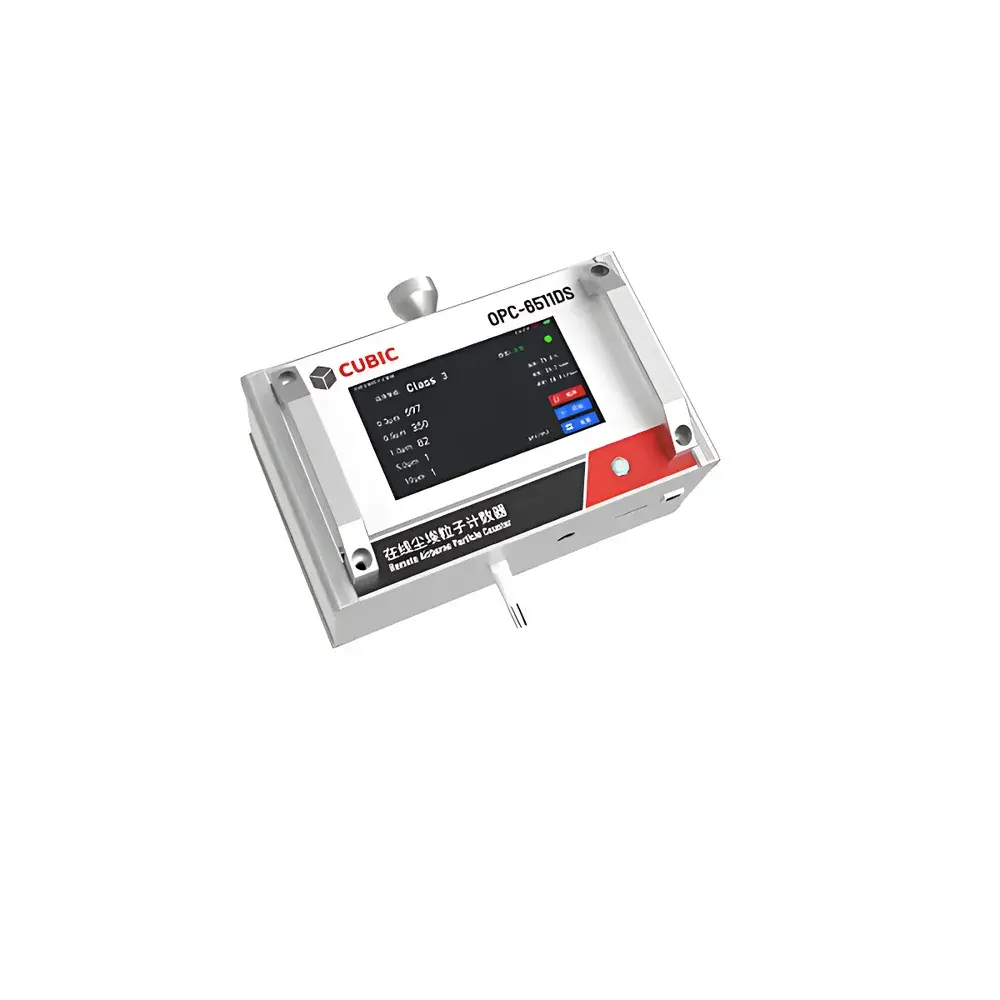
Cubic OPC-6511DS Portable Optical Particle Counter
| Brand | Cubic |
|---|---|
| Origin | Hubei, China |
| Model | OPC-6511DS |
| Instrument Type | Handheld |
| Flow Rate | 28.3 L/min |
| Counting Channels | 0.3 µm, 0.5 µm, 1.0 µm, 5.0 µm, 10.0 µm |
| Counting Efficiency | 50% @ 0.3 µm, 100% @ ≥0.5 µm (25±2°C, 50±10% RH) |
| Measurement Range | 0–1,000,000 pcs/28.3 L |
| Display | 7-inch color TFT LCD |
| Power Supply | DC 24.0 V ±15% |
| Battery Standby Duration | >5 h (2 min active / 28 min sleep cycle) |
| Communication Interfaces | RS485 (standard), RJ45 Ethernet (standard) |
| Compliance | JJF 1190–2008 |
| Warm-up Time | ≤8 s |
| Data Refresh Interval | 1 s |
| Operating Temperature | 0–45°C |
| Operating Humidity | 0–95% RH (non-condensing) |
| Storage Conditions | −20–60°C, 0–95% RH (non-condensing) |
| Sampling Probe | Isokinetic, external tube ID φ10 mm, max length 3 m |
| Lifetime | ≥3 years |
| Unit Options | pcs/28.3 L or pcs/m³ (switchable) |
| Protocol Support | TCP/IP, MQTT |
| Calibration Support | Standard source coefficient correction |
| Language Interface | English / Chinese toggle |
Overview
The Cubic OPC-6511DS Portable Optical Particle Counter is a handheld, high-flow aerosol monitoring instrument engineered for precision particle concentration measurement in dynamic environmental and controlled industrial settings. It operates on the principle of single-particle light scattering—where airborne particles pass through a focused laser beam, generating scattered light pulses proportional to their size. These pulses are detected by a high-sensitivity photodiode array and classified into five discrete size channels: 0.3 µm, 0.5 µm, 1.0 µm, 5.0 µm, and 10.0 µm. With a nominal sampling flow rate of 28.3 L/min—the industry-standard volumetric rate for cleanroom qualification—the OPC-6511DS delivers statistically robust particle counts per unit volume (default: pcs/28.3 L, convertible to pcs/m³). Its optical architecture incorporates an industrial-grade laser diode and proprietary dust-source intelligent recognition algorithms developed by Cubic Photonics, enabling reliable discrimination between true particulates and optical noise from humidity, condensate, or surface reflections. The device meets metrological requirements defined in JJF 1190–2008, China’s national verification regulation for airborne particle counters, ensuring traceable performance in field-deployed applications.
Key Features
- High-flow sampling at 28.3 L/min for rapid statistical convergence in low-concentration environments
- Five simultaneous counting channels with NIST-traceable sizing thresholds and verified counting efficiency (50% @ 0.3 µm; ≥100% @ ≥0.5 µm under standard lab conditions)
- Integrated isokinetic sampling probe with standardized 10 mm ID tubing interface (up to 3 m length) for representative spatial sampling
- 7-inch full-color TFT display supporting real-time channel-specific particle counts, ISO cleanliness classification (e.g., ISO 14644-1), and configurable alarm thresholds
- Dual communication architecture: isolated RS485 for industrial serial integration and RJ45 Ethernet port supporting TCP/IP and MQTT protocols for cloud-connected monitoring systems
- Field-adjustable duty cycling (default 2-min active / 28-min sleep) to extend battery runtime beyond 5 hours on a single charge
- On-device calibration support via standard aerosol reference sources, including user-accessible coefficient correction for long-term drift compensation
- Operating range certified from 0°C to 45°C and up to 95% RH (non-condensing), validated for use in pharmaceutical cleanrooms, battery dry rooms, and semiconductor fabrication support zones
Sample Compatibility & Compliance
The OPC-6511DS is designed for ambient and process air monitoring where representative sampling of polydisperse aerosols is required. It accommodates both indoor and outdoor atmospheric particulates—including combustion-derived soot, metallic wear debris, polymer microfibrils, and hygroscopic salts—provided relative humidity remains below condensation thresholds. Its optical design minimizes coincidence error at concentrations up to 1×10⁶ pcs/28.3 L, making it suitable for ISO Class 5–8 cleanroom verification per ISO 14644-1:2015. While not intrinsically rated for hazardous area deployment (e.g., ATEX or IECEx), the instrument complies with JJF 1190–2008 for verification, and its firmware architecture supports audit-ready data logging aligned with GLP/GMP principles. Though not FDA 21 CFR Part 11–certified out-of-the-box, raw data export (CSV/JSON) and timestamped event logs enable integration into validated electronic record systems when deployed with appropriate SOPs and metadata governance.
Software & Data Management
Data acquisition and configuration are managed locally via the embedded GUI or remotely via Ethernet. The device generates time-stamped particle count records at 1-second intervals, storing up to 10,000 measurement cycles internally. Export formats include comma-separated values (CSV) with headers indicating channel, timestamp, temperature, humidity, flow status, and unit mode. MQTT payloads transmit real-time channel data with QoS Level 1 reliability, supporting edge-to-cloud architectures compliant with IIoT frameworks. Firmware updates are performed via USB or network-initiated secure download. All configuration changes—including alarm setpoints, display language (English/Chinese), and unit selection—are logged with user ID and timestamp, forming a basic audit trail. Optional PC-based software (Cubic AirView Suite) provides trend analysis, map-based multi-node visualization, and automated ISO class reporting—fully compatible with Microsoft Windows 10/11 and macOS 12+.
Applications
The OPC-6511DS serves critical roles across regulated and high-precision sectors. In pharmaceutical manufacturing, it supports routine monitoring of Grade A/B/C/D cleanrooms during equipment qualification, personnel gowning validation, and post-maintenance recovery testing. Within lithium-ion battery production, it verifies dry room integrity (<1% RH environments) by detecting micron-scale metal oxide particulates shed during electrode slitting and stacking. In microelectronics R&D labs, it characterizes filter efficiency of ULPA systems and identifies contamination sources during wafer handling. Environmental health & safety teams deploy it for occupational exposure assessment near grinding, welding, or powder processing stations—comparing measured concentrations against OSHA PELs or ACGIH TLVs. Educational institutions utilize its intuitive interface and modular data output for teaching aerosol physics, metrology fundamentals, and sensor network design.
FAQ
What is the minimum detectable particle size and its associated counting efficiency?
The OPC-6511DS achieves 50% counting efficiency at 0.3 µm and ≥98% efficiency at 0.5 µm under standard calibration conditions (25±2°C, 50±10% RH).
Does the instrument require annual recalibration?
Per JJF 1190–2008, verification is recommended before each critical measurement campaign; full recalibration by an accredited lab is advised annually or after physical shock, optical contamination, or firmware update.
Can the OPC-6511DS be integrated into a Building Management System (BMS)?
Yes—via Modbus RTU over RS485 or custom JSON-over-TCP endpoints accessible through the RJ45 Ethernet port.
Is the sampling probe suitable for duct-mounted installation?
The isokinetic probe is intended for handheld or tripod-mounted use; for permanent duct integration, Cubic offers optional remote sampling manifolds with flow-controlled bypass modules.
How does the device handle high-humidity environments?
The optical chamber includes thermal stabilization and anti-condensation coating; however, operation above 95% RH (non-condensing) is not supported, and inlet filtration is recommended in fog-prone locations.
Related Products







