
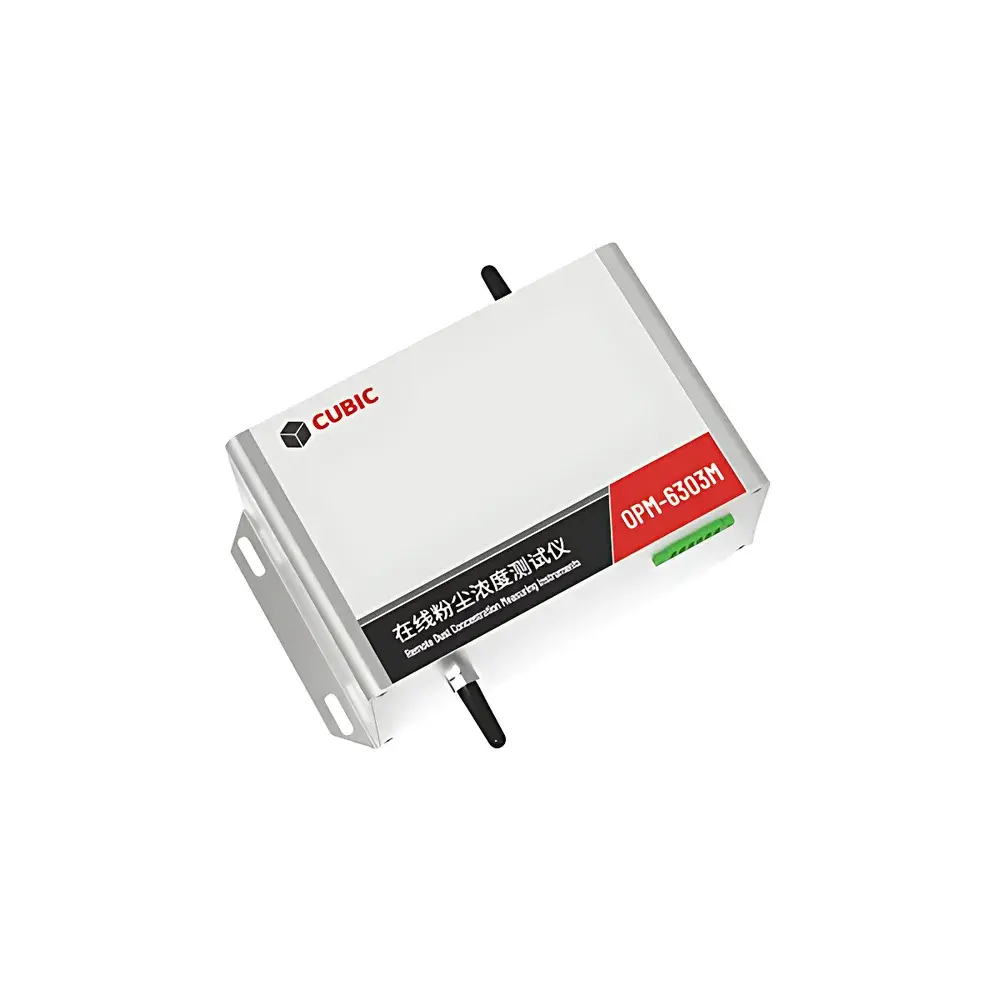
Cubic OPM-6303M Online Dust Concentration Monitor
| Brand | Cubic |
|---|---|
| Origin | Hubei, China |
| Model | OPM-6303M |
| Measurement Principle | Optical Light Scattering |
| Safety Rating | Non-Explosion-Proof |
| Measurement Range | 0–30 mg/m³ |
| PM₁.₀/PM₂.₅ Accuracy | ±10 µg/m³ (≤100 µg/m³), ±10% of reading (100–1000 µg/m³) |
| PM₁₀ Accuracy | ±15 µg/m³ (≤100 µg/m³), ±15% of reading (100–1000 µg/m³) |
| TSP Accuracy | ±20 µg/m³ (≤100 µg/m³), ±20% of reading (100–1000 µg/m³) |
| Warm-up Time | ≤8 s |
| Data Update Interval | 1 s |
| Operating Temperature | −30 to +70 °C |
| Relative Humidity | 0–95% RH (non-condensing) |
| Storage Temperature | −40 to +85 °C |
| Power Supply | DC 12 V |
| Average Current Draw | ≤4.5 A |
| Communication Interface | RS485 |
| Sampling Flow Rate | 1 L/min (standard, customizable) |
Overview
The Cubic OPM-6303M Online Dust Concentration Monitor is an industrial-grade particulate matter (PM) sensor engineered for continuous, real-time measurement of airborne suspended particles in ambient and process environments. Based on the principle of forward-scattered laser light detection, the instrument quantifies particle number concentration across multiple aerodynamic size fractions—PM1.0, PM2.5, PM10, and total suspended particulates (TSP)—and converts these counts into mass concentration values (µg/m³ or mg/m³) using calibrated Mie scattering algorithms. Its optical architecture integrates a high-stability industrial laser diode and a precisely aligned photodetector array, enabling reproducible signal acquisition under variable environmental conditions. The device is designed for fixed-site deployment in municipal air quality networks, industrial stack monitoring, cleanroom validation, and occupational health surveillance applications where regulatory compliance and long-term data integrity are critical.
Key Features
- Proprietary dust source intelligent identification algorithm—dynamically discriminates between anthropogenic, mineral, and biological aerosol sources based on multi-channel scattering signature analysis
- Constant-flow sampling system with precision mass flow control, maintaining stable 1 L/min volumetric flow rate (±2% tolerance) across pressure and temperature fluctuations
- Real-time output of four standardized PM metrics—PM1.0, PM2.5, PM10, and TSP—with data refreshed every second for responsive trend analysis and alarm triggering
- Extended operational envelope: functional across −30 °C to +70 °C and 0–95% RH (non-condensing), validated for outdoor cabinet mounting and unheated industrial enclosures
- Rapid thermal stabilization: achieves optical and electronic equilibrium within ≤8 seconds after power-on, minimizing downtime during scheduled maintenance or restart cycles
- RS485 Modbus RTU interface compliant with IEC 61158 and compatible with SCADA, DCS, and building management systems without protocol translation hardware
Sample Compatibility & Compliance
The OPM-6303M is optimized for ambient air, flue gas (post-dust removal), and indoor ventilation streams containing non-corrosive, non-oily, and non-fibrous particulates. It is not rated for explosive atmospheres (ATEX/IECEx Zone 0–2 or Class I/II Div 1) and requires upstream filtration when deployed in high-humidity or oil-laden exhaust streams to prevent optical window fouling. While not certified to ISO 12103-1 or EN 12341 for reference method equivalence, its calibration traceability follows a documented chain to Wuhan National Reference Station standards, supporting local equivalency verification per regional environmental authority protocols. For GLP/GMP-regulated environments, the device supports time-stamped data logging and can be integrated into audit-trail-capable platforms meeting FDA 21 CFR Part 11 requirements when paired with compliant host software.
Software & Data Management
Data output is delivered via ASCII-formatted Modbus registers, including instantaneous PM concentrations, internal temperature/humidity readings, laser intensity diagnostics, and flow status flags. Optional firmware upgrades enable configurable averaging windows (1–60 s), user-defined alarm thresholds per PM fraction, and event-triggered data snapshots. When interfaced with Cubic’s cloud-based AirSight™ platform—or third-party IoT middleware—the unit supports remote configuration, over-the-air firmware updates, and automated calibration coefficient adjustment based on co-located reference monitor drift trends. All timestamped records include UTC synchronization support via external NTP server integration.
Applications
- Municipal ambient air quality monitoring networks requiring continuous PM reporting to national databases (e.g., CNEMC, EPA AirNow)
- Industrial emissions compliance tracking at cement plants, steel mills, and thermal power stations—particularly for post-ESP or post-baghouse stack verification
- Indoor air quality (IAQ) assessment in hospitals, laboratories, and semiconductor fabrication facilities where PM1.0 and ultrafine particle exposure must be quantified
- Construction site boundary monitoring per local dust suppression ordinances, with automated SMS/email alerts upon threshold exceedance
- Research-grade longitudinal studies of aerosol dynamics, including hygroscopic growth effects and seasonal particle composition shifts
FAQ
Is the OPM-6303M suitable for use in explosive or hazardous areas?
No. The device carries a non-explosion-proof safety rating and must not be installed in classified hazardous locations without additional certified barrier systems or zone-specific enclosures.
How is calibration maintained over time?
The instrument supports field calibration using NIST-traceable polystyrene latex (PSL) microsphere aerosols and includes built-in zero-check functionality. Long-term stability is verified against co-located beta attenuation monitors (BAM) or tapered element oscillating microbalances (TEOM) per local regulatory guidance.
Can the sampling flow rate be adjusted?
Yes. The default 1 L/min flow is configurable via firmware update; custom flow rates from 0.5 to 2.0 L/min are supported subject to mechanical and thermal validation by Cubic Engineering.
Does the device meet U.S. EPA or EU EN 12341 requirements for regulatory reporting?
It is not designated as a Federal Reference Method (FRM) or Federal Equivalent Method (FEM) device. However, it may serve as a supplementary or indicative monitor when deployed alongside FRM/FEM systems in networked monitoring strategies.
What environmental conditions affect measurement accuracy?
High relative humidity (>80% RH) may induce particle hygroscopic swelling, leading to size-class misallocation. Users should apply region-specific correction coefficients derived from concurrent gravimetric filter analysis, particularly in coastal or monsoonal climates.







