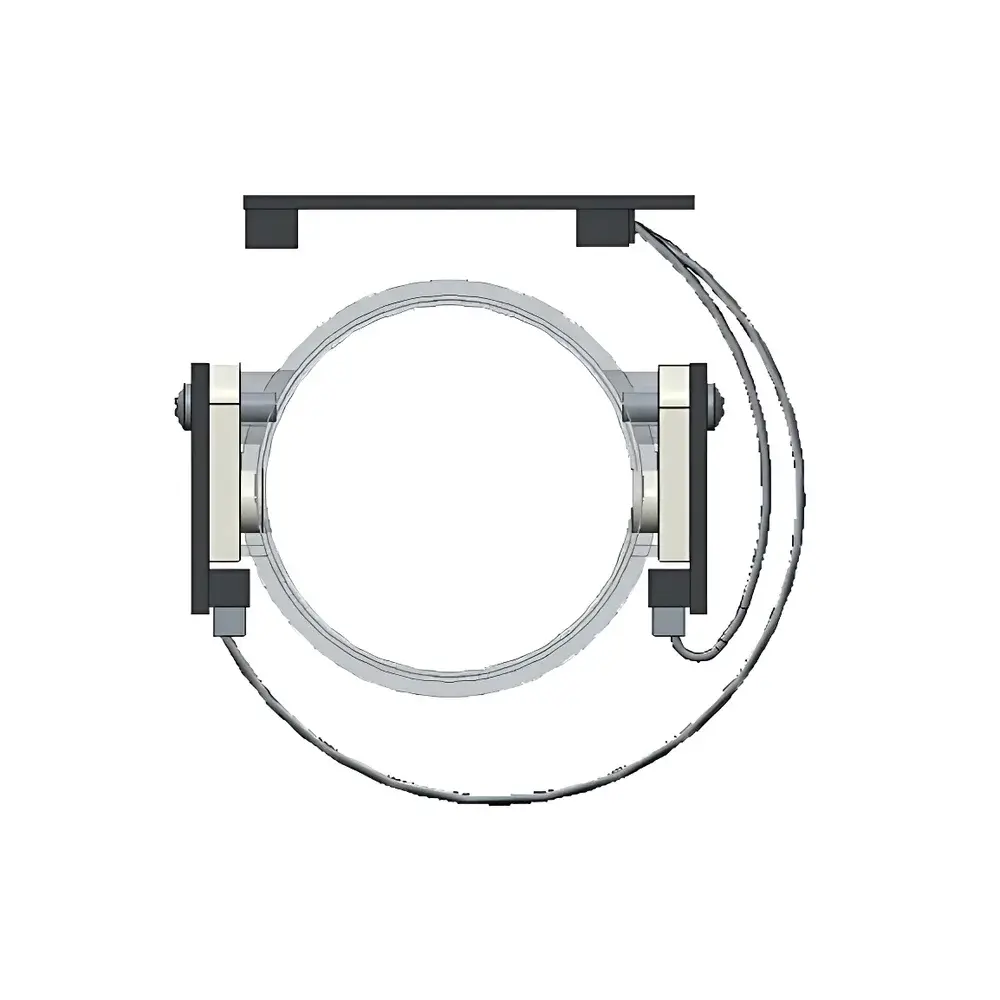
Cubic PM1009 Turbidity Sensor
| Brand | Cubic |
|---|---|
| Origin | Hubei, China |
| Manufacturer Type | Authorized Distributor |
| Country of Origin | China |
| Model | PM1009 |
| Pricing | Available Upon Request |
| Detection Principle | Optical Transmission (Opposed-Beam) |
| Warm-up Time | 1 s |
| Operating Temperature | −10 °C to +60 °C |
| Operating Humidity | ≤95% RH (non-condensing) |
| Storage Temperature | −20 °C to +80 °C |
| Supply Voltage | DC 5.0 V ± 0.25 V (Ripple < 50 mV) |
| Operating Current | < 60 mA |
| Output Signal | PWM (3.3 V logic level) |
| Response Time | < 200 ms |
| Dimensions (PCBA only) | 43 mm × 25 mm × 5 mm (W × H × D) |
Overview
The Cubic PM1009 Turbidity Sensor is an OEM-grade optical transmission sensor engineered for real-time particulate matter (PM) concentration monitoring in compact consumer and industrial vacuum airflow systems. Unlike scattering-based turbidity sensors, the PM1009 employs a precisely aligned opposed-beam optical architecture—comprising a high-stability infrared LED emitter and a matched photodiode receiver—enabling robust quantification of airborne dust load via attenuation measurement. This principle ensures immunity to surface contamination on optical windows, eliminating signal drift caused by dust accumulation on sensing surfaces—a common failure mode in reflective or single-ended optical sensors. Designed for integration into constrained mechanical envelopes, the PM1009 delivers deterministic, low-latency feedback (<200 ms response) essential for closed-loop suction control, filter life estimation, and adaptive cleaning logic in intelligent floor care appliances.
Key Features
- Optical transmission (opposed-beam) detection architecture for high long-term stability and minimal zero-point drift
- Sub-200 ms dynamic response time, enabling real-time airflow contamination tracking during active suction cycles
- Integrated analog-to-PWM signal conversion with 3.3 V logic-compatible output—eliminates need for external ADC or signal conditioning
- Compact PCBA form factor (43 × 25 × 5 mm) with standardized mounting footprint for seamless integration into handheld vacuum handles, extension tubes, robotic vacuum ducts, and wet-dry cleaning platforms
- Low-power operation: <60 mA at 5.0 V DC with ripple tolerance <50 mV—compatible with battery-powered and USB-powered subsystems
- Full operational specification validated across −10 °C to +60 °C and ≤95% RH (non-condensing), supporting deployment in diverse environmental conditions including high-humidity indoor environments
Sample Compatibility & Compliance
The PM1009 is optimized for gaseous sample streams containing respirable particulates typical of household dust—primarily silica, textile fibers, skin flakes, and pollen—with effective sensitivity across the 0.5–10 µm aerodynamic diameter range. Its optical path length and wavelength selection (typically 850 nm IR) provide balanced sensitivity to both coarse and fine fraction particles without requiring calibration against reference aerosols. While not certified to ISO 29463 or EN 1822 for filter testing, the sensor meets functional requirements for embedded air quality feedback in CE-marked domestic appliances. It supports design compliance with IEC 60335-1 (Household Appliance Safety) and IEC 61000-6-3 (EMC Emission Limits) when integrated per manufacturer’s layout guidelines. No hazardous substances are used in construction; RoHS 3 and REACH-compliant materials are employed throughout.
Software & Data Management
The PM1009 outputs a duty-cycle-modulated PWM signal (fixed frequency, variable duty cycle proportional to particle loading), enabling direct interface with microcontrollers (e.g., ARM Cortex-M0+, ESP32, PIC16F) without external signal conditioning. The PWM period is factory-set to 10 ms (100 Hz), with 0–100% duty cycle mapping linearly to relative turbidity levels—calibration coefficients are provided in the OEM datasheet for traceable conversion to engineering units (e.g., mg/m³ equivalent under controlled flow). Firmware-level integration supports timestamped data logging, moving-average filtering, and threshold-triggered events (e.g., “filter clog warning”). For regulatory traceability in GMP-aligned manufacturing environments, system-level software may implement audit trails and configuration lock-down per FDA 21 CFR Part 11 principles—though the sensor itself operates as a passive transducer with no onboard memory or firmware.
Applications
- Smart vacuum cleaners: Real-time suction power modulation based on inlet dust load
- Robotic floor scrubbers and mop-vacuum hybrids: Adaptive dirt detection to prioritize high-contamination zones
- Central vacuum systems: Remote monitoring of duct-line particulate accumulation
- Industrial handheld vacuums for workshop or automotive use: Operator feedback on filtration efficiency and maintenance scheduling
- OEM development platforms for UL/ETL-certified cleaning equipment requiring embedded air quality awareness
FAQ
Is the PM1009 calibrated against NIST-traceable aerosol standards?
No—the PM1009 is supplied as a relative turbidity transducer. Absolute mass concentration calibration requires system-level characterization using polydisperse test dust (e.g., Arizona Road Dust, A2) under controlled volumetric flow.
Can the sensor be used in high-temperature environments such as near motor exhaust?
No—it is rated for continuous operation up to +60 °C ambient. Prolonged exposure above this threshold risks LED output degradation and photodiode responsivity shift.
Does the PWM output require pull-up or pull-down resistors?
Yes—a 10 kΩ pull-up resistor to 3.3 V is recommended on the PWM output line to ensure clean logic transitions under capacitive loading.
Is condensation inside the optical channel a concern during high-humidity operation?
The sensor is rated for ≤95% RH non-condensing conditions. Internal optical surfaces are not heated or coated; condensation must be prevented via system-level enclosure design and airflow management.
What is the expected lifetime under continuous operation?
Based on accelerated life testing at 50 °C and 85% RH, the LED emitter maintains >90% initial intensity after 25,000 hours; photodiode degradation is negligible within the specified operating envelope.