
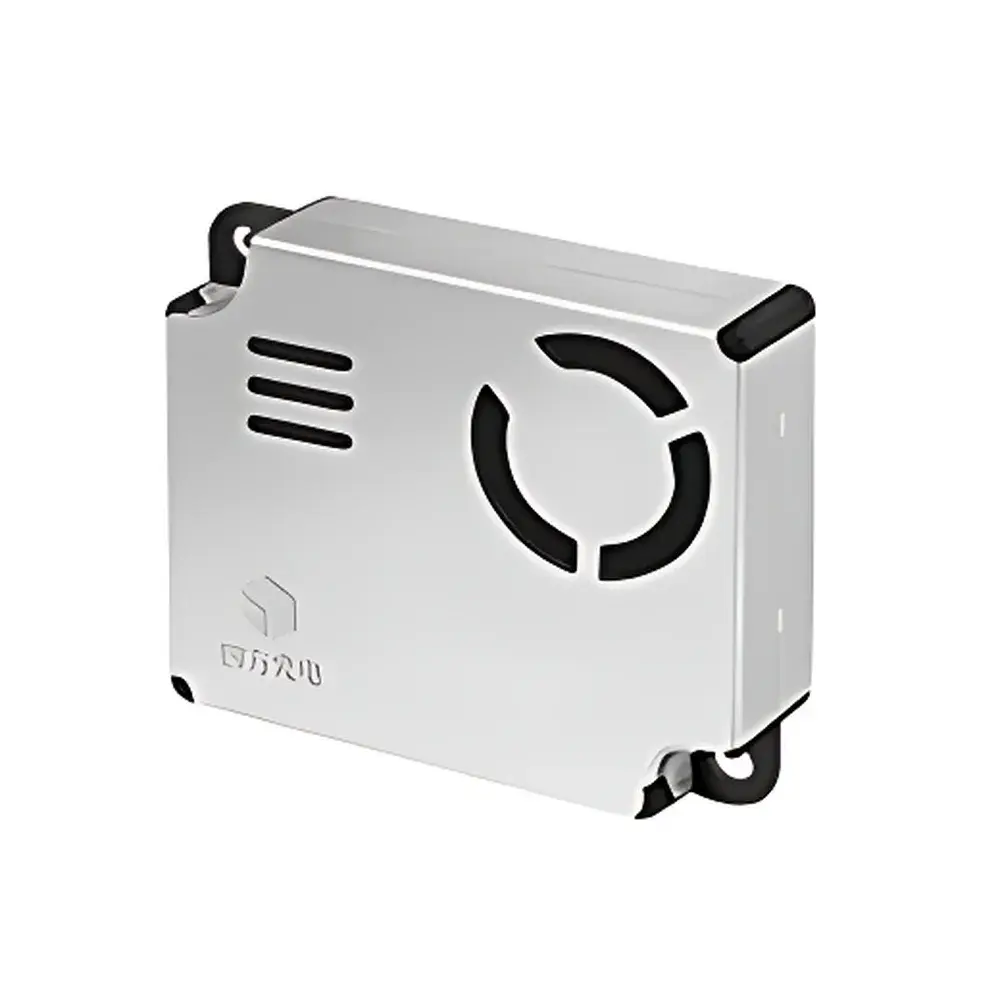
Cubic PM2008MSE Laser-Based Particulate Matter Sensor
| Brand | Cubic |
|---|---|
| Origin | Hubei, China |
| Model | PM2008MSE |
| Detection Principle | Optical Scattering (Laser Nephelometry) |
| Measurement Range | 0–1000 µg/m³ (PM1.0, PM2.5, PM10) |
| Resolution | 0.3 µm |
| Accuracy (PM2.5) | ±10 µg/m³ (≤100 µg/m³), ±10% of reading (>100 µg/m³) |
| Accuracy (PM10) | ±20 µg/m³ (≤100 µg/m³), ±20% of reading (>100 µg/m³) |
| Data Update Interval | 1 s |
| Warm-up Time | ≤8 s |
| Operating Temperature | −10 to +50 °C |
| Relative Humidity | 0–95% RH (non-condensing) |
| Storage Conditions | −20 to +60 °C, 0–95% RH |
| Supply Voltage | DC 5 V ±0.1 V (ripple <50 mV) |
| Operating Current | ≤100 mA |
| Standby Current | ≤200 µA |
| Interface | UART (3.3 V logic), I²C (3.3 V logic) |
| Dimensions | 48 × 40 × 12 mm (W × H × D) |
| Shielding | Full-metal EMI enclosure |
| Design | Ultra-thin profile (12 mm height) |
Overview
The Cubic PM2008MSE is a compact, high-performance laser-based particulate matter (PM) sensor engineered for reliable real-time monitoring of airborne aerosols in indoor air quality (IAQ), HVAC control, smart home appliances, and portable environmental monitors. It operates on the principle of laser nephelometry—where a collimated 650 nm diode laser illuminates suspended particles within a precisely defined sampling chamber, and a high-sensitivity photodiode detects forward-scattered light intensity. This optical signal is converted into particle count data across multiple size bins via proprietary Mie scattering inversion algorithms, enabling simultaneous derivation of mass concentration equivalents for PM1.0, PM2.5, and PM10 fractions. Unlike passive or passive-filter-based methods, the PM2008MSE employs active, constant-flow sampling with an integrated brushless micro-fan, ensuring consistent volumetric throughput and minimizing flow-induced measurement drift. Its fully metallic electromagnetic interference (EMI) shield minimizes susceptibility to electrical noise from adjacent electronics—a critical requirement for integration into consumer-grade devices operating in electrically dense environments.
Key Features
- Ultra-thin mechanical profile (12 mm height) optimized for space-constrained OEM integrations including air purifiers, thermostats, and wearable IAQ loggers.
- Full-metal EMI shielding ensures stable operation in high-noise industrial or residential settings compliant with IEC 61000-4-3 (radiated immunity) and IEC 61000-4-6 (conducted immunity) test conditions.
- Dual digital interfaces—UART (TTL 3.3 V) and I²C (3.3 V)—support flexible host system architecture and enable seamless firmware updates and configuration via standard embedded protocols.
- Calibration traceable to NIST-traceable reference aerosols (e.g., PSL, Arizona Test Dust) under controlled laboratory conditions (25 ±2 °C, 50 ±10% RH), supporting reproducible performance across production batches.
- Low power consumption: ≤100 mA active current and ≤200 µA standby mode, compatible with battery-powered edge nodes and energy-conscious IoT deployments.
- Rapid thermal stabilization (<8 s warm-up time) enables immediate deployment upon power-on without extended settling delays.
Sample Compatibility & Compliance
The PM2008MSE is validated for ambient and recirculated air streams containing typical urban and indoor aerosols—including combustion-derived soot, road dust, pollen fragments, and secondary organic aerosols. It does not require consumables or periodic filter replacement. While not certified as a regulatory-grade reference instrument per ISO 12103-1 or EN 12341, its output aligns with EPA and WHO PM2.5/PM10 reporting conventions when deployed in static, well-mixed environments. The sensor’s housing meets UL 94 V-0 flammability rating, and its PCB layout adheres to IPC-2221B design standards. For GMP or GLP-aligned applications, raw scatter data can be logged alongside timestamped environmental metadata (temperature, humidity) to support audit-ready traceability.
Software & Data Management
The sensor outputs structured ASCII frames via UART or binary packets over I²C, containing synchronized PM1.0, PM2.5, and PM10 mass concentrations (µg/m³), particle count per 0.1 L, and diagnostic flags (e.g., fan status, laser health, saturation warning). Cubic provides open-source C/C++ driver libraries for ARM Cortex-M and ESP32 platforms, along with Python utilities for PC-based validation and calibration logging. All firmware supports Over-The-Air (OTA) updates via signed binary payloads, meeting basic cybersecurity hygiene requirements for field-deployed sensors. Data integrity is preserved through cyclic redundancy check (CRC-8) on all communication channels. While the device itself does not implement FDA 21 CFR Part 11 electronic signature controls, its deterministic output format facilitates integration into validated software ecosystems that do.
Applications
- Real-time feedback control in residential and commercial air purification systems.
- Embedded air quality awareness in smart thermostats, ceiling-mounted occupancy sensors, and building automation controllers (BACnet/IP, Modbus RTU).
- Portable personal exposure monitors used in occupational health studies and citizen science campaigns.
- Edge-node input for AI-driven predictive maintenance of HVAC filters based on cumulative PM loading trends.
- Environmental education kits and university lab instrumentation for aerosol physics coursework.
FAQ
What is the minimum detectable particle size?
The PM2008MSE achieves 50% counting efficiency at 0.3 µm under standardized test conditions using monodisperse polystyrene latex (PSL) spheres.
Does the sensor require zero-point calibration in the field?
No. The device performs automatic baseline compensation during idle periods and does not rely on user-initiated zeroing; however, long-term drift mitigation is supported via scheduled factory recalibration every 12–18 months.
Can it operate reliably in high-humidity environments?
Yes—tested up to 95% RH non-condensing. Condensation on optical surfaces is prevented by internal thermal management and hydrophobic lens coating.
Is analog output available?
No. The PM2008MSE provides digital-only output via UART or I²C to ensure noise-immune signal transmission and eliminate ADC-related quantization errors.
How is traceability maintained across manufacturing lots?
Each unit undergoes individual optical alignment verification and multi-point aerosol calibration against primary reference instruments calibrated to NIST SRM 1691 and ISO 2591-1 protocols.







