
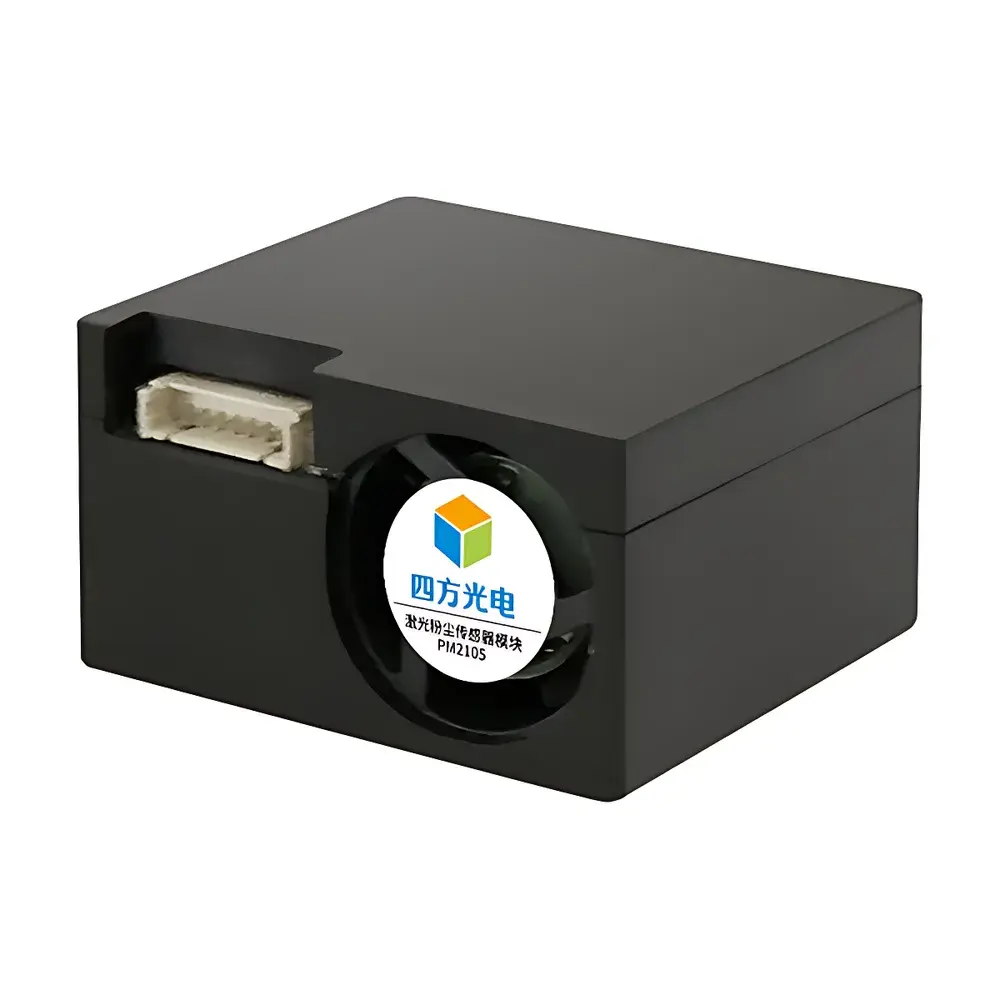
Cubic PM2105 Laser-Based Particulate Matter Sensor Module
| Brand | Cubic |
|---|---|
| Origin | Hubei, China |
| Manufacturer Type | Authorized Distributor |
| Origin Category | Domestic (China) |
| Model | PM2105 |
| Pricing | Available Upon Request |
| Detection Principle | Laser Light Scattering |
| PM2.5 Range | 0–1000 µg/m³ |
| Warm-up Time | ≤8 s |
| Data Update Interval | 1 s |
| Accuracy | ±15 µg/m³ or ±15% of reading (at 25°C ±2°C, 50% RH ±10%, referenced to TSI AM510/8530) |
| Operating Temperature | −10°C to +50°C |
| Operating Humidity | 5–95% RH (non-condensing) |
| Storage Conditions | −30°C to +60°C, 0–95% RH (non-condensing) |
| Supply Voltage | DC 5.0 V ±0.1 V (ripple <50 mV) |
| Operating Current | ≤100 mA |
| Standby Current | <20 mA |
| Output Interfaces | UART TTL (3.3 V), I²C (3.3 V / 5 V compatible), PWM (reserved) |
| Dimensions | 42 × 35 × 23.7 mm (W × H × D) |
Overview
The Cubic PM2105 is a compact, OEM-grade laser scattering particulate matter (PM) sensor module engineered for reliable real-time measurement of airborne PM2.5 mass concentration in indoor air quality (IAQ), HVAC control, smart home appliances, and portable environmental monitors. It operates on the principle of Mie light scattering: an integrated 650 nm laser diode illuminates aerosol particles drawn through the sensing chamber via dual-directional airflow (inlet and outlet on opposite sides), while a high-sensitivity photodiode detects scattered light intensity. A proprietary calibration algorithm—traceable to reference instruments such as the TSI SidePak AM510 and 8530—converts raw scattering signals into gravimetric PM2.5 concentration values (µg/m³) with metrological consistency across varying particle composition and humidity conditions. The module features a sealed optical path with internal electromagnetic shielding to suppress ambient light interference and EMI, ensuring stable performance in electrically noisy environments.
Key Features
- Optimized dual-port airflow design enabling laminar, low-turbulence particle sampling without external fans
- Fast thermal stabilization: full operational readiness within ≤8 seconds after power-on
- High temporal resolution: 1 Hz data output rate supports responsive feedback loops in closed-loop IAQ systems
- Multi-mode operation: configurable for continuous monitoring, single-shot acquisition, scheduled interval sampling, or dynamic trigger-based measurement
- Onboard alert logic: programmable threshold-based digital alarm output simplifies integration into safety-critical or maintenance-alert applications
- Low-power architecture: <20 mA standby current enables battery-operated deployment in edge-sensing nodes
- Flexible digital interfacing: native support for UART TTL (3.3 V logic), I²C (3.3 V / 5 V tolerant), and reserved PWM pin for pulse-density modulation output
Sample Compatibility & Compliance
The PM2105 is validated for use with ambient and recirculated air containing typical urban and indoor aerosols—including combustion-derived soot, dust, pollen, and secondary organic aerosols—with effective detection down to ~0.3 µm aerodynamic diameter. Its calibration protocol follows ISO 29463-3:2017 principles for filter-based reference equivalence and has been verified against gravimetric and beta-attenuation methods under controlled laboratory conditions per EN 12341:2014 Annex B. While not certified as a regulatory-grade reference monitor, the module meets functional requirements for indicative PM2.5 monitoring under WHO Air Quality Guidelines and EU Directive 2008/50/EC Annex XI for indicative measurement methods. No hazardous substances are used in construction; RoHS 2011/65/EU and REACH SVHC compliance is documented in the manufacturer’s Declaration of Conformity.
Software & Data Management
The PM2105 communicates via ASCII command protocol over UART or register-mapped access over I²C, allowing seamless integration with embedded Linux, FreeRTOS, or Arduino-based host controllers. Cubic provides open-source driver libraries (C/C++, Python) and a Windows-based configuration utility for firmware updates, offset calibration, and alarm threshold programming. All data transmissions include CRC-8 checksums to ensure integrity. When deployed in networked systems, the sensor supports time-stamped payload formatting compatible with MQTT and Modbus RTU protocols—enabling traceability in GLP-aligned field deployments. Audit logs (e.g., error codes, self-test results, calibration timestamps) are retained in non-volatile memory and accessible via diagnostic commands, satisfying basic FDA 21 CFR Part 11 data integrity expectations for non-clinical environmental monitoring.
Applications
- Smart air purifiers and HVAC demand-controlled ventilation systems
- Portable personal air quality monitors and wearable exposure trackers
- Building management systems (BMS) for occupancy-responsive IAQ optimization
- Industrial hygiene stations in light manufacturing and office environments
- Educational kits and university lab experiments on aerosol physics and environmental sensing
- Edge-node deployments in low-cost urban PM mapping networks
FAQ
Is the PM2105 suitable for outdoor ambient air monitoring?
It is designed primarily for indoor or semi-enclosed environments. Prolonged outdoor exposure without environmental housing may compromise long-term stability due to condensation, UV degradation, and particulate fouling.
Does the sensor require periodic recalibration?
Factory calibration is stable for ≥12 months under typical operating conditions. Field recalibration is supported using NIST-traceable aerosol generators or co-location with reference monitors per ISO 12103-1 A2 test dust protocols.
Can multiple PM2105 modules be daisy-chained on one I²C bus?
Yes—each unit supports configurable I²C slave address (default 0x12), enabling up to 8 sensors on a single bus with proper pull-up resistor sizing.
What is the expected lifetime under continuous operation?
Rated for >20,000 hours MTBF at 25°C and 50% RH, assuming clean-air inlet filtration and avoidance of high-humidity condensation cycles.
Is firmware update capability available over UART?
Yes—bootloader mode enables field firmware upgrades via UART using STMicroelectronics STM32 DFU protocol, with rollback support and version verification.







