
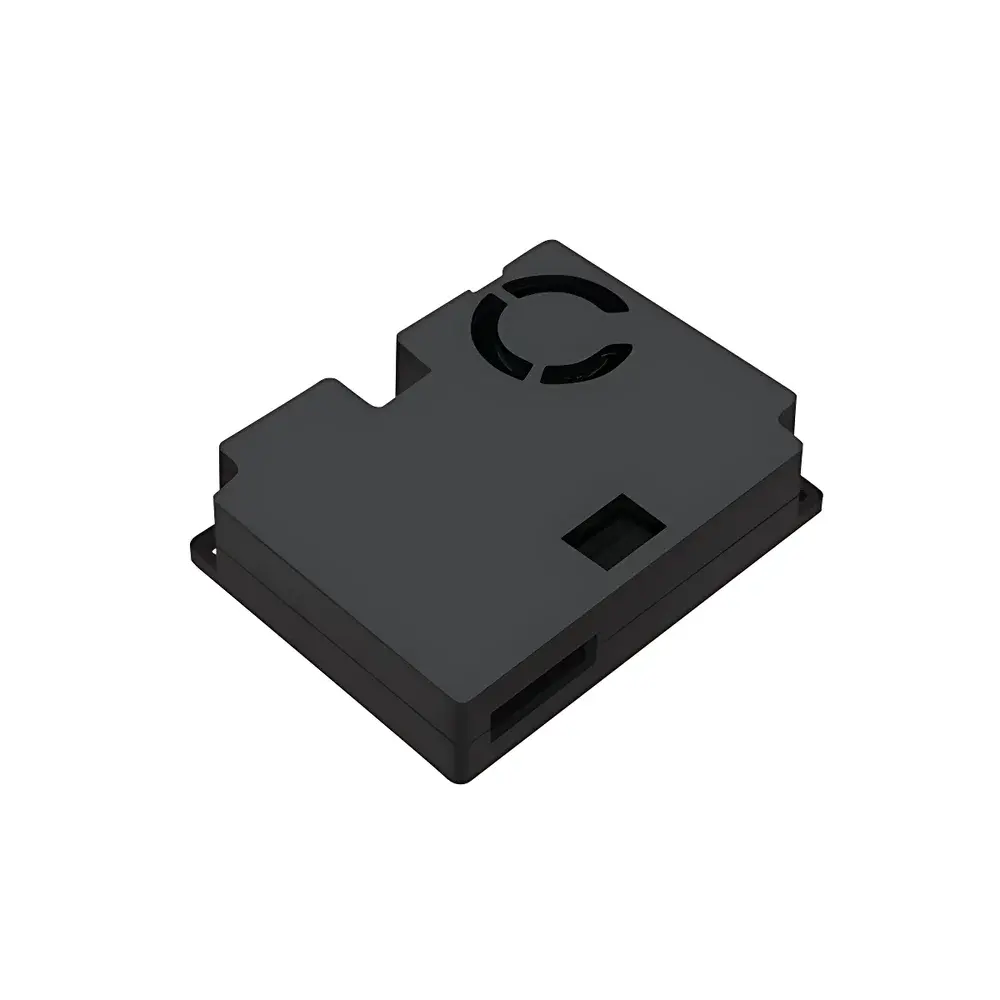
Cubic PM2107 Laser-Based Particulate Matter Sensor
| Brand | Cubic |
|---|---|
| Origin | Hubei, China |
| Manufacturer Type | Authorized Distributor |
| Regional Classification | Domestic (China) |
| Model | PM2107 |
| Pricing | Available Upon Request |
| Operating Principle | Laser Light Scattering |
| Measurement Range | 0–1000 µg/m³ |
| Accuracy | ±15 µg/m³ or ±15% of reading |
| Detection Principle | Laser Scattering |
| PM2.5 Range | 0–1000 µg/m³ |
| Power-On Stabilization Time | ≤8 s |
| Data Update Interval | 1 s |
| Environmental Conditions (Calibration) | 25°C ±2°C, 50% RH ±10%, referenced to TSI AM510/8530 |
| Operating Temperature | −10°C to +50°C |
| Operating Humidity | 5–95% RH (non-condensing) |
| Storage Temperature | −30°C to +60°C |
| Storage Humidity | 0–95% RH (non-condensing) |
| Supply Voltage | DC 5.0 V ±0.1 V, ripple <50 mV |
| Operating Current | ≤100 mA |
| Standby Current | <20 mA |
| Output Interfaces | UART TTL (3.3 V logic), PWM (default 5 V, 3.3 V configurable) |
| Dimensions | 58.7 mm (W) × 45 mm (H) × 13.9 mm (D) |
Overview
The Cubic PM2107 is a compact, OEM-grade laser scattering particulate matter sensor engineered for precise, real-time measurement of PM2.5 mass concentration in indoor air environments. It operates on the principle of Mie scattering: an integrated 650 nm laser diode illuminates airborne particles passing through a precisely defined optical sensing chamber; scattered light intensity is captured by a high-sensitivity photodiode and converted into particle concentration via factory-calibrated algorithms traceable to reference instruments including the TSI AM510 and 8530. Unlike passive infrared sensors, the PM2107 delivers quantitative digital output with superior signal-to-noise ratio and minimal cross-sensitivity to humidity-induced optical artifacts. Its design prioritizes metrological integrity under dynamic indoor conditions—enabling reliable integration into HVAC monitoring systems, smart air purifiers, IAQ dashboards, and building management platforms requiring continuous, low-power ambient particulate surveillance.
Key Features
- Drop-in mechanical and electrical compatibility with Cubic’s legacy PM1003 infrared sensor—no redesign of housing, mounting fixtures, or PCB layout required
- Dual-output interface support: UART TTL (3.3 V logic level) for high-resolution serial data streaming and PWM (configurable between 3.3 V and 5 V) for direct analog-like integration with microcontrollers lacking UART peripherals
- Integrated electromagnetic shielding enclosure minimizing susceptibility to EMI from nearby switching power supplies, motors, or RF sources
- Rapid thermal stabilization: full optical and electronic readiness achieved within ≤8 seconds after power application—critical for battery-powered or duty-cycled deployments
- Low-power architecture: typical operating current ≤100 mA at 5.0 V; standby current <20 mA—optimized for energy-constrained edge nodes
- Robust environmental tolerance: validated operation across −10°C to +50°C and 5–95% RH (non-condensing), supporting deployment in diverse climatic zones and uncontrolled indoor spaces
Sample Compatibility & Compliance
The PM2107 is optimized for aerosol sampling in non-explosive, non-corrosive indoor air environments. It does not require sample conditioning (e.g., heating, drying, or filtration) for standard residential, commercial, or light industrial applications. While not certified to IECEx or ATEX standards, its enclosure meets IP20 requirements per IEC 60529 for protection against solid objects ≥12.5 mm. The sensor complies with RoHS Directive 2011/65/EU and REACH Regulation (EC) No. 1907/2006. Calibration methodology aligns with ISO 29463-3:2017 (high-efficiency filters) and references gravimetric protocols outlined in EPA Method IO-4, enabling traceability for QA/QC workflows in non-regulatory IAQ monitoring contexts. Note: This device is not intended for occupational exposure assessment per OSHA or NIOSH guidelines nor for regulatory compliance reporting under EU Air Quality Directive 2008/50/EC without supplementary validation.
Software & Data Management
The PM2107 outputs time-stamped PM2.5 concentration values (µg/m³) at 1 Hz via UART, supporting ASCII-based command-response protocol for configuration (e.g., PWM mode selection, firmware version query). Raw UART packets include checksum validation (XOR-based) to ensure data integrity over noisy embedded links. For system-level traceability, integrators may log timestamps alongside readings to reconstruct temporal profiles compliant with GLP-aligned logging practices. While the sensor itself does not implement FDA 21 CFR Part 11 electronic signature or audit trail functionality, its deterministic output behavior and stable calibration drift (<2% per 6 months under nominal conditions) support inclusion in validated systems where external software handles audit logging, user access control, and data archiving.
Applications
- Real-time indoor air quality (IAQ) monitoring in smart thermostats, HVAC controllers, and energy recovery ventilators
- OEM integration into consumer air purifiers and portable air quality monitors requiring high-fidelity PM2.5 feedback
- Building automation systems (BAS) performing demand-controlled ventilation based on particulate load thresholds
- Educational and research platforms studying aerosol dynamics in controlled chambers or classroom environments
- Edge-node sensor networks for urban microclimate mapping where size, power, and cost constraints preclude use of benchtop beta attenuation or TEOM analyzers
FAQ
Is the PM2107 suitable for outdoor ambient air monitoring?
No. It is designed exclusively for indoor environments with stable temperature/humidity ranges and absence of rain, dust ingress, or extreme UV exposure. Outdoor deployment requires weatherproof enclosures, inlet heaters, and impactor-based size-selective sampling not provided by this module.
Does the sensor require periodic recalibration?
Factory calibration remains stable under normal operating conditions for up to six months. Field verification against a reference instrument (e.g., TSI SidePak AM510) is recommended quarterly in mission-critical installations.
Can the PM2107 distinguish between PM2.5 and PM10?
No. It is a single-channel PM2.5-optimized sensor. Its internal cut-point is fixed via physical inlet geometry and algorithmic post-processing calibrated to the PM2.5 aerodynamic diameter definition per ISO/CIE 12103-1 A2 dust.
What is the expected lifetime of the laser diode?
Rated for >25,000 hours of continuous operation at 25°C ambient, corresponding to approximately 3 years of 24/7 use. Lifetime decreases logarithmically with junction temperature rise above 40°C.







