
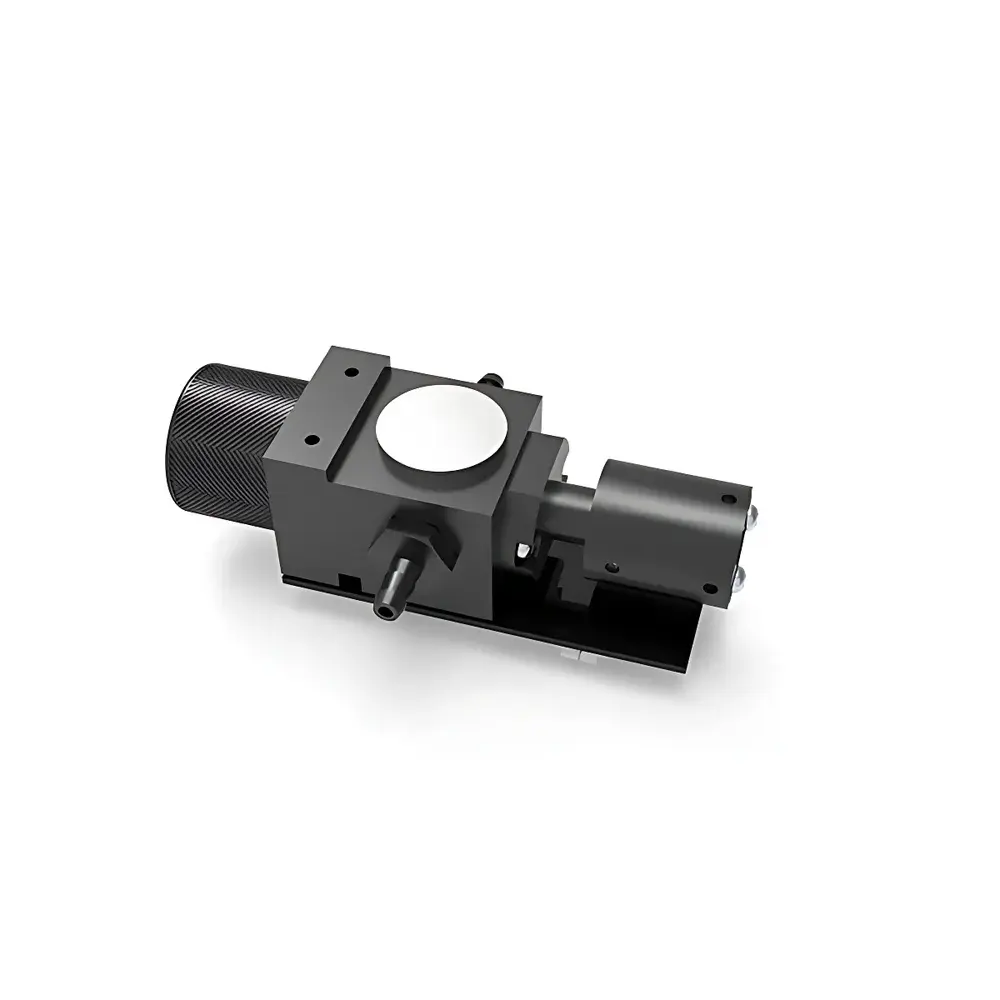
Cubic PM3003Q Laser-Based Dust Sensor Module
| Brand | Cubic |
|---|---|
| Origin | Hubei, China |
| Manufacturer Type | Authorized Distributor |
| Origin Category | Domestic (China) |
| Model | PM3003Q |
| Price | USD 630 (FOB) |
| Operating Principle | Laser Light Scattering |
| Safety Rating | Non-Explosive Atmosphere Rated |
| Measurement Range | 0–50 mg/m³ (max display: 1000 mg/m³) |
| Accuracy | ±200 µg/m³ for 0–1 mg/m³ |
| Detection Principle | Optical Scattering |
| Recommended Sample Flow Rate | 2 L/min |
| Data Update Interval | 1 s |
| Operating Temperature | 30–70 °C |
| Operating Humidity | 5–95% RH (non-condensing) |
| Storage Temperature | −40–85 °C |
| Storage Humidity | 0–95% RH (non-condensing) |
| Supply Voltage | DC 5 V ± 0.2 V (ripple < 100 mV) |
| Average Current Consumption | <150 mA |
| Standby Current | <25 mA |
| Interface | UART (TTL 3.3 V logic level) |
| Dimensions | 90.8 × 60.2 × 37.6 mm (W × H × D) |
Overview
The Cubic PM3003Q is a compact, OEM-grade laser scattering dust sensor module engineered for continuous, real-time measurement of airborne particulate mass concentrations. It operates on the principle of Mie scattering: an integrated industrial-class 650 nm laser diode illuminates aerosol particles drawn through a precisely defined optical chamber; scattered light intensity—proportional to particle size and concentration—is captured by a high-sensitivity photodetector array. Advanced signal processing algorithms, combined with Cubic’s proprietary dust source intelligent recognition algorithm, enable simultaneous quantification of PM₂.₅, PM₁₀, and total suspended particulates (TSP) mass concentrations in mg/m³. Designed for integration into environmental monitoring systems, the module delivers stable performance under variable ambient conditions without requiring manual calibration during typical field deployment.
Key Features
- Triple-parameter output: Concurrent real-time reporting of PM₂.₅, PM₁₀, and TSP mass concentrations
- Industrial-grade 650 nm laser source with extended lifetime (>20,000 h) and thermal drift compensation
- Anti-dust accumulation optical path design featuring laminar airflow control and hydrophobic lens coating
- Integrated constant-flow micro-pump (2.0 ± 0.1 L/min) with pressure-compensated feedback control
- Compact form factor (90.8 × 60.2 × 37.6 mm) optimized for embedded integration in space-constrained enclosures
- Low-power operation: <150 mA average current draw at 5 V DC; <25 mA standby mode for battery-powered deployments
- Digital UART interface (3.3 V TTL logic) supporting configurable baud rates up to 115.2 kbps for seamless host MCU integration
Sample Compatibility & Compliance
The PM3003Q is validated for use with ambient air, construction site emissions, urban roadside aerosols, and indoor HVAC return ducts. It is not intended for corrosive, explosive, or high-humidity condensing environments. While not certified to ATEX or IECEx standards, its non-explosive classification aligns with IEC 60079-0 general requirements for equipment used in non-hazardous locations. The sensor meets key metrological benchmarks referenced in ISO 29463-3 (high-efficiency filter testing), EN 12341 (ambient air quality — PM measurement), and US EPA EQPM-0604-190 (performance specification for PM₂.₅ continuous ambient air monitors). Accuracy specifications are traceable to NIST-traceable gravimetric reference samplers under controlled laboratory conditions (25 ± 2 °C, 50 ± 10% RH).
Software & Data Management
The module outputs ASCII-formatted serial data packets containing timestamped PM₂.₅, PM₁₀, and TSP values, along with diagnostic flags (e.g., flow error, laser fault, saturation alert). Firmware supports configurable averaging windows (1–60 s) and alarm thresholds via UART command set. When integrated into networked environmental monitoring platforms, raw sensor data can be ingested into cloud-based analytics engines compliant with ISO/IEC 17025 data integrity requirements. Optional firmware versions include GLP-compliant audit trail logging (timestamped configuration changes, calibration events, and error logs), supporting regulatory submissions under FDA 21 CFR Part 11 where applicable to occupational hygiene applications.
Applications
- Fixed and mobile ambient air quality monitoring stations (AQS)
- Construction site扬尘 (dust) compliance monitoring networks per local environmental regulations
- Smart city microstation deployments with LoRaWAN/NB-IoT telemetry gateways
- Indoor air quality (IAQ) modules in HVAC control systems and smart building management platforms
- OEM integration into portable occupational exposure meters for mining, quarrying, and foundry operations
- Research-grade particulate emission characterization in wind tunnel and chamber studies
FAQ
Does the PM3003Q require periodic zero or span calibration?
No routine field calibration is required. Factory calibration is performed using NIST-traceable reference aerosols. Users may perform verification checks against reference instruments annually or after exposure to extreme contamination events.
Can the sensor operate continuously at 70 °C ambient temperature?
Yes—the internal thermal management system maintains optical alignment and detector linearity across the full 30–70 °C operating range. Long-term exposure above 70 °C may degrade laser diode lifetime and is not recommended.
Is the UART interface compatible with RS-232 or RS-485 systems?
The native interface is TTL-level UART (3.3 V logic). External level shifters are required for RS-232 or RS-485 compatibility.
What is the expected service life under typical outdoor deployment?
With proper housing (IP65-rated enclosure, sun shield, and inlet filter maintenance every 3–6 months), field service life exceeds 36 months with maintained accuracy within specification limits.







