
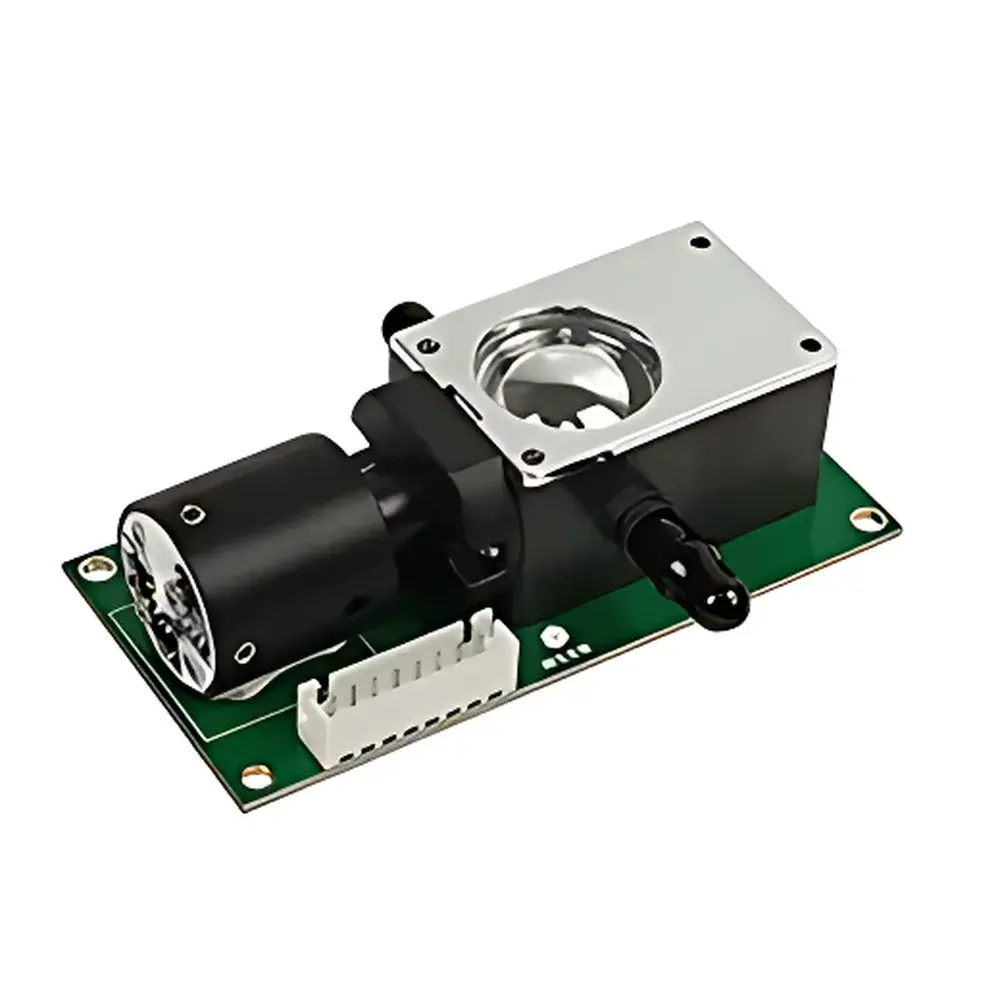
Cubic PM3003S Optical Dust Sensor for Real-Time PM1.0/PM2.5/PM10/TSP Monitoring
| Brand | Cubic |
|---|---|
| Origin | Hubei, China |
| Model | PM3003S |
| Measurement Principle | Laser Light Scattering (90° Detection Geometry) |
| Safety Rating | Explosion-Proof (Ex ib IIB T4 Gb) |
| Measurement Range | 0–1000 µg/m³ |
| Accuracy | PM1.0: ±10 µg/m³ or ±10% of reading |
| PM2.5 | ±10 µg/m³ or ±10% of reading |
| PM10 | ±15 µg/m³ or ±15% of reading |
| TSP | ±20 µg/m³ or ±20% of reading |
| Sampling Flow Rate | 1.0 L/min (pump-assisted) |
| Data Refresh Interval | 1 s |
| Operating Temperature | −30 °C to +70 °C |
| Relative Humidity | 0–95% RH (non-condensing) |
| Power Supply | DC 5.0 V ±0.1 V (ripple <50 mV) |
| Current Consumption | <150 mA (operational), <25 mA (standby) |
| Output Interfaces | Analog voltage (0–5 V or 0–10 V configurable), UART TTL (3.3 V logic level) |
| Dimensions | 82 × 40.2 × 26.3 mm (W × H × D) |
Overview
The Cubic PM3003S is an industrial-grade optical dust sensor engineered for continuous, real-time monitoring of airborne particulate mass concentrations in ambient and semi-outdoor environments. It operates on the principle of laser light scattering—specifically, Mie scattering theory—where a collimated 650 nm semiconductor laser beam interacts with suspended particles drawn into the sensing chamber via a precision-controlled diaphragm pump. The scattered light intensity at 90° is captured by a low-noise photodiode array and converted into quantitative mass concentration values for PM1.0, PM2.5, PM10, and total suspended particulates (TSP), all referenced to gravimetric calibration standards traceable to national reference laboratories. Designed for long-term deployment in harsh field conditions—including roadside monitoring stations, construction site perimeters, and urban air quality networks—the PM3003S features an explosion-proof housing (Ex ib IIB T4 Gb), wide thermal tolerance (−30 °C to +70 °C), and active temperature compensation algorithms that maintain measurement stability across dynamic environmental gradients.
Key Features
- Industrial-grade linear laser source with >20,000-hour operational lifetime and minimal output drift under thermal cycling
- Pump-assisted sampling at precisely regulated 1.0 L/min flow rate, ensuring consistent particle transport and eliminating reliance on ambient airflow
- Intelligent dust-source recognition algorithm that distinguishes between mineral dust, soot, pollen, and hygroscopic aerosols based on scattering pattern dynamics and temporal response profiles
- Multi-range analog output (0–5 V / 0–10 V) and UART TTL (3.3 V) interface, supporting seamless integration into SCADA, IoT gateways, and PLC-based environmental control systems
- Embedded temperature and humidity compensation firmware compliant with ISO 12103-1 and EN 12341 reference methodologies for ambient aerosol characterization
- Robust aluminum alloy enclosure with IP65-rated ingress protection and explosion-proof certification for use in Zone 1 hazardous locations
Sample Compatibility & Compliance
The PM3003S is validated for use with ambient air containing particulate matter of diverse origin—including road dust, construction emissions, biomass combustion aerosols, and fugitive industrial dusts. Its optical design minimizes bias from particle shape, refractive index variation, and hygroscopic growth effects through dual-wavelength scatter normalization and real-time RH feedback correction. The sensor meets the performance requirements of China’s HJ 653–2013 standard for particulate matter monitors and demonstrates R² > 0.90 correlation against β-ray attenuation reference instruments during extended co-location studies (>30 days) under field conditions. While not certified to EU CE-MD or US EPA EQPM specifications as a standalone analyzer, it complies with electromagnetic compatibility (EMC) per IEC 61326-1 and safety requirements per IEC 60079-0 and IEC 60079-11 for intrinsically safe apparatus.
Software & Data Management
The PM3003S operates autonomously without external software dependencies. Raw scattering signals are processed onboard using fixed-point arithmetic optimized for low-power microcontrollers. Calibration coefficients—including size-cut efficiency curves for PM1.0, PM2.5, and PM10—are stored in write-protected EEPROM and can be updated via UART using manufacturer-provided configuration tools. All output data streams include timestamped metadata (UTC epoch time, internal temperature, relative humidity, and pump status). For regulatory-grade deployments, users may implement audit-trail logging on host systems to satisfy GLP/GMP documentation requirements. Firmware supports Modbus RTU over UART for interoperability with legacy environmental monitoring platforms.
Applications
- Dense-network urban air quality monitoring systems requiring high spatial resolution and low unit cost per node
- Real-time fugitive dust tracking at construction sites, mining operations, and bulk material handling facilities
- Dynamic compliance verification for local environmental regulations (e.g., China’s “Blue Sky Defense Campaign” enforcement metrics)
- Integration into intelligent transportation systems (ITS) for road-condition–linked particulate emission modeling
- Indoor–outdoor air exchange studies in semi-enclosed public spaces such as bus terminals, railway stations, and open-air markets
- Research-grade exposure assessment in occupational hygiene and epidemiological cohort studies where portability and power efficiency are critical
FAQ
Is the PM3003S suitable for regulatory reporting under EPA or EU directives?
No—the PM3003S is classified as a reference-grade indicative monitor, not a certified equivalent method instrument. It may serve as a screening tool or supplementary data source but must be co-located and validated against FRM/FEM devices for official submissions.
What calibration protocols are recommended for long-term field operation?
Annual recalibration against NIST-traceable gravimetric filters is advised. Field zero checks using HEPA-filtered air and span verification with polydisperse PSL aerosols (e.g., 1.0 µm, 2.5 µm, and 10 µm modes) should be performed quarterly.
Does the sensor require periodic optical cleaning or maintenance?
Yes—optical windows should be inspected and gently cleaned with lint-free wipes and isopropyl alcohol every 3–6 months in high-dust environments. The integrated pump filter must be replaced every 6 months or after 4,000 operating hours.
Can the analog output be configured for different scaling ranges?
Yes—output scaling (e.g., 0–5 V = 0–500 µg/m³ for PM2.5) is programmable via UART command set, allowing adaptation to specific data acquisition hardware input ranges.
How does the intelligent dust-source recognition function improve data interpretation?
By analyzing transient scattering signatures during particle transit, the algorithm classifies dominant aerosol types and applies context-aware correction factors—reducing systematic bias in mixed-source environments such as urban crossroads with traffic and construction emissions.







