
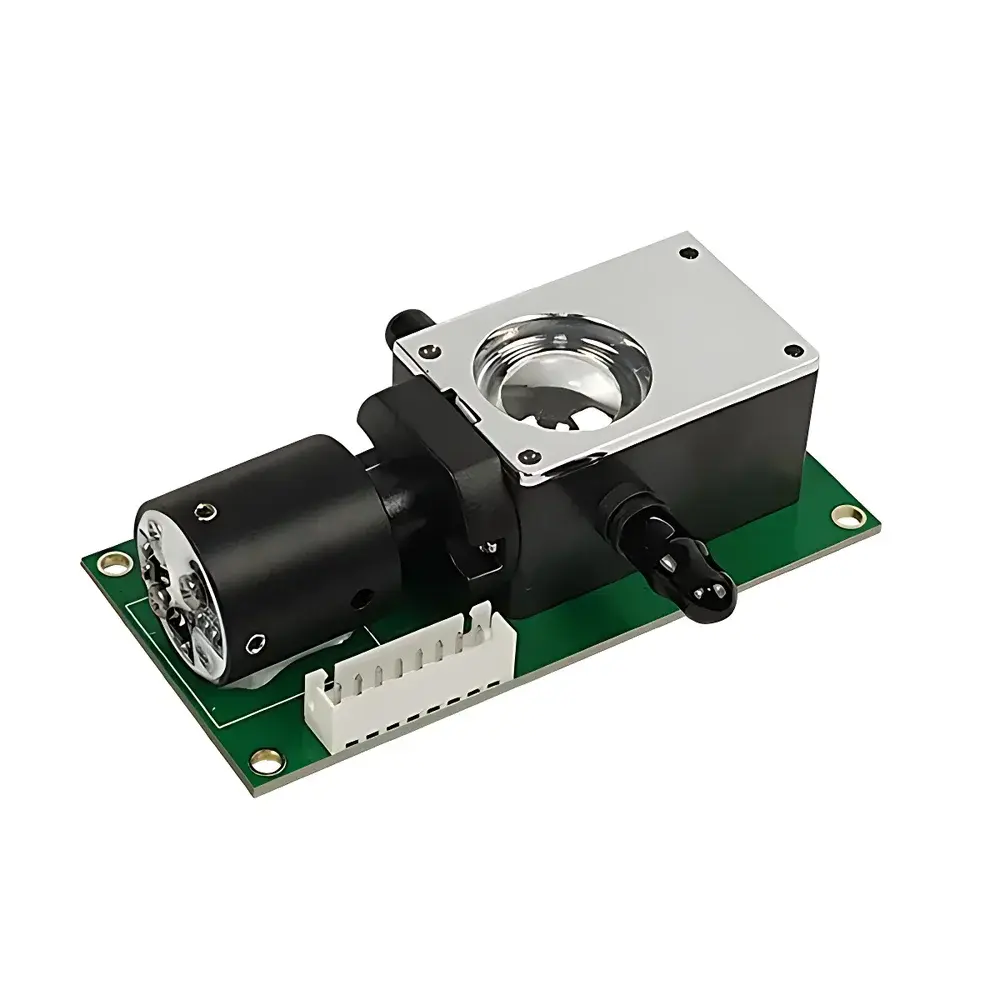
Cubic PM3003SN Laser-Based Particle Counting Sensor
| Brand | Cubic |
|---|---|
| Origin | Hubei, China |
| Model | PM3003SN |
| Detection Principle | Laser Light Scattering |
| Measurement Range | 0–10,000,000 pcs/L (1 pcs/L = 28.3 pcs/ft³) |
| Output Channels | 0.3 µm, 0.5 µm, 1.0 µm, 2.5 µm, 5.0 µm, 10 µm |
| Counting Efficiency | 50% @ 0.3 µm |
| Warm-up Time | ≤8 s |
| Data Refresh Rate | 1 s |
| Operating Temperature | −30°C to +70°C |
| Operating Humidity | 0–95% RH (non-condensing) |
| Storage Temperature | −40°C to +85°C |
| Supply Voltage | DC 5.0 V ±0.1 V (ripple <50 mV) |
| Operating Current | <150 mA |
| Standby Current | <25 mA |
| Signal Outputs | Analog raw signal |
| Dimensions | 82 × 40.2 × 26.3 mm (W×H×D) |
Overview
The Cubic PM3003SN is a high-stability, industrial-grade laser particle counting sensor engineered for continuous airborne particulate monitoring in demanding environmental and occupational health applications. It operates on the principle of single-particle laser light scattering—where a collimated, linearly stabilized laser beam interrogates aerosol particles drawn through an optimized sensing volume. Scattered light pulses are detected by a low-noise photodiode array and converted into digital pulse-height signals, enabling real-time discrimination and counting across six discrete size channels: 0.3 µm, 0.5 µm, 1.0 µm, 2.5 µm, 5.0 µm, and 10 µm. Designed with automotive-grade thermal management and long-life optical components, the PM3003SN delivers consistent performance under wide ambient conditions (−30°C to +70°C, 0–95% RH non-condensing), making it suitable for integration into HVAC monitoring systems, cleanroom environmental sensors, portable air quality analyzers, and fixed-location IAQ stations.
Key Features
- Multi-channel particle sizing: Simultaneous quantification of particle number concentrations across six calibrated thresholds (0.3–10 µm), supporting compliance with ISO 21501-4 and JJF 1190–2008 calibration requirements.
- Industrial laser source: Linear-mode, constant-power laser diode with extended operational lifetime (>20,000 h) and minimal thermal drift—ensuring stable scattering intensity and reproducible counting efficiency.
- High-flow sampling architecture: Integrated automotive-grade turbo fan provides consistent volumetric flow rate without external pump dependency; optional external pump interface enables customized aspiration for low-pressure or ducted sampling environments.
- Rapid system readiness: Full optical and electronic stabilization achieved within ≤8 seconds after power-on, minimizing startup delay in time-critical monitoring deployments.
- Dual-output flexibility: Analog voltage output (0–3.3 V) proportional to channel-specific counts, plus UART TTL (3.3 V logic) serial interface for direct microcontroller integration and firmware-upgradable configuration.
- Robust mechanical design: Compact form factor (82 × 40.2 × 26.3 mm) with IP5X-rated enclosure compatibility and conformal coating options for enhanced reliability in humid or vibration-prone installations.
Sample Compatibility & Compliance
The PM3003SN is validated for use with ambient air, filtered indoor air, and low-concentration process gases containing non-volatile, non-cohesive solid or liquid aerosols. It is not intended for corrosive, explosive, or high-humidity condensing environments without appropriate inlet conditioning (e.g., Nafion dryers or impactor pre-separators). Calibration traceability aligns with JJF 1190–2008 “Calibration Specification for Airborne Particle Counters”, with counting efficiency verified against NIST-traceable reference instruments (e.g., TSI 9306) under controlled laboratory conditions (25±2°C, 50±10% RH). While not certified to IEC 61508 or SIL standards, its architecture supports functional safety integration when deployed within broader system-level risk assessments per ISO 14644-2 and ISO 16890 frameworks.
Software & Data Management
The sensor communicates via ASCII-based UART protocol at configurable baud rates (default: 9600 bps), supporting command-driven parameter readout (e.g., channel counts, temperature, uptime) and firmware updates. Raw analog outputs enable direct ADC acquisition in embedded systems without protocol parsing overhead. Cubic provides open datasheets, register maps, and sample Arduino/Python drivers—facilitating rapid prototyping and OEM integration. For regulatory environments requiring auditability (e.g., GLP-compliant indoor air studies or HVAC validation per ISO 14644-1), users must implement external timestamping, data logging, and change-control procedures—no built-in 21 CFR Part 11 audit trail or encrypted storage is provided at the sensor level.
Applications
- Real-time indoor air quality (IAQ) monitoring in smart buildings, schools, and healthcare facilities.
- OEM integration into portable PM2.5/PM10 monitors, wearable exposure trackers, and battery-powered environmental nodes.
- Pre-filter and post-filter efficiency verification in HVAC filtration systems and HEPA integrity testing setups.
- Baseline particulate trending in clean manufacturing zones (ISO Class 5–8), semiconductor tool exhaust lines, and pharmaceutical isolators.
- Field-deployable ambient air networks compliant with national air quality index (AQI) reporting protocols.
FAQ
What is the minimum detectable particle size and corresponding counting efficiency?
The PM3003SN achieves 50% counting efficiency at 0.3 µm and ≥98% efficiency at 0.5 µm and above, as validated per JJF 1190–2008 using monodisperse PSL aerosols and TSI 9306 as reference.
Can the sensor operate continuously in high-humidity environments?
Yes—within 0–95% RH non-condensing conditions. Condensation must be prevented via inlet heating, desiccant drying, or differential pressure control to avoid optical window fouling and signal attenuation.
Is external sampling pump required?
No—the integrated turbo fan sustains sufficient flow for standard applications. An external pump may be used for pressurized duct sampling or when higher flow rates (>1 L/min) are needed for dilution or multi-sensor manifolding.
Does the sensor support Modbus or RS-485 communication?
No—it provides only UART TTL (3.3 V) and analog outputs. Protocol conversion to Modbus RTU or RS-485 requires external bridge hardware.
What is the recommended recalibration interval?
Annual recalibration against traceable reference standards is advised for metrological continuity in regulated applications; field verification using test aerosols (e.g., 0.3 µm PSL) is recommended every 3–6 months.
Related Products







