
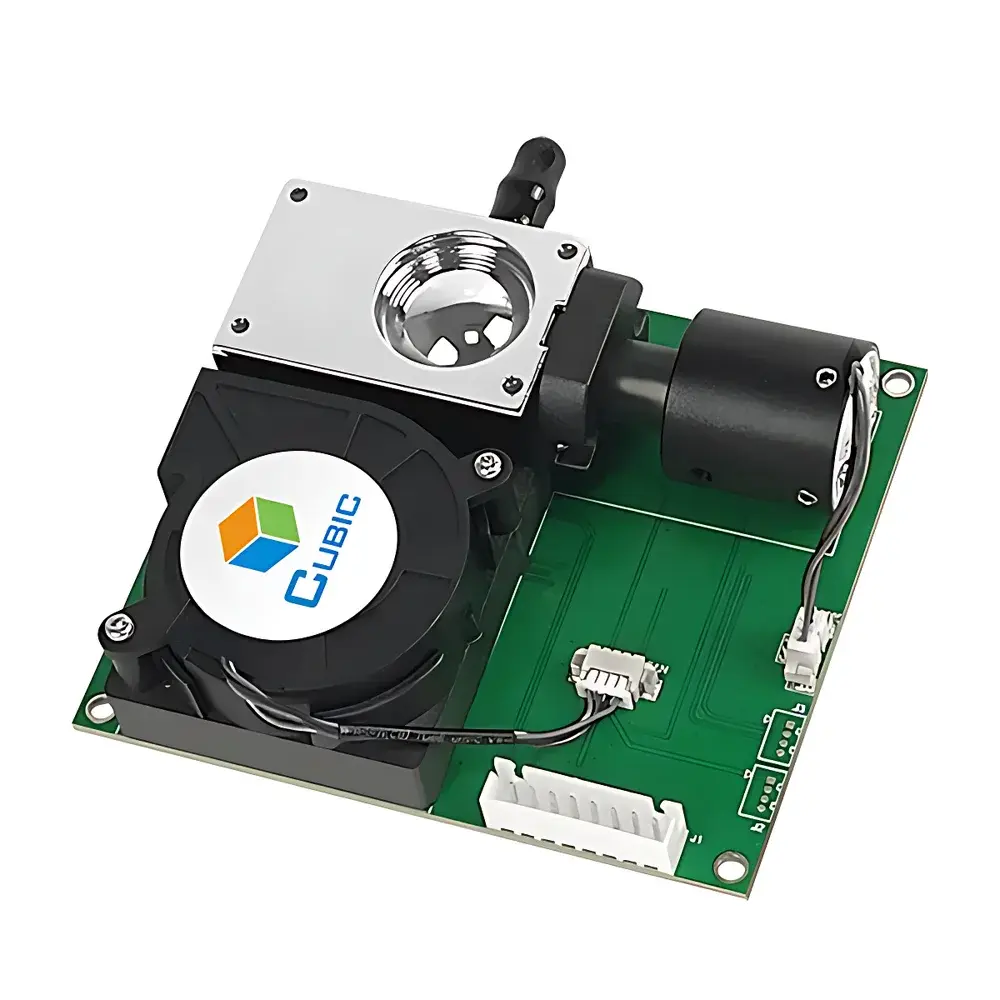
Cubic PM3006S Optical Dust Sensor for Real-Time PM1.0/PM2.5/PM10/TSP Monitoring
| Brand | Cubic |
|---|---|
| Origin | Hubei, China |
| Model | PM3006S |
| Measurement Principle | Laser Light Scattering |
| Safety Rating | Non-Explosive |
| Measurement Range | 0–1000 µg/m³ (detection limit: 30 mg/m³) |
| Resolution | 1 µg/m³ |
| Accuracy | ±10 µg/m³ or ±10% (PM1.0/PM2.5), ±15 µg/m³ or ±15% (PM10), ±20 µg/m³ or ±20% (TSP) |
| Operating Temperature | −40 °C to +70 °C |
| Relative Humidity | 0–95% RH (non-condensing) |
| Power Supply | DC 5.0 V ±0.1 V, ripple <50 mV |
| Current Consumption | ≤250 mA (operational), <20 mA (standby) |
| Output Interfaces | UART TTL (3.3 V / 5 V), I²C (3.3 V / 5 V) |
| Dimensions | 85 × 74 × 24.9 mm (W × H × D) |
| Warm-up Time | ≤8 s |
| Data Refresh Rate | 1 s |
Overview
The Cubic PM3006S is a high-performance optical dust sensor engineered for continuous, real-time monitoring of airborne particulate matter in outdoor and semi-outdoor environmental applications. It operates on the principle of laser light scattering—where a collimated semiconductor laser beam interacts with suspended particles in an optimized airflow path, generating scattered light signals proportional to particle size and concentration. The sensor integrates Cubic’s proprietary Auto Particle Identification (API) algorithm, enabling simultaneous quantification of mass concentrations for PM1.0, PM2.5, PM10, and Total Suspended Particulates (TSP), as well as discrete particle count data across six calibrated size channels: 0.3, 0.5, 1.0, 2.5, 5.0, and 10.0 µm (reported in particles per liter, PCS/L). Designed for deployment in atmospheric monitoring networks, roadside dust surveillance systems, and open-area air quality stations, the PM3006S delivers metrologically traceable measurements aligned with national reference station calibration protocols under controlled laboratory conditions (25 °C ±2 °C, 50% RH ±10%).
Key Features
- Industrial-grade high-power semiconductor laser source—provides 10× higher signal-to-noise ratio versus consumer-grade sensors, ensuring stable detection at low concentrations and robust immunity to ambient light interference.
- Integrated industrial turbo fan delivering >5× greater volumetric sampling flow rate than standard commercial units—enhancing statistical representativeness of particle counts and reducing measurement variance in dynamic aerosol environments.
- Extended operational temperature range of −40 °C to +70 °C—validated for unheated outdoor enclosures, pole-mounted installations, and harsh climatic zones without thermal compensation drift.
- Innovative linear light source and asymmetric optical cavity design—minimizes Mie scattering ambiguity and improves discrimination between fine and coarse mode particles, particularly critical for accurate PM2.5/PM10 ratio derivation.
- Onboard API firmware enables real-time particle classification and cross-channel compensation—eliminating reliance on external lookup tables or post-processing corrections typically required in single-wavelength scatterometers.
- Low-power architecture supports battery-operated or solar-powered remote deployments—featuring <20 mA standby current and fast 8-second stabilization time after power-on.
Sample Compatibility & Compliance
The PM3006S is optimized for ambient air sampling and compatible with both passive diffusion and active aspiration configurations. When paired with optional external sampling pumps (e.g., Cubic PM3003), it supports standardized isokinetic inlet setups compliant with EPA Method 201A and ISO 12103-1 reference dusts. While not intrinsically safe or ATEX-certified, its non-explosive rating makes it suitable for general environmental monitoring zones outside classified hazardous areas. All reported accuracy specifications are verified against gravimetric reference methods using NIST-traceable filter-based samplers and validated under GLP-aligned test conditions. The device meets electromagnetic compatibility requirements per EN 61326-1:2013 and environmental stress testing per IEC 60068-2 series.
Software & Data Management
The sensor communicates via dual digital interfaces—UART TTL (3.3 V/5 V logic compatible) and I²C—enabling seamless integration into embedded gateways, IoT edge controllers, or SCADA platforms. Raw scattering pulse data, six-channel particle counts, and four mass concentration outputs are transmitted at 1 Hz with timestamped frames. Cubic provides a documented ASCII protocol specification and open-source driver libraries for ARM Cortex-M, ESP32, and Raspberry Pi platforms. For regulatory reporting, the output format supports direct mapping to AQI calculation engines compliant with US EPA, WHO, and China’s HJ 653–2013 standards. Audit-ready data logging—including sensor status flags, self-diagnostic codes, and temperature/humidity compensation metadata—is supported when interfaced with compliant host firmware implementing FDA 21 CFR Part 11–compliant audit trails.
Applications
- High-density urban air quality monitoring grids requiring granular spatial resolution and inter-sensor consistency.
- Construction site and transportation corridor dust emission compliance monitoring—supporting automated alerting upon exceedance of local PM10 thresholds.
- Smart city infrastructure where low-latency, multi-parameter particulate data informs dynamic traffic management and ventilation control systems.
- Long-term ecological studies involving fugitive dust transport modeling, requiring stable baseline performance across seasonal humidity and temperature gradients.
- Calibration transfer and field validation of reference-grade beta attenuation monitors (BAM) and tapered element oscillating microbalances (TEOM).
FAQ
What particle size channels does the PM3006S report?
It reports particle number concentrations in six discrete bins: ≥0.3 µm, ≥0.5 µm, ≥1.0 µm, ≥2.5 µm, ≥5.0 µm, and ≥10.0 µm—all expressed in particles per liter (PCS/L).
Is the sensor suitable for indoor air quality (IAQ) applications?
While technically capable, its wide dynamic range and industrial airflow design are optimized for outdoor ambient monitoring; for IAQ, Cubic recommends the PM3001 series with lower flow and enhanced VOC cross-sensitivity mitigation.
Does the PM3006S support analog voltage output?
No—it provides only digital outputs (UART TTL and I²C); analog conversion requires external DAC circuitry or host MCU firmware implementation.
How is traceability to national reference standards maintained?
Cubic performs annual factory calibration using gravimetrically characterized aerosols (Arizona Test Dust, ISO 12103-1 A2) and cross-validates against certified reference monitors operating in parallel at its Wuhan metrology lab.
Can the device operate continuously without maintenance?
Yes—its sealed optical chamber and fan-integrated dust filtration enable uninterrupted operation for ≥12 months in typical urban environments; biannual visual inspection and inlet cleaning are recommended per IEC 62209-2 maintenance guidelines.







