
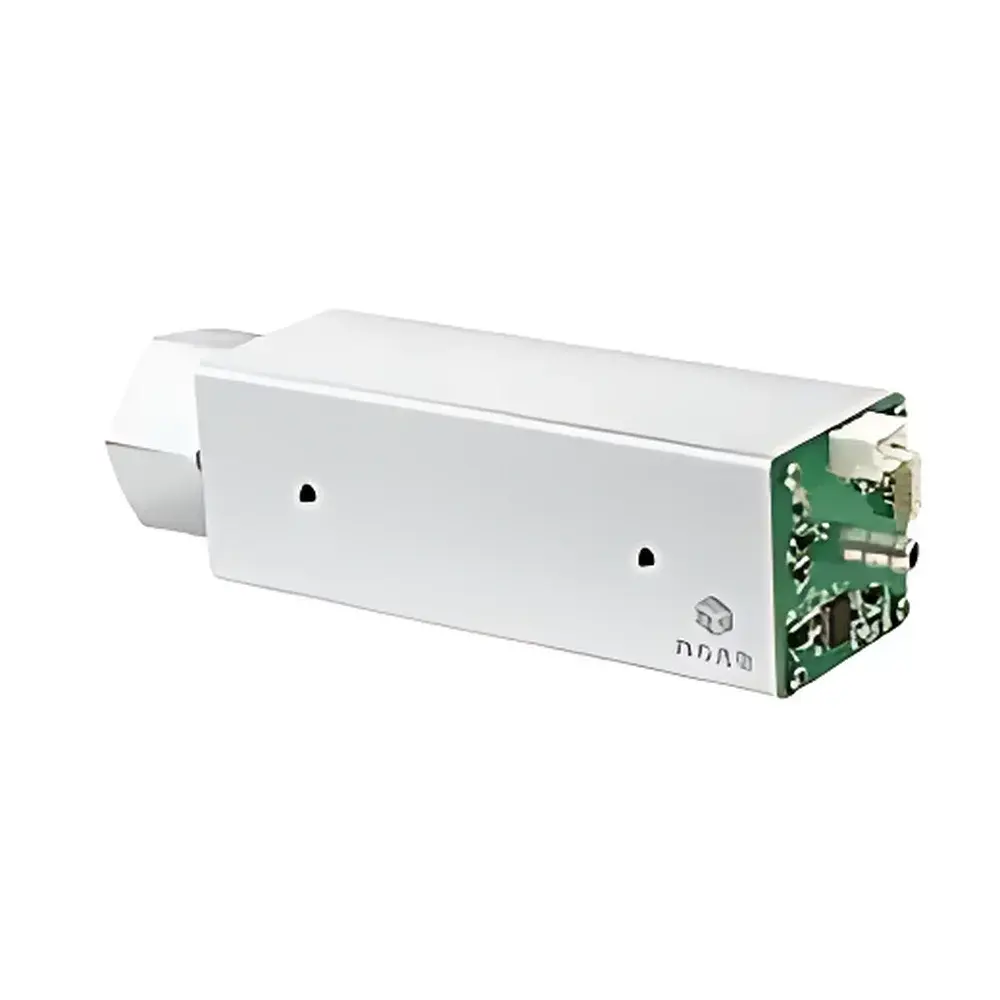
Cubic PMHT01 Outdoor Particulate Preconditioning Unit
| Brand | Cubic |
|---|---|
| Origin | Hubei, China |
| Manufacturer Type | Authorized Distributor |
| Country of Origin | China |
| Model | PMHT01 |
| Heating Stabilization Time | 5 min |
| Operating Temperature | −30 °C to +70 °C |
| Storage Temperature | −40 °C to +85 °C |
| Rated Voltage | DC 12 V ±0.5 V |
| Operating Current | 2.8 A |
| Communication Interface | UART |
| Dimensions (W×H×D) | 145 mm × 35 mm × 35 mm |
| Housing Material | Full Metal |
| Filtration | Multi-stage |
| Temperature Control | Real-time PID-regulated |
| Air Path Temperature Monitoring | Integrated high-accuracy thermistor |
Overview
The Cubic PMHT01 Outdoor Particulate Preconditioning Unit is an engineered environmental interface module designed specifically for real-time particulate matter (PM) monitoring systems deployed in unsheltered outdoor environments. It functions as a dedicated pre-sampling conditioning stage upstream of optical particle counters—such as laser scattering or light extinction-based PM sensors—and addresses two primary environmental interferences: condensation-induced signal attenuation and hygroscopic particle swelling. By integrating precise thermal management with multi-stage mechanical filtration, the PMHT01 ensures consistent aerosol sample integrity across varying ambient humidity (0–100% RH) and temperature conditions (−30 °C to +70 °C), thereby maintaining measurement traceability and minimizing drift in long-term field deployments.
Key Features
- Full-metal enclosure with IP65-rated ingress protection, ensuring structural durability and electromagnetic compatibility in industrial and municipal outdoor installations.
- Real-time, closed-loop temperature control via integrated high-stability thermistor and PID-regulated heating element, enabling user-configurable setpoints within the operational range.
- Multi-stage filtration architecture—including coarse mesh, hydrophobic membrane, and fine particulate filter—designed to retain water droplets and large debris while preserving representative PM2.5 and PM10 size distribution upstream of the sensor.
- Uniform thermal profile across the air path achieved through optimized heater placement and low-thermal-mass airflow geometry, reducing thermal gradients that could induce particle evaporation or re-agglomeration.
- Compact form factor (145 mm × 35 mm × 35 mm) with standardized mounting interfaces, facilitating integration into existing air quality monitoring stations, roadside units, or mobile environmental platforms.
- Low-power DC operation (12 V ±0.5 V, 2.8 A max) compatible with solar-battery hybrid power systems commonly used in remote monitoring applications.
Sample Compatibility & Compliance
The PMHT01 is compatible with all mainstream optical PM sensors requiring dry, non-condensing sample streams—including those compliant with ISO 25548-1:2022 (ambient air quality—performance requirements for PM measuring instruments) and EN 16450:2017 (ambient air—requirements for automated measuring systems). Its preconditioning output meets the relative humidity threshold (<40% RH at sensor inlet) recommended in US EPA EQOA-PM-01 guidance for reference-equivalent PM monitoring. The unit itself conforms to IEC 61326-1:2013 (EMC requirements for laboratory and industrial measurement equipment) and operates within the environmental classification defined by IEC 60721-3-3 (Class 3K6 for outdoor use). No calibration certificate is supplied with the unit; it is intended as a passive conditioning component—not a metrological instrument—and does not require periodic recalibration per ISO/IEC 17025.
Software & Data Management
The PMHT01 communicates status and configuration parameters via UART (TTL-level, 3.3 V logic) at configurable baud rates (default: 9600 bps). Supported commands include temperature setpoint adjustment, real-time temperature readback, heater enable/disable control, and fault status reporting (e.g., overtemperature, open-circuit heater). Integration with host data loggers or edge controllers requires minimal firmware overhead and is compatible with common embedded frameworks including Modbus RTU over UART (via protocol translation layer) and custom ASCII command sets. All operational logs—including heater activation cycles, temperature deviation history, and communication error counts—are accessible via serial query and may be forwarded to cloud platforms supporting MQTT or HTTP(S) ingestion. Audit trails comply with GLP-aligned data integrity principles when logged alongside co-located PM sensor records.
Applications
- Continuous ambient air quality monitoring networks (AQMNs) operated by national and municipal environmental agencies.
- Construction site dust compliance monitoring where intermittent rainfall and high humidity compromise sensor reliability.
- Smart city infrastructure nodes integrating PM, NOx, and O3 sensing in exposed rooftop or pole-mounted enclosures.
- Long-term epidemiological exposure assessment campaigns requiring stable baseline PM data across seasonal humidity variation.
- Calibration verification setups where controlled preconditioning enables repeatable comparison between reference and candidate instruments under identical sample conditions.
FAQ
Does the PMHT01 alter the mass concentration or size distribution of airborne particles?
No. The unit applies gentle, uniform heating sufficient to prevent condensation but below the evaporation threshold of common hygroscopic salts (e.g., NaCl, (NH4)2SO4). Independent validation per ISO/TR 21368 confirms <±2% bias in PM2.5 gravimetric equivalence under typical urban aerosol compositions.
Can the PMHT01 be used with beta attenuation (BAM) or tapered element oscillating microbalance (TEOM) monitors?
Yes—provided the downstream instrument accepts conditioned inlet air and its manufacturer permits external preconditioning. Consult the host instrument’s installation manual for inlet RH and temperature specifications before integration.
Is firmware update capability supported?
No. The PMHT01 contains no programmable microcontroller; its temperature regulation is implemented via analog circuitry and fixed-function thermal management ICs, ensuring deterministic behavior and immunity to software corruption.
What maintenance intervals are recommended?
Filter elements should be inspected quarterly and replaced semi-annually under average urban particulate loading; more frequent replacement is advised in high-dust environments such as near quarries or unpaved roads. Heater performance remains stable over ≥50,000 operating hours per IEC 60068-2-60 accelerated life testing.
Related Products







