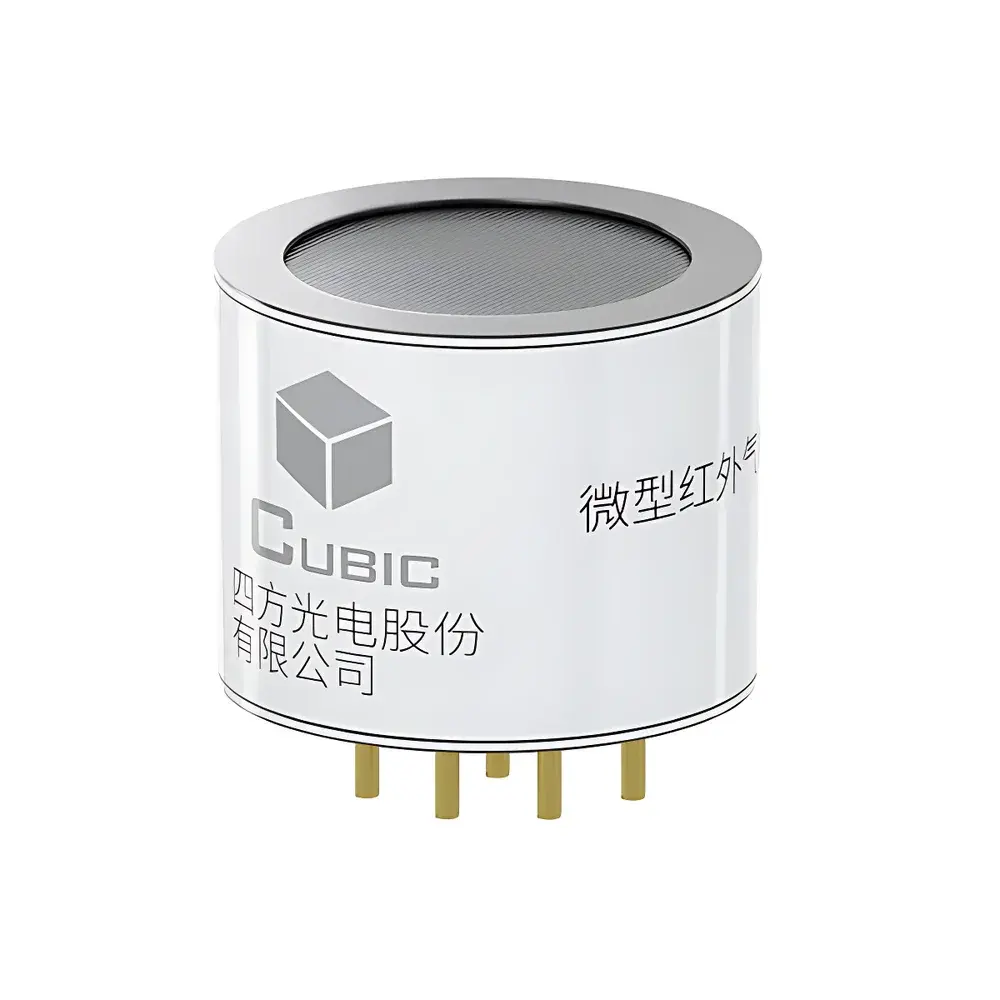
Cubic SBH Miniature NDIR Propane Gas Sensor
| Brand | Cubic |
|---|---|
| Origin | Hubei, China |
| Manufacturer Type | Authorized Distributor |
| Country of Origin | China |
| Model | SBH |
| Price | USD 340 (FOB) |
| Detection Principle | Non-Dispersive Infrared (NDIR) |
| Measurement Range Options | 0–2% vol, 0–5% vol, 0–75% vol |
| Accuracy | ≤ ±0.06% vol (0.00–1.00% vol) |
| Operating Temperature | −40°C to +70°C |
| Storage Temperature | −40°C to +70°C |
| Operating Humidity | 0–95% RH (non-condensing) |
| Explosion Protection Rating | Ex ia II C T4 Ga |
| Output Interface | Dual-mode — analog (0–5 V / 4–20 mA) and digital (UART TTL/RS485) |
| Housing Material | Full-metal hermetic enclosure |
| Optical Design | Dual-beam NDIR with reference & measurement channels |
| Temperature Compensation | Full-range automatic compensation |
| Dimensions | Φ20 × 19 mm or Φ20 × 16.6 mm (excluding pins) |
Overview
The Cubic SBH Miniature NDIR Propane Gas Sensor is an industrial-grade, non-dispersive infrared (NDIR) gas detection module engineered for reliable, selective, and stable measurement of propane (C3H8) concentration in ambient air. Unlike catalytic bead (pellistor) or thermal conductivity sensors, the SBH leverages dual-beam NDIR spectroscopy—exploiting the characteristic absorption band of propane near 3.3–3.5 µm—to deliver inherent selectivity against common interferents (e.g., methane, butane, CO2, water vapor). Its solid-state optical architecture eliminates moving parts and consumables, ensuring long-term baseline stability and minimal drift over time. Designed for integration into fixed gas monitoring systems, portable analyzers, and safety instrumentation, the SBH meets stringent operational demands across hazardous and non-hazardous environments without requiring frequent recalibration.
Key Features
- Dual-beam NDIR architecture: Simultaneous measurement and reference channel detection compensates for optical aging, dust accumulation, and source intensity fluctuation—enhancing measurement reproducibility and reducing zero drift.
- Full-metal hermetic housing: Robust stainless steel and aluminum construction provides mechanical durability, EMI shielding, and resistance to chemical corrosion in industrial atmospheres.
- Comprehensive temperature compensation: Embedded thermistor network and firmware-driven algorithm apply real-time correction across the full operating range (−40°C to +70°C), maintaining accuracy without external temperature sensors.
- Dual-output interface: Supports simultaneous analog output (0–5 V DC or 4–20 mA, user-selectable) and digital communication via UART (TTL-level) or RS485 (Modbus RTU), enabling flexible system integration and remote diagnostics.
- Intrinsically safe certification: Certified to Ex ia II C T4 Ga per IEC 60079-0 and IEC 60079-11, suitable for installation in Zone 0/1 explosive atmospheres containing propane and other Group II C gases.
- Multi-range configuration: Available in three standard detection spans (0–2% vol, 0–5% vol, 0–75% vol), allowing optimization for leak detection, process control, or LEL monitoring applications.
Sample Compatibility & Compliance
The SBH sensor is optimized for propane detection in clean, dry, or moderately humid air matrices (0–95% RH, non-condensing). It exhibits negligible cross-sensitivity to CO2, CH4, and H2O within typical environmental concentrations. For applications involving high particulate load, condensable vapors, or aggressive corrosive gases (e.g., Cl2, H2S), optional hydrophobic membrane filtration or sample conditioning modules are recommended. The device complies with key international standards including IEC 60079-29-1 (gas detectors—performance requirements), EN 50194-1 (domestic gas alarm systems), and meets electromagnetic compatibility requirements per EN 61326-1 (industrial environments). While not FDA-cleared or ISO 13485-certified, its design principles align with general-purpose industrial gas sensing best practices referenced in OSHA 1910.120 and ATEX Directive 2014/34/EU.
Software & Data Management
The SBH operates as a smart transducer with onboard signal processing. Its digital interface supports Modbus RTU protocol (RS485) and ASCII command set (UART), enabling direct readout of calibrated ppm/%vol values, internal temperature, sensor status flags (e.g., fault, warm-up complete), and diagnostic counters. Firmware allows configurable averaging time (1–60 s), output update rate (1–10 Hz), and alarm thresholds. When integrated into larger SCADA or DCS platforms, the sensor’s consistent data structure facilitates audit-ready logging. Though the SBH itself does not store historical data, its deterministic output format supports seamless ingestion into time-series databases compliant with ISA-95 Level 0–2 data models. No proprietary software is required; configuration and calibration verification can be performed using standard terminal emulators or OEM-provided utility tools.
Applications
- Fixed-point propane leak detection in petrochemical refineries, LNG terminals, and bulk storage facilities
- Portable combustible gas indicators (CGIs) used by safety inspectors and maintenance technicians
- Process gas analysis in propane-fueled combustion control systems (e.g., industrial ovens, kilns)
- Medical gas purity verification in laboratory-grade propane supply lines for GC carrier gas or calibration standards
- Underground coal mine ventilation monitoring where propane may serve as a tracer gas or indicate hydrocarbon seepage
- Environmental chamber validation and HVAC commissioning in laboratories handling flammable gas mixtures
FAQ
What is the expected service life of the SBH sensor under continuous operation?
Typical operational lifetime exceeds 5 years when operated within specified environmental limits and protected from mechanical shock, condensation, and exposure to silicone vapors or halogenated solvents.
Does the SBH require periodic zero/span calibration?
Yes—annual calibration is recommended for critical safety applications; biennial calibration suffices for non-safety process monitoring. Calibration must be performed using certified propane-in-air standards traceable to NIST or equivalent national metrology institutes.
Can the SBH be used in oxygen-deficient or high-CO₂ environments?
The sensor’s NDIR principle is unaffected by background O₂ or CO₂ concentration; however, extreme CO₂ levels (>10%) may cause minor spectral overlap—validation testing with representative gas mixtures is advised.
Is firmware upgrade supported in-field?
Firmware updates are possible via UART interface using OEM-provided tools and signed binaries; upgrades are typically reserved for critical bug fixes or regulatory compliance enhancements.
What mounting options are available for panel or duct installation?
The SBH features a standardized M20 × 1.5 threaded body (Φ20 mm) compatible with common industrial sensor housings, probe mounts, and sampling manifolds; custom adapter plates and flow-through caps are available upon request.