
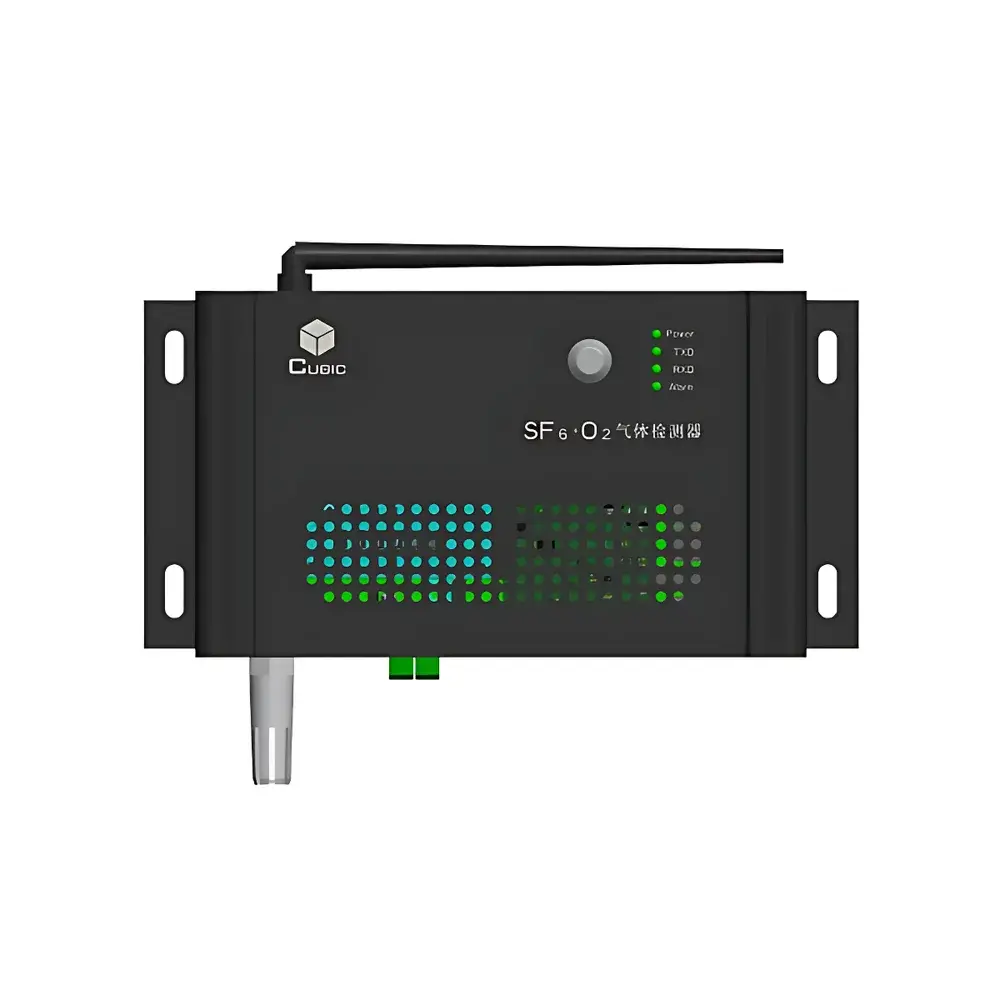
Cubic SF6+O2 Dual-Gas Monitor with NDIR and Electrochemical Sensing
| Brand | Cubic |
|---|---|
| Origin | Hubei, China |
| Model | SF6+O2 |
| Detection Principle | NDIR for SF6 |
| SF6 Range | 0–1500 ppm |
| O₂ Range | 0–25.0 %vol |
| SF6 Resolution | 1 ppm |
| O₂ Resolution | 0.1 %vol |
| SF6 Accuracy | ±2% FS |
| O₂ Accuracy | ±0.5% vol |
| SF6 Alarm Threshold | Adjustable (default 1000 ppm) |
| O₂ Alarm Threshold | Adjustable (default 18.0% vol) |
| Response Time (T90) | ≤60 s (diffusion mode) for both gases |
| Temperature Range | −30 to +85 °C |
| Temp Accuracy | ±1 °C |
| Humidity Range | 0–99 %RH |
| RH Accuracy | ±5 %RH |
| PIR Detection Distance | ≥3 m |
| Dimensions | 205 × 105 × 58 mm |
| Weight | <1.5 kg |
| Output Interfaces | RS485, Wi-Fi, optional RS232 |
| IP Rating | IP54 (customizable) |
| Power Supply | AC 220 V ±10%, 50 Hz ±1% |
| Power Consumption | <15 W |
| Design Life | >10 years |
| Compliance | DL/T 1555–2016, DL/T 639, JB/T 10893 |
Overview
The Cubic SF6+O2 Dual-Gas Monitor is an engineered solution for continuous, real-time monitoring of sulfur hexafluoride (SF₆) and oxygen (O₂) concentrations in indoor electrical substations, GIS switchgear rooms, and high-voltage equipment enclosures. It operates on two complementary sensing principles: non-dispersive infrared (NDIR) spectroscopy for SF₆ detection and limiting-current electrochemical sensing for O₂—ensuring high selectivity, long-term stability, and immunity to cross-interference from common background gases (e.g., CO₂, CH₄, N₂). The instrument simultaneously measures ambient temperature and relative humidity to support environmental compensation algorithms, maintaining measurement integrity across operational conditions ranging from −20 °C to +50 °C and 0–90% RH (non-condensing). Designed for integration into centralized SCADA or building management systems (BMS), it delivers traceable, auditable gas data aligned with utility safety protocols and regulatory expectations for confined-space occupancy and arc-flash risk mitigation.
Key Features
- Proprietary NDIR optical path architecture for SF₆—optimized for low-drift performance and minimal zero-point drift over extended operation
- Electrochemical O₂ sensor with built-in temperature and pressure compensation, compliant with IEC 60751 and ASTM D6204 for oxygen deficiency monitoring
- Passive infrared (PIR) motion detection module with ≥3 m sensing range—enables occupancy-aware alarm escalation and energy-efficient wake-on-demand operation
- Auto-zero calibration routine executed at user-defined intervals or upon power-up—reduces manual maintenance and eliminates false alarms caused by baseline drift
- Embedded data logging with non-volatile memory: stores up to 30 days of 1-minute interval readings, including timestamped alarm events, sensor diagnostics, and environmental metadata
- Multi-protocol communication stack: native Modbus RTU over RS485 (up to 1200 m), IEEE 802.11 b/g/n Wi-Fi (WPA2-PSK), and optional RS232 interface for legacy system integration
- Ruggedized enclosure rated IP54—suitable for indoor industrial environments with dust exposure and occasional moisture ingress; customizable sealing options available for higher IP ratings
Sample Compatibility & Compliance
The monitor is validated for use in air matrices containing typical substation atmospheres—free of aggressive solvents, silicone vapors, or high-concentration hydrocarbons that could poison the electrochemical O₂ cell or attenuate NDIR signal transmission. It meets the functional safety requirements specified in DL/T 1555–2016 (“Technical Specification for SF₆ Leakage Monitoring Systems in GIS”) and DL/T 639 (“Code for Safety Monitoring of SF₆ Gas in Electrical Equipment”). While not certified to IEC 61508 or SIL-2, its architecture supports deterministic fault response per IEC 62061 Annex A, enabling integration into safety-related subsystems under site-specific risk assessment. All firmware and configuration parameters are stored with write-protection and checksum validation to satisfy GLP audit trail requirements for data integrity.
Software & Data Management
Data export is supported via CSV over Wi-Fi or RS485, with timestamps synchronized to UTC using SNTP. The onboard web interface (HTTPS-enabled) allows secure remote configuration of alarm thresholds, sampling intervals, and PIR sensitivity—without requiring proprietary software. Logged data includes sensor raw outputs, compensated values, diagnostic flags (e.g., “low battery,” “optical window contamination”), and environmental context. For enterprise deployment, Cubic provides a RESTful API endpoint (available upon request) compatible with MQTT brokers and cloud platforms such as AWS IoT Core and Microsoft Azure IoT Hub—enabling automated ingestion into predictive maintenance dashboards or regulatory reporting workflows.
Applications
- GIS (Gas-Insulated Switchgear) rooms: continuous SF₆ leak detection and O₂ depletion warning to prevent asphyxiation hazards during maintenance
- High-voltage transformer vaults and cable tunnel environments where SF₆ is used as insulation medium
- Power generation facilities—including nuclear and thermal plants—where O₂ monitoring supports confined-space entry permit systems per OSHA 1910.146
- Research laboratories handling SF₆-based plasma etching or dielectric testing setups
- Industrial HVAC control systems requiring ambient air quality verification prior to personnel access
FAQ
What is the recommended calibration frequency for field operation?
Annual bump testing with certified SF₆ (1000 ppm in air) and O₂ (15.0% vol in N₂) reference gases is advised; full span calibration every 24 months or after sensor replacement.
Can the device operate reliably in high-humidity environments without condensation?
Yes—the internal humidity sensor and compensation algorithm remain effective up to 99% RH; however, sustained condensation on optical windows or sensor membranes may impair performance and is outside the specified operating envelope.
Is the Wi-Fi module compatible with enterprise WPA3-Enterprise networks?
No—it supports WPA2-PSK only; for WPA3 or 802.1X environments, RS485 integration via gateway is recommended.
Does the unit comply with FDA 21 CFR Part 11 for electronic records?
It does not include digital signature or audit trail features required for Part 11 compliance; however, exported CSV logs can be ingested into validated LIMS or ELN systems that do.
How is sensor lifetime verified beyond the 10-year design claim?
Each unit ships with a factory-issued sensor health certificate referencing accelerated life testing per ISO 16000-23, including thermal cycling (−40 °C to +85 °C, 500 cycles) and exposure to 5000 ppm SO₂ for 72 hours to validate robustness against common contaminants.
Related Products







