
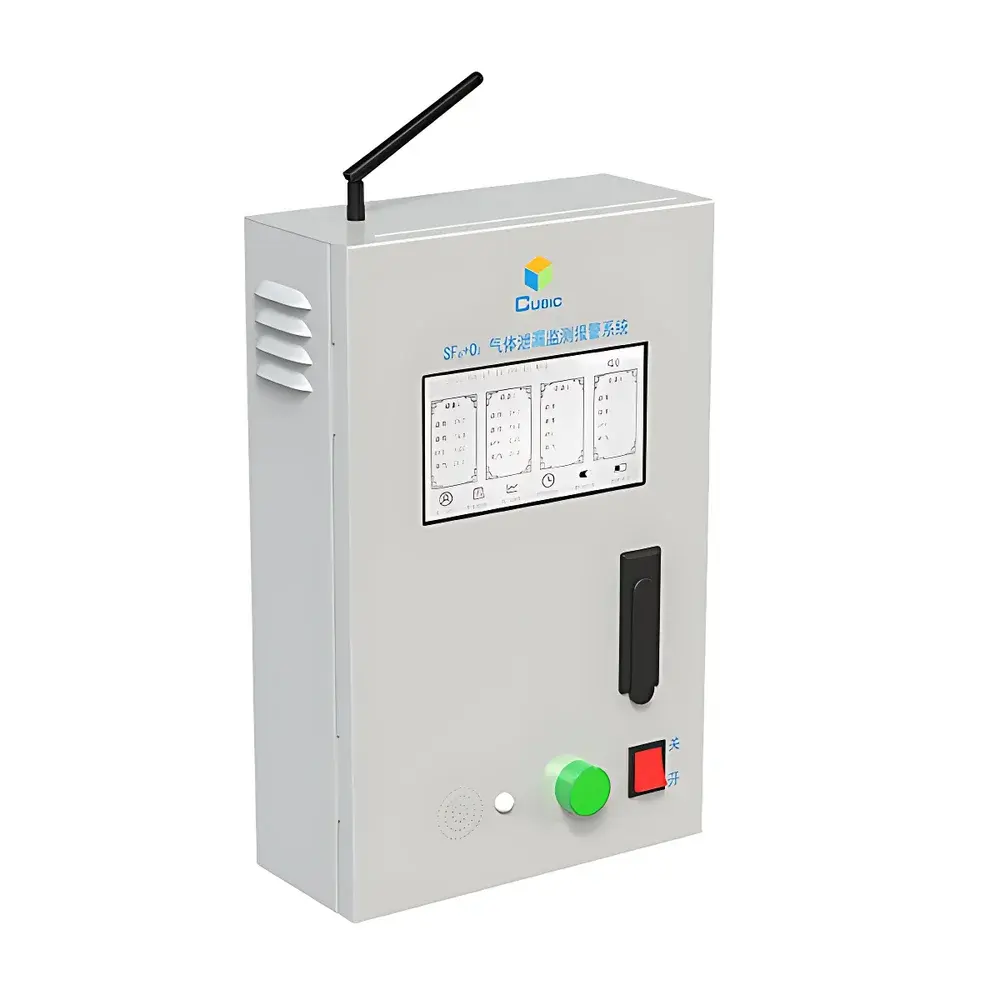
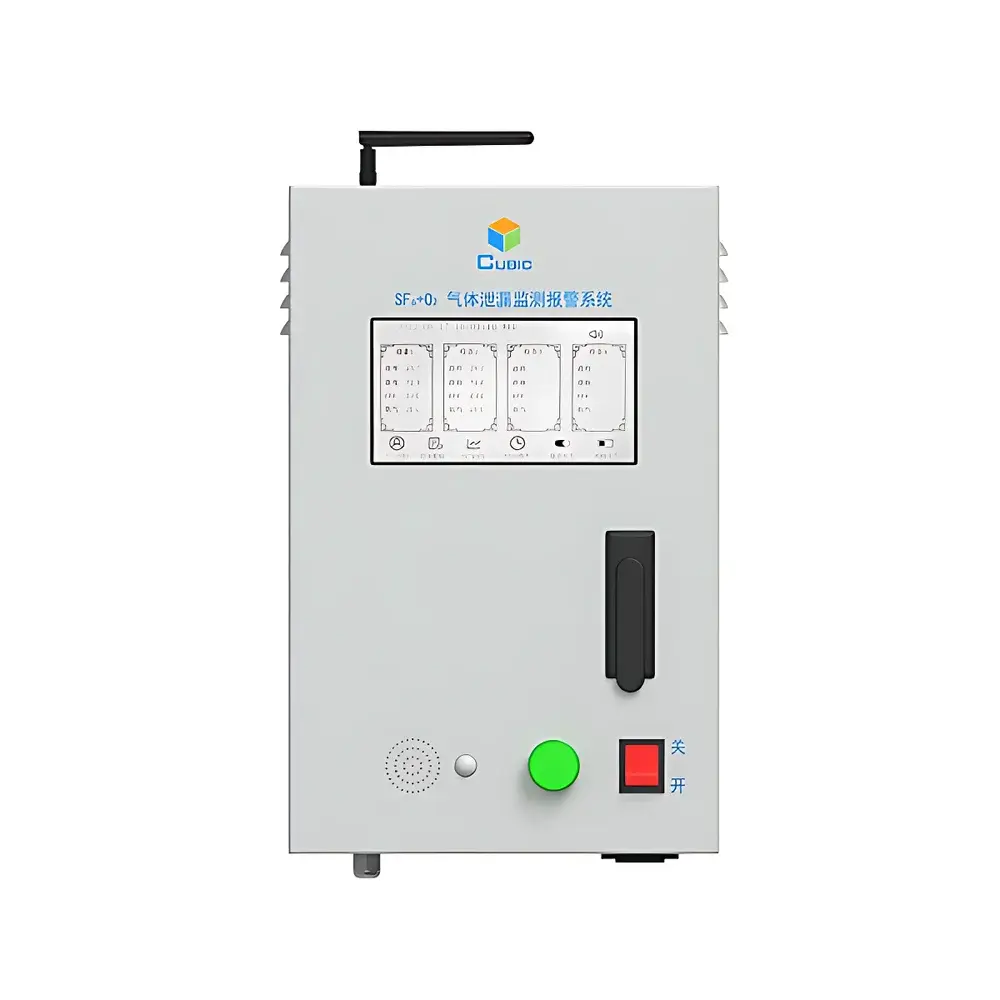
Cubic SF6+O2 Integrated Environmental Monitoring Control Cabinet
| Brand | Cubic |
|---|---|
| Origin | Hubei, China |
| Manufacturer Type | Authorized Distributor |
| Country of Origin | China |
| Model | SF6+O2-CAB-7IN |
| Price | Upon Request |
| Display | 7-inch resistive touchscreen (800×480) |
| Alarm Triggers | SF6 ≥ 1000 ppm, O₂ ≤ 19.6% vol |
| Communication | RS485 (≤1000 m), Wi-Fi |
| PIR Detection Range | ≥3 m |
| Relay Output Capacity | 250 VAC / 10 A |
| Data Retention | 10 years (non-volatile memory) |
| Enclosure Rating | IP54 (customizable) |
| Operating Temp. | –20°C to +50°C |
| Humidity Range | 0–90% RH (non-condensing) |
| Power Supply | AC 220 V ±10%, 50 Hz ±1%, <15 W |
| Compliance | DL/T 1555–2016, DL/T 639, JB/T 10893 |
Overview
The Cubic SF6+O2 Integrated Environmental Monitoring Control Cabinet is an engineered central control system designed for continuous, real-time monitoring of sulfur hexafluoride (SF₆) and oxygen (O₂) concentrations—alongside ambient temperature and relative humidity—in enclosed high-voltage electrical substations, GIS switchgear rooms, and other critical indoor power infrastructure environments. Built upon electrochemical (O₂) and non-dispersive infrared (NDIR) sensing principles for SF₆, the cabinet integrates multi-node sensor inputs into a unified supervisory platform. Its architecture complies with Chinese national standards DL/T 1555–2016 (for SF₆ leakage monitoring in GIS facilities), DL/T 639 (safety requirements for SF₆ handling), and JB/T 10893 (industrial gas detection systems), ensuring operational alignment with utility-sector safety protocols and regulatory expectations for confined-space atmospheric integrity.
Key Features
- 7-inch industrial-grade resistive touchscreen display (800 × 480 resolution) with intuitive HMI interface for real-time visualization of SF₆ concentration (ppm), O₂ volume percentage (% vol), temperature (°C), and humidity (% RH)
- Dual-mode alarm activation: visual (LED strobe), audible (integrated speaker with human-voice annunciator), and relay-triggered actuation (e.g., forced ventilation initiation)
- Passive infrared (PIR) motion detection module with ≥3-meter sensing range, enabling occupancy-aware operation and energy-efficient duty cycling
- Configurable relay logic: automatic fan activation on SF₆ ≥1000 ppm or O₂ ≤19.6% vol; manual override; and scheduled ventilation cycles
- Non-volatile internal memory retaining ≥10 years of timestamped event logs—including alarms, faults, calibration actions, and system status changes—with power-loss resilience
- Robust enclosure rated IP54 (dust-protected, splash-resistant); optional custom IP upgrades available for specific site deployment requirements
- Redundant communication interfaces: isolated RS485 (max. 1000 m cable run, Modbus RTU protocol) and IEEE 802.11 b/g/n Wi-Fi for cloud-connected telemetry and remote configuration
- Automatic network time synchronization via NTP or internal RTC, ensuring audit-trail consistency across distributed sensor nodes
Sample Compatibility & Compliance
The control cabinet is intended for use with Cubic’s certified SF₆ and O₂ sensor modules (e.g., CDM-100 series), supporting up to 32 distributed detection points per cabinet. It operates reliably under environmental conditions specified in IEC 60780-2 (nuclear and power industry environmental testing) and meets electromagnetic compatibility (EMC) requirements per GB/T 17626 series. All firmware and data handling workflows adhere to DL/T 1555–2016’s mandatory logging, alarm escalation, and response timing stipulations. While not intrinsically explosion-proof, its IP54-rated housing and relay isolation design support safe integration within Zone 2 classified areas when deployed with certified field sensors meeting EN 60079-0/11 standards.
Software & Data Management
Firmware supports Modbus RTU register mapping for SCADA integration and provides RESTful API endpoints over Wi-Fi for third-party platform ingestion (e.g., Siemens Desigo, Schneider EcoStruxure). Event logs are stored in binary-encoded, CRC-secured format to prevent tampering; exportable via USB or secure FTP as CSV with ISO 8601 timestamps. Audit trails include user login history, parameter modification records, and sensor zero/span calibration metadata—supporting GLP-aligned documentation practices. Remote firmware updates are digitally signed and validated prior to installation, fulfilling basic cybersecurity hygiene requirements outlined in NIST SP 800-53 Rev. 5 (SI-2, SI-3).
Applications
- GIS (Gas-Insulated Switchgear) rooms in 110 kV–1000 kV substations, where SF₆ leakage poses asphyxiation and dielectric failure risks
- Underground transformer vaults and cable tunnel access chambers requiring O₂ deficiency warning prior to personnel entry
- High-voltage laboratory test bays and manufacturing cleanrooms handling SF₆-filled equipment
- Renewable-integrated microgrids with compact switchgear enclosures demanding compact, low-power monitoring solutions
- Utility asset management programs requiring long-term trend analysis of ambient gas composition correlated with maintenance cycles
FAQ
What communication protocols does the cabinet support?
It natively implements Modbus RTU over RS485 and TCP/IP-based Wi-Fi connectivity using standard HTTP/HTTPS and Modbus TCP for interoperability with existing SCADA and BMS platforms.
Can the cabinet operate without external network connectivity?
Yes—the core monitoring, local alarm, relay control, and data logging functions remain fully autonomous offline; network connectivity is required only for remote supervision and historical data retrieval.
Is the system compliant with international electrical safety standards?
It conforms to GB/T 16836 (electrical safety for measuring instruments) and withstands 1500 VAC dielectric strength testing between power input and chassis ground, satisfying minimum insulation requirements for Class I equipment per IEC 61010-1.
How is sensor calibration managed?
Zero and span calibration can be performed locally via touchscreen menu or remotely via command register write; all calibration events are immutably logged with operator ID and timestamp.
What is the expected service life of the cabinet’s internal components?
Designed for >10 years of continuous operation under rated environmental conditions, with industrial-grade capacitors, conformally coated PCBs, and thermal derating applied to power electronics.
Related Products







