
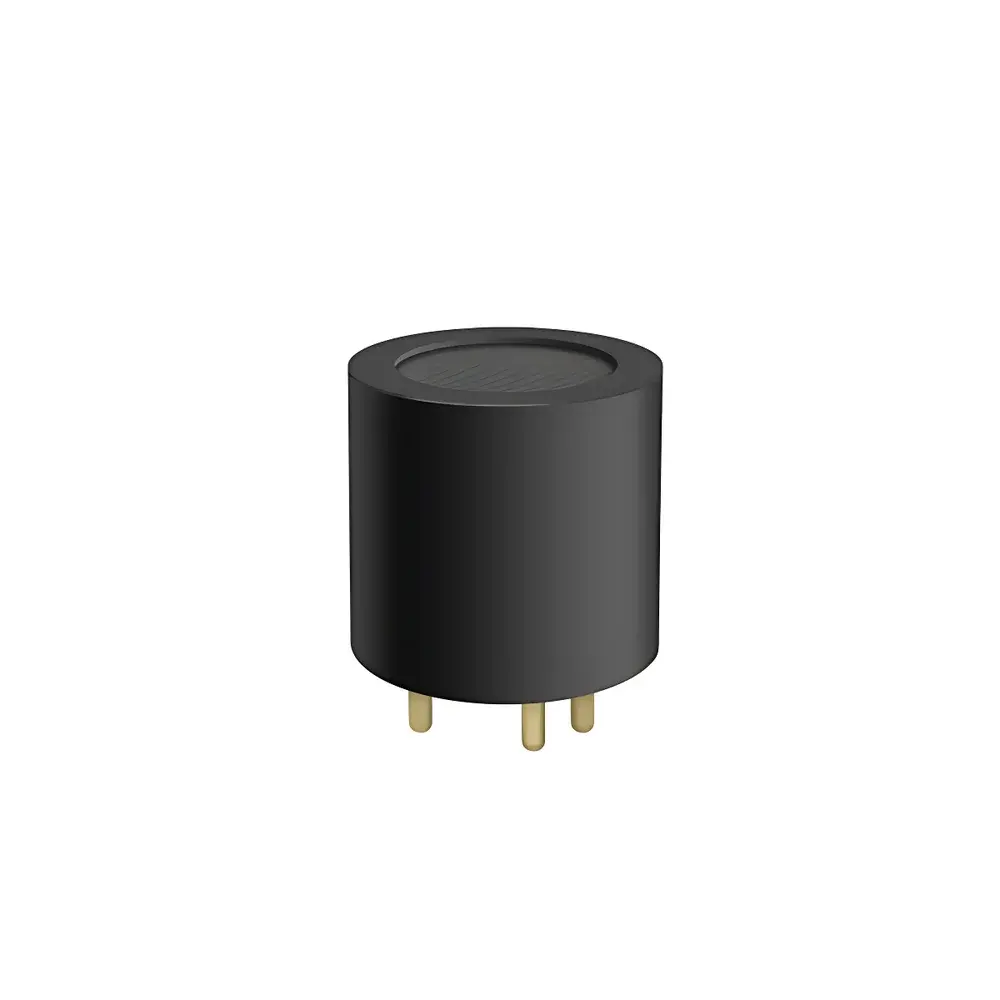
Cubic SRH-20 Miniature NDIR Carbon Dioxide Sensor
| Brand | Cubic |
|---|---|
| Origin | Hubei, China |
| Manufacturer Type | Authorized Distributor |
| Origin Category | Domestic (China) |
| Model | SRH-20 |
| Price | USD 365 (FOB) |
| Detection Principle | Non-Dispersive Infrared (NDIR) |
| Range | 0–20% vol CO₂ |
| Accuracy | ≤±0.5% vol (0–5% vol), ≤±10% of reading (5–20% vol) |
| Resolution | 0.01% vol |
| Operating Temperature | −10°C to +50°C |
| Storage Temperature | −40°C to +70°C |
| Humidity Range | 0–95% RH (non-condensing) |
| Warm-up Time | 10 s |
| Response Time (T₉₀) | <25 s |
| Supply Voltage | 3.3–5.5 VDC |
| Average Current Consumption | <40 mA |
| UART Baud Rate | 9600 bps |
| Dimensions | Φ20 × 16.6 mm (excl. pins) |
| Weight | 5 g |
| Service Life | >10 years |
| IP Rating | IP64 |
| Output Interface | Digital UART (TTL-level) |
Overview
The Cubic SRH-20 is a compact, high-reliability miniature carbon dioxide (CO₂) sensor engineered for continuous, real-time gas concentration monitoring in space-constrained and power-sensitive applications. It employs a proprietary non-dispersive infrared (NDIR) detection architecture with a thermopile detector and dual-wavelength reference compensation, enabling selective, interference-resistant measurement of CO₂ across a 0–20% volume range. Unlike electrochemical or catalytic bead sensors, the SRH-20 exhibits no susceptibility to poisoning, drift from humidity fluctuations, or cross-sensitivity to common atmospheric gases such as CO, CH₄, SO₂, or NOₓ—making it suitable for long-term deployment in unattended environmental and industrial settings. Its solid-state optical path, hermetically sealed IR source, and temperature-compensated signal processing ensure metrological stability over its rated 10-year operational lifetime.
Key Features
- Miniaturized form factor (Φ20 × 16.6 mm, 5 g) optimized for integration into portable analyzers, HVAC controllers, medical ventilators, and IoT-enabled air quality nodes.
- High-resolution digital output (0.01% vol resolution) via TTL-level UART interface at 9600 bps, eliminating analog signal conditioning requirements and reducing system-level noise susceptibility.
- IP64-rated housing provides protection against dust ingress and water splashing—validated for use in non-condensing indoor environments and semi-outdoor enclosures.
- Fast thermal stabilization (10 s warm-up) and rapid T₉₀ response (<25 s) support dynamic CO₂ tracking in rapidly changing air streams, including demand-controlled ventilation (DCV) loops.
- Full-range accuracy specification: ≤±0.5% vol absolute error within 0–5% vol; ≤±10% of reading above 5% vol—aligned with ISO 7726 and ASHRAE Standard 62.1 verification thresholds for indoor air quality (IAQ) monitoring.
- Low-power operation (3.3–5.5 VDC, <40 mA avg.) enables battery-powered deployments with multi-year runtime when paired with duty-cycled sampling protocols.
Sample Compatibility & Compliance
The SRH-20 is designed for direct sampling of ambient air and non-corrosive gas mixtures. It does not require sample conditioning (e.g., filtration or drying) under standard indoor operating conditions (0–95% RH, non-condensing). The sensor complies with RoHS Directive 2011/65/EU and REACH Regulation (EC) No. 1907/2006. While not certified to ATEX or IECEx for hazardous locations, its intrinsic safety profile (low voltage, low energy) supports Class I, Division 2 / Zone 2 installation when integrated into appropriately rated host systems. Calibration traceability follows NIST-traceable reference gas standards (CO₂ in N₂, certified to ISO 6142).
Software & Data Management
The SRH-20 communicates exclusively via ASCII-based UART protocol, supporting simple command-response interaction for configuration (e.g., baud rate adjustment, zero calibration trigger) and real-time data polling. Raw CO₂ concentration values are transmitted as ASCII strings (e.g., “CO2=1234” for 1234 ppm), facilitating seamless integration with microcontroller firmware (Arduino, ESP32, STM32), PLCs, and SCADA platforms. For regulatory-compliant deployments, users may implement audit-trail logging on the host system to meet GLP/GMP data integrity expectations per FDA 21 CFR Part 11—though the sensor itself does not store historical data or provide cryptographic signing.
Applications
- Indoor Air Quality (IAQ) monitoring in smart buildings, schools, and offices for demand-controlled ventilation (DCV) compliance with EN 16798-1 and ASHRAE 62.1.
- Respiratory gas analysis subsystems in portable spirometers and anesthesia monitors (Class II medical device integration per IEC 60601-1, pending final system-level validation).
- Control feedback in CO₂-enriched agricultural chambers and vertical farming environments.
- Leak detection and process gas monitoring in food packaging lines (modified atmosphere packaging, MAP) and beverage carbonation systems.
- Embedded sensing in consumer-grade air purifiers and smart thermostats requiring UL/CE-marked gas sensing modules.
FAQ
Does the SRH-20 require periodic field calibration?
Yes—while factory-calibrated with NIST-traceable standards, annual zero-point verification using certified zero air (or ambient air scrubbed of CO₂) is recommended for applications requiring ≤±0.5% vol accuracy in the low-range segment.
Can the sensor operate in high-humidity environments?
It is rated for 0–95% RH non-condensing operation; prolonged exposure to condensation or aerosol-laden airstreams requires upstream hydrophobic filtration to prevent optical window fouling.
Is the UART interface compatible with RS-232 or RS-485 systems?
No—the SRH-20 outputs TTL-level logic (0 V / 3.3 V), requiring level-shifting circuitry for compatibility with RS-232 (±12 V) or RS-485 differential bus systems.
What is the expected drift over 10 years?
Typical long-term baseline drift is <±2% of full scale per year under continuous operation at 25°C and 50% RH, verified per accelerated life testing per IEC 60721-3-3 Class 3K3.
Does Cubic provide OEM calibration certificates?
Yes—each unit ships with a factory calibration report listing serial number, date, test gas concentrations, measured output, and uncertainty budget per ISO/IEC 17025 principles.
Related Products







