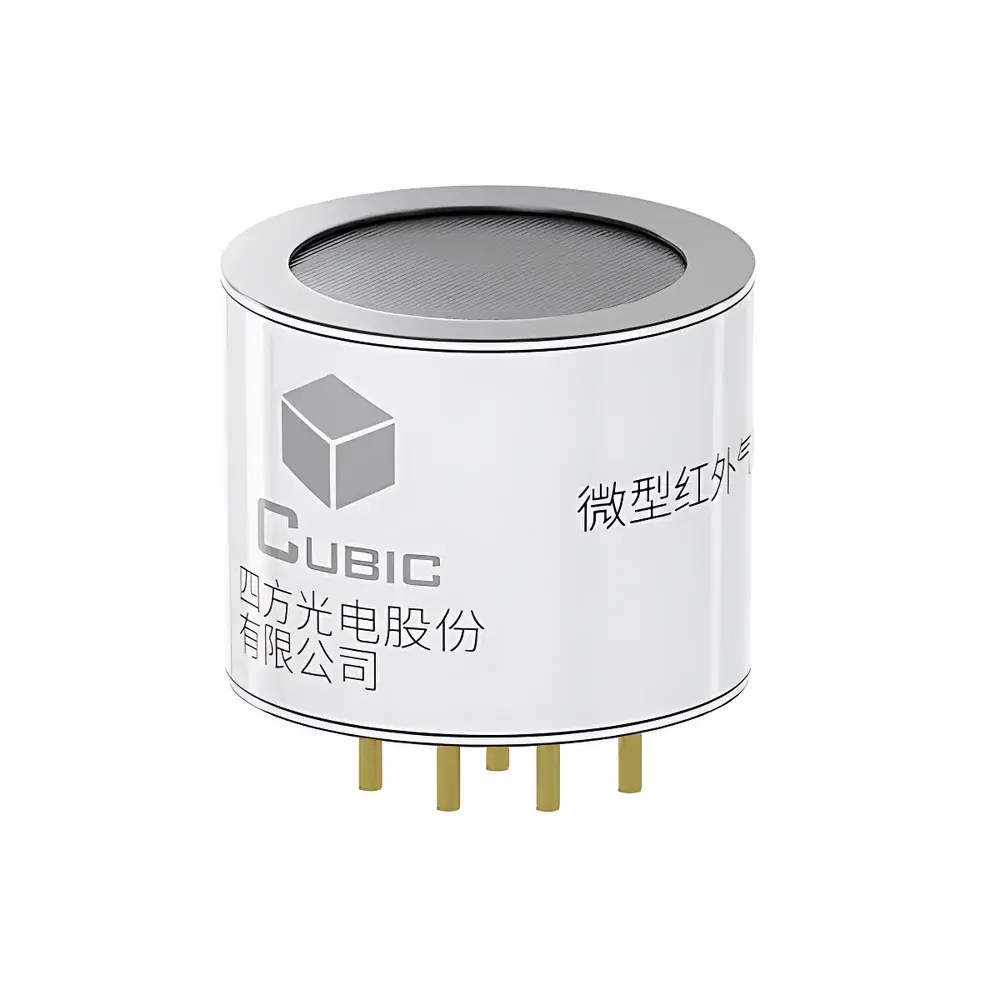
Cubic SRH Miniature NDIR Carbon Dioxide Sensor
| Brand | Cubic |
|---|---|
| Origin | Hubei, China |
| Manufacturer Type | Authorized Distributor |
| Country of Origin | China |
| Model | SRH |
| Price | USD 250 (FOB) |
| Detection Principle | Non-Dispersive Infrared (NDIR) |
| Measurement Ranges | 0–5000 ppm |
| Accuracy | ±25 ppm or ±10% of reading (for ppm ranges) |
| Operating Temperature | −20 °C to +55 °C |
| Storage Temperature | −40 °C to +70 °C |
| Humidity Range | 0–95% RH (non-condensing) |
| Explosion Protection | Exia II C T4 Ga |
| Output Options | Digital (UART TTL/RS485) and Analog (0–5 V / 4–20 mA) |
| Housing | All-metal, dual-beam optical architecture |
| Dimensions | Φ20 × 19 mm / Φ20 × 16.6 mm (excluding pins) |
Overview
The Cubic SRH Miniature NDIR Carbon Dioxide Sensor is an industrial-grade, non-dispersive infrared (NDIR) gas sensing module engineered for high-reliability CO₂ concentration measurement in ambient air and process gas streams. Unlike catalytic bead or thermal conductivity-based sensors, the SRH employs a dual-beam NDIR optical architecture—featuring a dedicated measurement channel and reference channel—to actively compensate for optical drift, dust accumulation, and source aging. This design ensures long-term baseline stability and minimizes recalibration frequency in uncontrolled environments. The sensor operates on the fundamental absorption principle of CO₂ at 4.26 µm wavelength, with a thermopile detector and integrated temperature-compensated microcontroller enabling full-scale temperature compensation across its entire operating range (−20 °C to +55 °C). Its compact cylindrical form factor (Φ20 × 16.6 mm or Φ20 × 19 mm) and robust all-metal housing make it suitable for integration into OEM analyzers, HVAC controllers, safety monitors, and portable gas detection instruments.
Key Features
- Dual-beam NDIR optical path design for inherent drift compensation and enhanced long-term repeatability
- Full-range temperature compensation algorithm embedded in firmware—no external calibration required across −20 °C to +55 °C
- All-metal hermetic housing providing mechanical durability, EMI resilience, and resistance to chemical vapor exposure
- Simultaneous analog (0–5 V DC or 4–20 mA) and digital (UART TTL or RS485) output interfaces for flexible system integration
- ATEX/IECEx-certified intrinsic safety rating: Exia II C T4 Ga—suitable for use in Zone 0/1 hazardous areas including petrochemical refineries and coal mine ventilation systems
- Multiple configurable measurement spans: 0–5000 ppm, 0–10,000 ppm, 0–20,000 ppm, and volumetric ranges up to 20% vol
- No consumables or moving parts—designed for >5 years operational lifetime under continuous duty
Sample Compatibility & Compliance
The SRH sensor is optimized for CO₂ measurement in dry to moderately humid air (0–95% RH, non-condensing). It exhibits minimal cross-sensitivity to common interferents including CO, CH₄, SO₂, and NO₂ (<2% signal deviation at 1000 ppm interferent concentration), verified per ISO 12039 and ASTM D6250 test protocols. The device complies with IEC 60079-0 (general requirements for explosive atmospheres) and IEC 60079-11 (intrinsic safety ‘ia’ protection), certified to Exia II C T4 Ga classification. Electrical interface design meets EMC standards per EN 61326-1 (industrial environment) and RoHS 2015/863/EU. For regulated applications—including pharmaceutical cleanroom monitoring and medical device integration—the sensor supports traceable factory calibration with NIST-traceable reference gases and optional GLP-compliant calibration certificates.
Software & Data Management
The SRH communicates via ASCII protocol over UART (TTL-level or RS485) with configurable baud rates (9600–115200 bps) and CRC-8 frame integrity checking. A standard command set enables real-time data polling, span adjustment, zero calibration trigger, and firmware version query. Optional evaluation software (Windows/Linux/macOS) provides live waveform visualization, data logging (CSV export), and batch configuration of multiple nodes in distributed networks. When deployed in FDA-regulated environments (e.g., incubator atmosphere control or bioreactor headspace monitoring), the sensor’s digital output supports audit trail generation when paired with compliant SCADA or LIMS platforms adhering to 21 CFR Part 11 requirements for electronic records and signatures.
Applications
- Industrial process gas monitoring in petrochemical cracking units and syngas purification loops
- Continuous emissions monitoring (CEM) pre-analyzer sampling modules for flue gas ducts
- Indoor air quality (IAQ) control in smart buildings, schools, and hospitals per ASHRAE Standard 62.1
- Medical respiratory equipment and capnography subsystems requiring low-power, high-stability CO₂ sensing
- Environmental research stations measuring soil respiration or atmospheric boundary layer CO₂ gradients
- OEM integration into portable multi-gas detectors used in mining safety and confined-space entry protocols
FAQ
What calibration standards are used during factory calibration?
Factory calibration is performed using NIST-traceable CO₂ reference gases (certified by BAM or NPL) across three points per range, with uncertainty <±1.5% of reading at 23 °C and 50% RH.
Can the SRH operate in condensing humidity conditions?
No—the sensor is rated for 0–95% RH non-condensing only. Prolonged exposure to condensation may damage the optical window or cause internal corrosion; use with integrated desiccant filters or heated sample lines is recommended in high-humidity applications.
Is firmware upgrade supported in-field?
Yes—UART-based firmware updates are supported via bootloader mode; updated versions include improved temperature compensation models and expanded diagnostic registers.
Does the sensor require periodic zero/span calibration in operation?
While not mandatory due to dual-beam stability, annual verification against certified gas is recommended for GMP/GLP compliance; automatic baseline correction is disabled by default but can be enabled via configuration command.
What is the expected service life under continuous operation?
Minimum 5 years MTBF (Mean Time Between Failures) demonstrated in accelerated life testing at 40 °C and 70% RH, assuming nominal power cycling and no mechanical shock or corrosive gas exposure beyond specification limits.