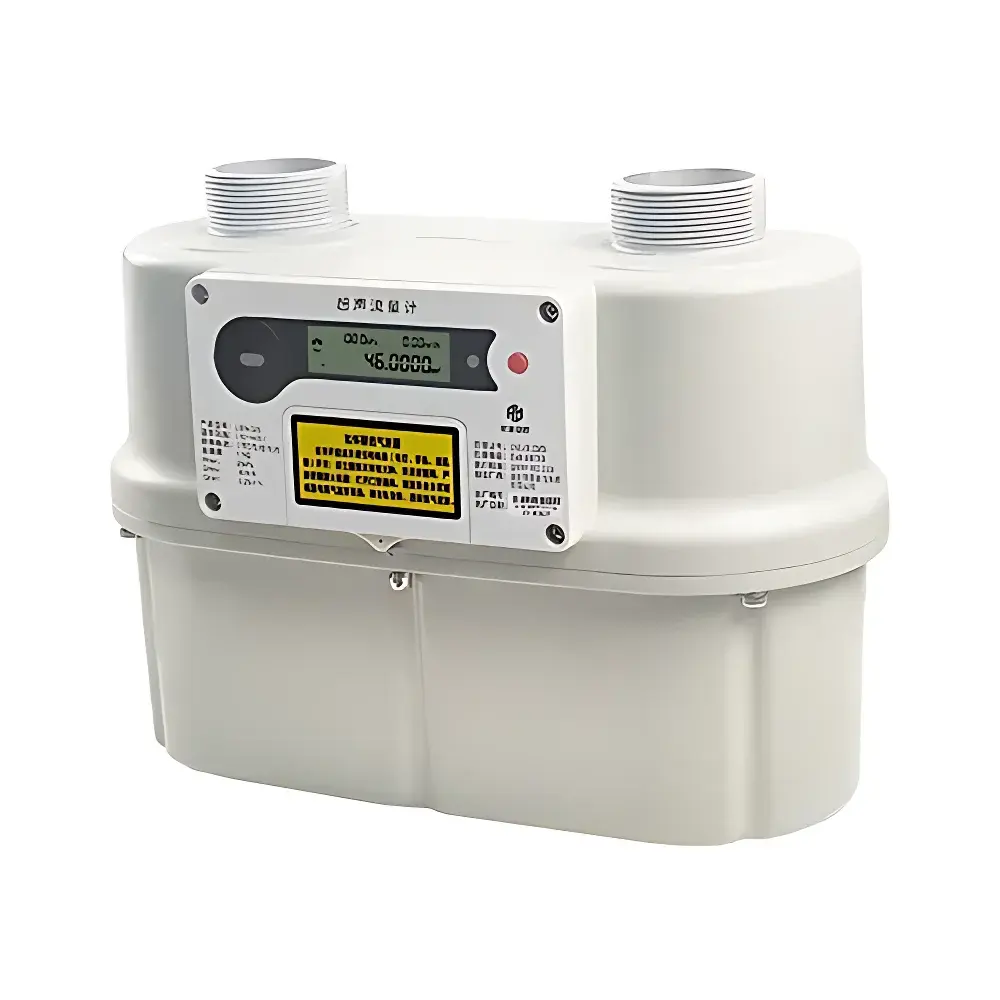
Cubic USM Series Commercial & Industrial Ultrasonic Gas Meters
| Brand | Cubic |
|---|---|
| Origin | Hubei, China |
| Manufacturer Type | Authorized Distributor |
| Country of Origin | China |
| Model | USM |
| Product Type | Ultrasonic Gas Flowmeter |
| Measurement Principle | Transit-Time Ultrasonic Flow Measurement |
| Accuracy Class | 1.5 |
| Operating Pressure Range | 0–50 kPa |
| Operating Temperature | −10 °C to +40 °C |
| Storage Temperature | −20 °C to +60 °C |
| Explosion Protection | Ex ib IIB T3 Gb |
| Ingress Protection | IP54–IP65 |
| Power Supply | ER34615 Lithium Battery, 3.6 V |
| Flow Range (USM-G25) | 0.25–40 m³/h |
| Flow Range (USM-G40) | 0.4–65 m³/h |
| Flow Range (USM-G65) | 0.65–100 m³/h |
| Connection | Threaded (G2, G2½) |
| Dimensions (USM-G25/G40) | 330 × 244/248 × 167 mm |
| Weight | ~4 kg |
Overview
The Cubic USM Series Commercial & Industrial Ultrasonic Gas Meters are precision-engineered, fully electronic flow measurement instruments designed for accurate volumetric flow metering of natural gas in commercial and light industrial applications. Utilizing the transit-time ultrasonic principle, the USM series determines gas velocity by measuring the time difference between upstream and downstream ultrasonic pulse propagation across the pipe cross-section. This non-intrusive, clamp-on–compatible design eliminates mechanical wear, pressure drop, and sealing-related leakage risks inherent in diaphragm-type meters. The meters comply with EN 1434 (domestic and commercial gas meters), OIML R137 (gas meters – metrological and technical requirements), and support traceable calibration under ISO/IEC 17025-accredited laboratory conditions. Built for long-term stability, the USM series integrates temperature and pressure compensation algorithms in real time to deliver corrected volume (standard cubic meters at 15 °C and 101.325 kPa), ensuring compliance with billing-grade accuracy requirements in regulated utility environments.
Key Features
- Transit-time ultrasonic measurement technology delivering high sensitivity across wide turndown ratios (up to 1:160 for USM-G65), enabling reliable low-flow detection without mechanical hysteresis;
- Integrated multi-parameter sensing: simultaneous measurement of volumetric flow rate, static gas temperature, and line pressure using co-located, factory-aligned transducers;
- Zero-moving-parts architecture—no diaphragms, gears, or magnetic couplings—eliminating mechanical drift, friction-induced error, and susceptibility to external magnetic fields;
- Low-pressure loss design (< 100 Pa at Qmax), reducing system energy consumption and mitigating compressor load in distributed gas networks;
- Fully domesticated signal processing chain: proprietary ASIC-based ultrasonic signal conditioning, temperature-compensated time-of-flight calculation, and dual-channel pressure sensor fusion;
- Robust mechanical construction with aluminum alloy housing, conformal-coated PCBs, and IP54–IP65-rated enclosures suitable for indoor and semi-outdoor installation;
- Intrinsic safety certification per Ex ib IIB T3 Gb for use in Zone 1 hazardous areas where natural gas may be present in potentially explosive concentrations.
Sample Compatibility & Compliance
The USM series is validated for dry, clean natural gas (methane-rich, Wobbe index 48–53 MJ/m³, calorific value ≥34 MJ/m³) meeting ISO 13686 and EN 437 specifications. It is not intended for biogas, hydrogen-blended gas (>5% H₂), or corrosive/condensing media. All units undergo individual verification per EN 1434 Annex B, including repeatability testing at Qmin, Qt, and Qmax, as well as pressure loss characterization. Documentation includes EU Declaration of Conformity (DoC), test reports from CNAS-accredited laboratories, and optional UKCA/CE marking packages aligned with UK Statutory Instrument 2016 No. 1150 and EU Regulation (EU) 2016/426. Traceability to NIM (National Institute of Metrology, China) and BIPM reference standards is maintained throughout production and calibration.
Software & Data Management
Meter configuration, diagnostics, and data retrieval are supported via IR optical interface or optional M-Bus/RS485 communication modules compliant with EN 13757-3. The embedded firmware implements secure parameter locking, event logging (e.g., battery voltage drop, temperature excursions, tamper attempts), and configurable data storage intervals (15-min to 1-hour integrated profiles). Optional cloud connectivity enables remote firmware updates, anomaly detection via statistical process control (SPC) thresholds, and integration into SCADA or AMI platforms supporting DLMS/COSEM v6.2. Audit trails meet GLP-aligned requirements for data integrity, including immutable timestamping, user role-based access control, and cryptographic signature of critical configuration changes—fully compatible with FDA 21 CFR Part 11 readiness assessments when deployed in regulated infrastructure monitoring contexts.
Applications
- Commercial building gas supply monitoring (hotels, hospitals, shopping malls);
- Light industrial process gas allocation (food processing, textile drying, HVAC boiler feed);
- District heating network fuel input metering;
- Gas distribution substation balancing and leak detection support;
- Energy management systems (EnMS) per ISO 50001 requiring certified sub-metering;
- Smart city utility infrastructure with NB-IoT or LoRaWAN telemetry gateways.
FAQ
What gas composition is supported by the USM series?
Natural gas meeting ISO 13686 Group H or L specifications (methane ≥85%, inert gases ≤15%, no condensables or particulates above 5 µm).
Is field recalibration required during service life?
No routine recalibration is mandated; the USM series maintains metrological stability per EN 1434 Clause 7.3. Verification every 8 years (or per local regulatory cycle) is recommended using portable ultrasonic provers traceable to national standards.
Can the USM operate with fluctuating inlet pressure?
Yes—the built-in absolute pressure sensor (range 80–120 kPa abs) and dynamic compensation algorithm ensure volumetric correction remains valid across the specified 0–50 kPa gauge operating band.
Does the device support pulse output for legacy BMS integration?
Yes—optical pulse output (S0 interface) is standard, configurable for 100 or 1000 pulses per m³, with galvanic isolation and adjustable debounce filtering.
How is battery life managed under continuous operation?
The ER34615 lithium thionyl chloride cell delivers ≥10 years of operation at 15-min reading intervals, with low-power sleep mode and end-of-life voltage monitoring reported via diagnostic registers.