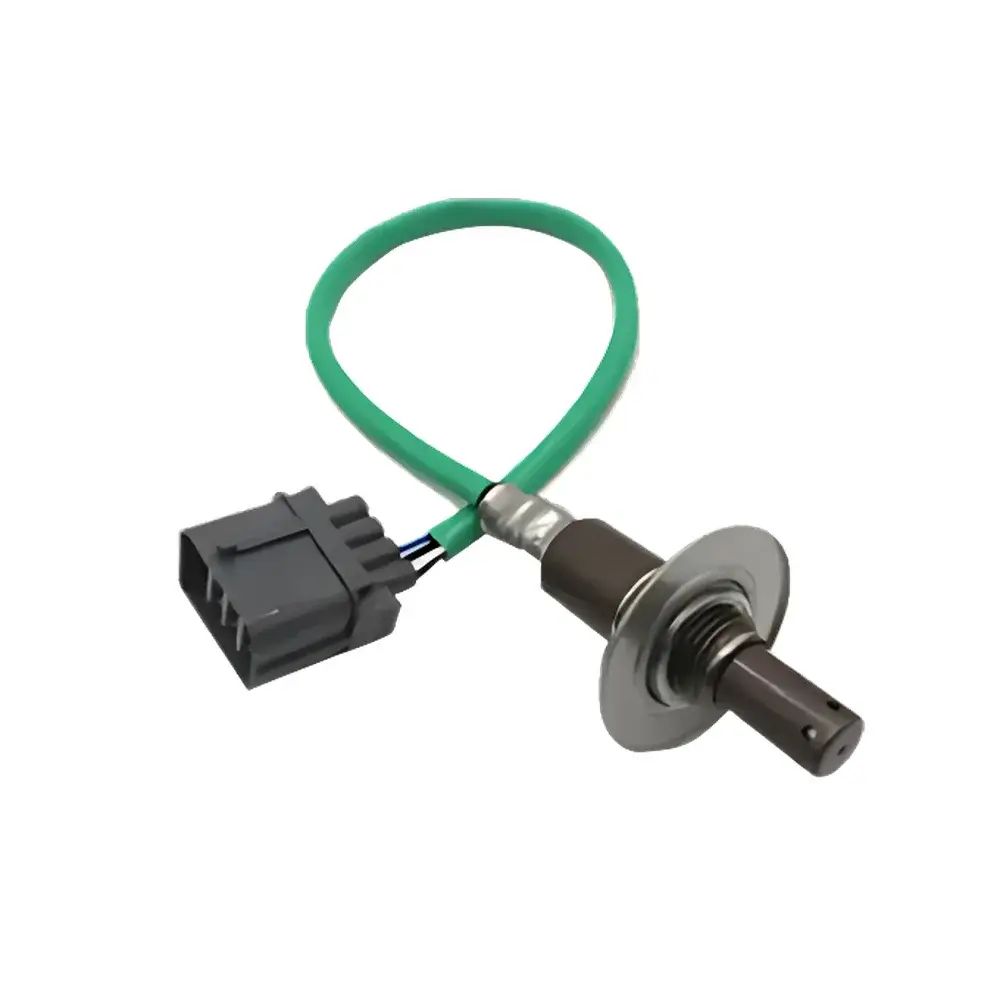
Cubic ZS-AFR-01 Planar Wideband Oxygen Sensor
| Brand | Cubic |
|---|---|
| Origin | Hubei, China |
| Manufacturer Type | Authorized Distributor |
| Country of Origin | China |
| Model | ZS-AFR-01 |
| Operating Voltage | DC 9–12 V |
| Storage Temperature | −40 °C to 90 °C |
| Operating Exhaust Temperature Range | 150 °C to 930 °C |
| Mounting Thread | M18×1.5 |
| Heater Steady-State Power | 10 W |
| Measurement Accuracy (at λ = 1) | ±0.02 |
| Air–Fuel Ratio (AFR) Measurement Range | 0–2 (λ-equivalent) |
| Light-Off Time | < 15 s |
| Sensing Principle | Zirconia-based Solid Electrolyte (High-Temperature Nernst + Pump Cell Configuration) |
Overview
The Cubic ZS-AFR-01 Planar Wideband Oxygen Sensor is an automotive-grade exhaust gas sensor engineered for precise, real-time air–fuel ratio (AFR) monitoring across the full stoichiometric and lean-burn operating range (λ = 0 to 2). Unlike conventional narrowband zirconia sensors—limited to binary rich/lean detection near λ = 1—the ZS-AFR-01 employs a dual-cell electrochemical architecture: a Nernst reference cell and an oxygen-pumping cell integrated within a single high-temperature co-fired ceramic (HTCC) substrate. This planar design enables continuous, linear AFR quantification by actively controlling oxygen ion flux through the solid electrolyte under applied bias, thereby maintaining a reference oxygen partial pressure in the measurement chamber. The sensor operates reliably in harsh exhaust environments, supporting closed-loop fuel control strategies essential for modern gasoline powertrains complying with Euro 6, China 6, and EPA Tier 3 emission standards.
Key Features
- Planar HTCC monolithic structure ensuring mechanical robustness, thermal shock resistance, and long-term dimensional stability at sustained exhaust temperatures up to 930 °C.
- Integrated heater with low thermal mass and 10 W steady-state power consumption, achieving light-off in less than 15 seconds—critical for cold-start emissions compliance.
- Self-contained signal conditioning interface compatible with standard 9–12 V DC vehicle power systems; no external amplifier required for OEM integration.
- Proprietary electrode formulation and sintering process deliver high reproducibility in λ = 1 accuracy (±0.02) and minimal drift over 100,000 km equivalent service life.
- M18×1.5 threaded mounting interface conforming to ISO 228-1 and SAE J1927 mechanical specifications for universal fitment on manifold-mounted and downpipe exhaust configurations.
Sample Compatibility & Compliance
The ZS-AFR-01 is validated for use in gasoline-fueled internal combustion engines, including port fuel injection (PFI), direct injection (GDI), and homogeneous charge compression ignition (HCCI) architectures. It maintains stable output under transient exhaust conditions—including rapid AFR excursions, condensable hydrocarbon exposure, and intermittent water vapor ingress—without signal hysteresis or poisoning-induced calibration shift. The sensor meets functional safety requirements per ISO 26262 ASIL-B for sensor hardware elements and complies with electromagnetic compatibility (EMC) standards ISO 11452-2 (radiated immunity) and ISO 7637-2 (transient conducted immunity). All materials are RoHS-compliant and free of restricted substances per ELV Directive 2000/53/EC.
Software & Data Management
While the ZS-AFR-01 is an analog-output sensor (typically delivering 0–5 V or current-loop signals proportional to λ), it is fully interoperable with industry-standard engine control unit (ECU) calibration frameworks such as ETAS INCA, Vector CANape, and dSPACE ControlDesk. Its linear response curve enables straightforward polynomial or lookup-table mapping in ECU flash memory. For validation and diagnostics, raw sensor voltage and heater duty cycle data can be logged via CAN bus (using SAE J1939 or UDS protocol extensions) with timestamped traceability suitable for GLP-aligned development testing and regulatory submission documentation.
Applications
- Real-time AFR feedback control in gasoline engine management systems for optimal combustion efficiency and three-way catalyst (TWC) light-off performance.
- OBD-II compliant monitoring of catalyst conversion efficiency and misfire detection during drive-cycle certification (e.g., WLTC, FTP-75).
- Development and calibration of advanced combustion modes, including stratified-charge and ultra-lean burn operation.
- Aftermarket diagnostic tools and portable emissions analyzers requiring wide dynamic range and fast response time.
- Research applications in engine test cells, dynamometer laboratories, and emissions R&D facilities requiring traceable, repeatable λ measurements under variable load and speed conditions.
FAQ
What is the difference between a wideband oxygen sensor and a traditional zirconia sensor?
A traditional narrowband sensor only indicates whether the mixture is richer or leaner than stoichiometric (λ = 1) via a sharp voltage transition (~0.1–0.9 V). In contrast, the ZS-AFR-01 provides a continuous, linear analog output across λ = 0 to 2, enabling quantitative AFR control.
Can this sensor be used in diesel or flex-fuel applications?
It is specifically calibrated and validated for gasoline exhaust gas composition. Diesel applications require different reference gas handling and soot resistance; flex-fuel use necessitates extended hydrocarbon tolerance not covered in current type approval.
Does the sensor require periodic recalibration?
No field recalibration is required under normal operating conditions. The HTCC-based architecture exhibits inherent long-term stability, with factory calibration traceable to NIST-traceable gas standards and verified per ISO 17025 accredited procedures.
Is the ZS-AFR-01 compatible with CAN FD or SENT protocols?
The base model outputs analog voltage/current. Digital variants with SENT or CAN FD interfaces are available upon request as custom-engineered solutions for specific OEM platforms.