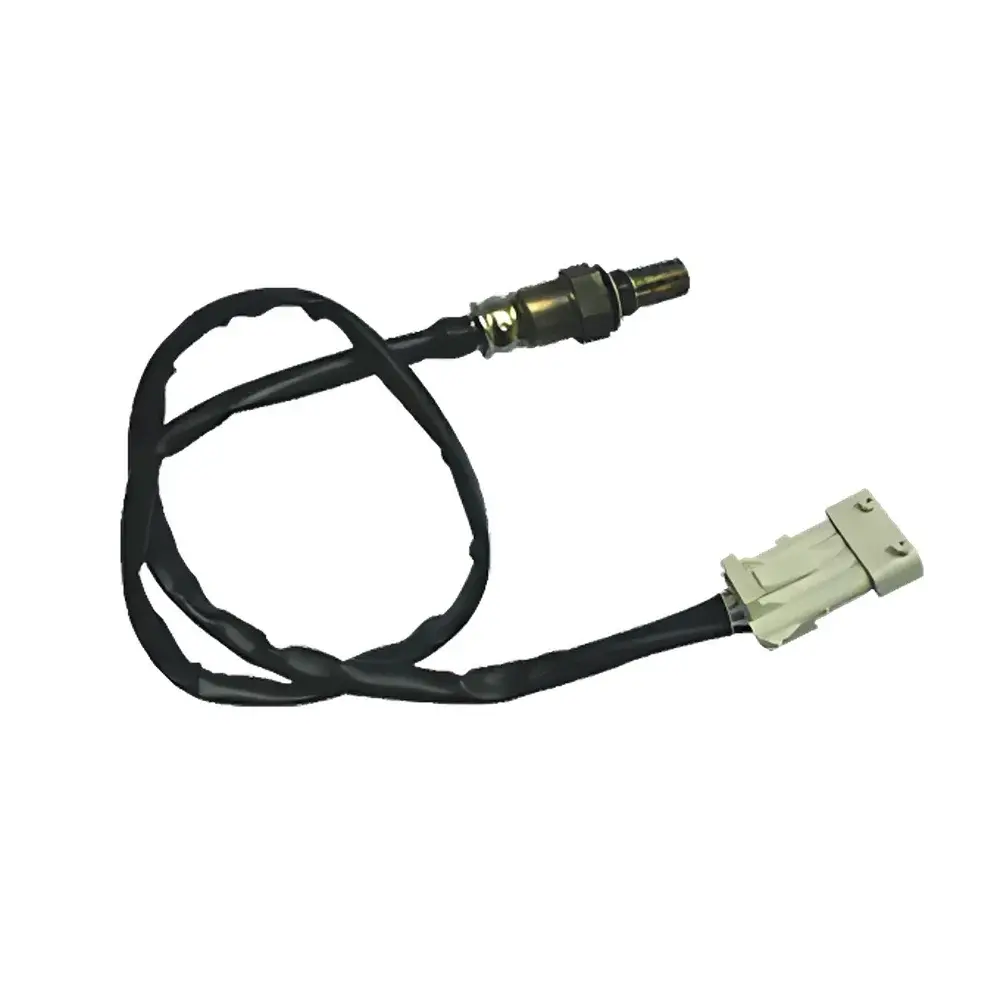
Cubic ZS-ST-09 Motorcycle Oxygen Sensor
| Brand | Cubic |
|---|---|
| Origin | Hubei, China |
| Manufacturer Type | Authorized Distributor |
| Country of Origin | China |
| Model | ZS-ST-09 |
| Application | Two-Wheeler Exhaust Lambda Monitoring |
| Detection Principle | Zirconia-Based Potentiometric (Limit-Current Type) |
| Operating Voltage | DC 12 V |
| Storage Temperature | −40 °C to +90 °C |
| Exhaust Gas Operating Temperature Range | 150 °C to 930 °C |
| Installation Thread | M12 × 1.25 |
| Signal Output Voltage (λ = 0.93–0.97) | ≥750 mV |
| Signal Output Voltage (λ = 1.05–1.10) | 50 ± 30 mV |
| Internal Resistance | ≤1 kΩ (at 850 °C: ≤0.5 kΩ) |
| Response Time (600 → 300 mV) | <150 ms |
| Response Time (300 → 600 mV) | <100 ms (at 850 °C: <60 ms) |
| Light-off Time | <15 s |
| Exhaust Moisture & Deposit Tolerance | High |
| Compliance | Designed for ISO 8767, SAE J167, and GB/T 20071-2022 (Motorcycle Emission Control Systems) |
Overview
The Cubic ZS-ST-09 Motorcycle Oxygen Sensor is a high-reliability, zirconia-based potentiometric lambda sensor engineered specifically for two-wheeled vehicle exhaust aftertreatment systems. It operates on the principle of oxygen ion conduction across a stabilized zirconium dioxide (ZrO2) electrolyte membrane under elevated temperatures—typically above 350 °C—enabling precise discrimination between fuel-rich (λ 1) combustion conditions. Unlike wideband sensors, the ZS-ST-09 functions as a binary switching device, delivering a sharp voltage transition near stoichiometric air-fuel ratio (λ = 1.0), which serves as the primary feedback signal for closed-loop fuel injection control in carbureted or EFI-equipped motorcycles. Its HTCC (High-Temperature Co-fired Ceramic) chip architecture ensures mechanical robustness, thermal shock resistance, and long-term stability in harsh exhaust environments characterized by thermal cycling, condensate exposure, and particulate deposition.
Key Features
- Proprietary HTCC ceramic chip fabricated in-house—no third-party wafer sourcing—ensuring full traceability and process control
- Optimized thermal mass and heater integration enabling light-off time <15 seconds, meeting stringent cold-start emission requirements per GB/T 20071-2022
- Signal stability maintained across exhaust gas temperatures from 150 °C to 930 °C, with internal resistance dropping from ≤1 kΩ (at 600 °C) to ≤0.5 kΩ (at 850 °C)
- Asymmetric response kinetics: <100 ms rise time (300 → 600 mV) and <150 ms fall time (600 → 300 mV) at operating temperature—critical for real-time AFR correction during transient throttle events
- Enhanced chemical resilience against sulfur compounds, phosphorus, and condensed hydrocarbons commonly found in two-stroke and low-displacement four-stroke exhaust streams
- M12 × 1.25 threaded stainless-steel housing with integrated sealing gasket—compatible with OEM mounting configurations across Honda, Yamaha, Suzuki, and domestic Chinese motorcycle platforms
Sample Compatibility & Compliance
The ZS-ST-09 is validated for use with gasoline-fueled internal combustion engines in motorcycles and scooters with displacement ranging from 50 cc to 650 cc. It interfaces directly with standard ECU analog input circuits compliant with SAE J167 signal conditioning specifications. The sensor meets the functional safety and environmental durability criteria outlined in ISO 8767 (Motorcycle Exhaust Gas Sensors – Performance Requirements) and aligns with China’s national standard GB/T 20071-2022 for motorcycle onboard diagnostic (OBD) systems. While not certified to automotive-grade AEC-Q200, its design incorporates GLP-aligned manufacturing controls—including lot-level calibration verification and accelerated life testing at 1,000 thermal cycles (−40 °C to 930 °C)—to support Tier 2 emissions compliance and extended service intervals.
Software & Data Management
As a hardware-level analog transducer, the ZS-ST-09 does not embed firmware or require driver software. Its millivolt-level output is interpreted directly by the host ECU using pre-programmed lookup tables or adaptive PID algorithms. For diagnostic and calibration validation, the sensor’s output may be logged via standardized OBD-II PIDs (e.g., PID 0x05 for oxygen sensor voltage) using generic scan tools compliant with ISO 15031-5 and SAE J1978. All production units undergo factory calibration against NIST-traceable reference gases (N2/O2 mixtures at λ = 0.95 and λ = 1.05) with documented uncertainty budgets; calibration certificates are available upon request for quality audit purposes.
Applications
- Closed-loop air-fuel ratio control in EFI-equipped motorcycles to maintain λ ≈ 1.0 during steady-state and transient operation
- Real-time monitoring of three-way catalytic converter (TWC) efficiency via upstream/downstream sensor pairing
- OBD-II readiness monitoring for post-catalyst oxygen storage capacity assessment
- Aftermarket engine tuning and emissions retrofitting for legacy two-wheelers targeting Euro 4/China 6 equivalence
- Research-grade combustion analysis in university and tier-2 powertrain labs studying lean-burn strategies and alternative fuels (e.g., ethanol blends, LPG)
FAQ
What is the difference between the ZS-ST-09 and wideband oxygen sensors?
The ZS-ST-09 is a narrowband (switching-type) sensor optimized for stoichiometric control—it outputs a binary voltage shift near λ = 1.0. Wideband sensors provide continuous linear output across λ = 0.7–1.5 but require complex control circuitry and are rarely used in cost-sensitive motorcycle ECUs.
Does this sensor require external heating control?
Yes—the integrated heater must be powered and regulated by the ECU per SAE J167 duty-cycle protocols. The sensor cannot operate below ~350 °C without active heating.
Can it withstand exposure to water condensate in the exhaust pipe?
Yes—its HTCC substrate and hermetic glass-metal seal exhibit proven resistance to thermal shock-induced cracking and electrochemical degradation from intermittent moisture ingress.
Is calibration required after installation?
No—factory calibration is permanent and non-field-adjustable. Signal drift beyond specification indicates physical contamination or heater failure, requiring replacement per GB/T 20071-2022 maintenance guidelines.
What is the typical service life under normal riding conditions?
Rated for ≥80,000 km or 5 years, assuming adherence to OEM fuel quality standards and absence of oil or coolant blow-by into the exhaust stream.