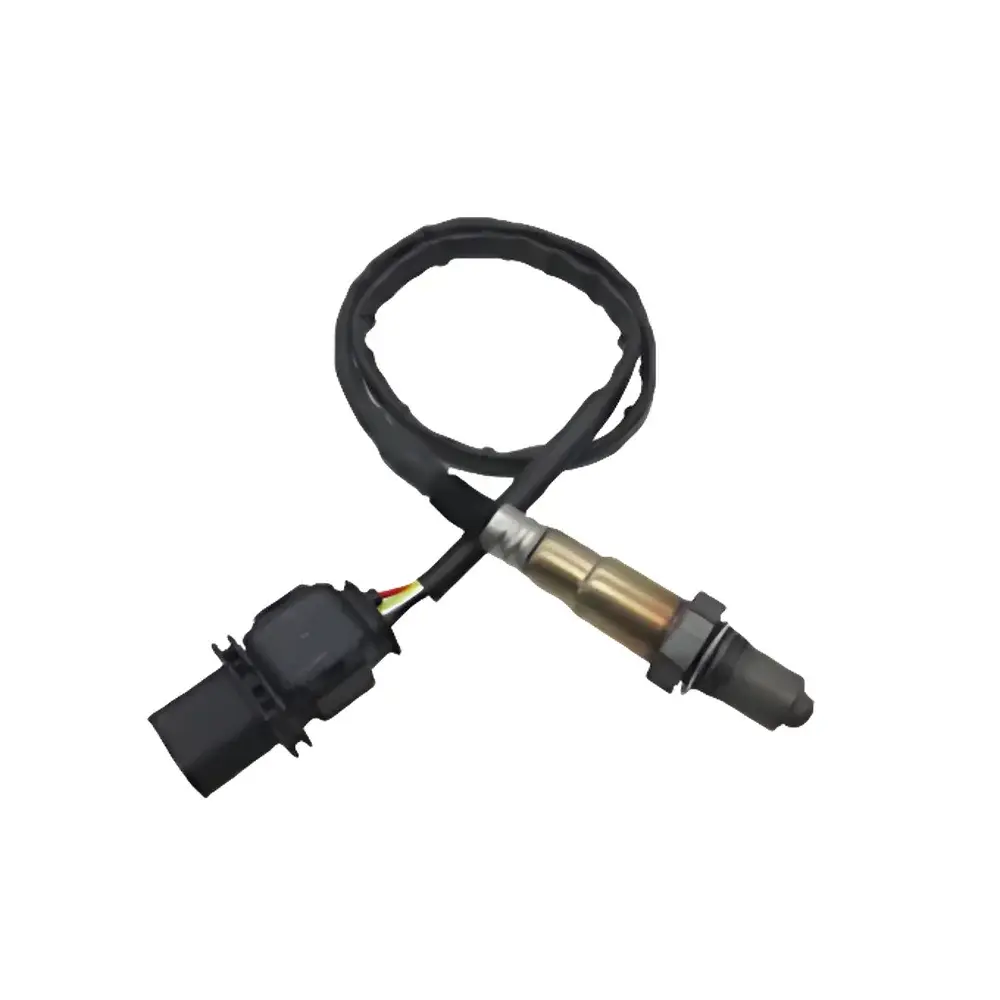
Cubic ZS-WB4.9-01 Wide-Range Oxygen Sensor
| Brand | Cubic |
|---|---|
| Origin | Hubei, China |
| Manufacturer Type | Authorized Distributor |
| Country of Origin | China |
| Model | LSU4.9-based Wide-Range Oxygen Sensor |
| Pricing | Available Upon Request |
| Detection Principle | Zirconia Solid Electrolyte (High-Temperature Nernst Principle) |
| Operating Voltage | DC 7.5 V |
| Storage Temperature | −40 °C to +90 °C |
| Exhaust Gas Operating Temperature Range | 150 °C to 930 °C |
| Mounting Thread | M18 × 1.5 |
| Heater Steady-State Power | 7.5 W |
| Nernst Cell Internal Resistance | 300 Ω |
| Lambda (λ) Measurement Range | 0.65 to ∞ |
| Lambda Accuracy | ±0.03 at λ = 0.8 |
Overview
The Cubic ZS-WB4.9-01 Wide-Range Oxygen Sensor is an automotive-grade, planar zirconia-based exhaust gas sensor engineered for continuous, high-fidelity lambda (λ) measurement across the full stoichiometric spectrum—from rich (λ 2.0). Unlike conventional narrow-band zirconia sensors that operate only near λ = 1.0 and provide binary rich/lean switching signals, the ZS-WB4.9-01 employs a dual-chamber electrochemical architecture based on the Nernst principle and oxygen-pump current control. Its core sensing element is fabricated using High-Temperature Co-fired Ceramic (HTCC) technology, ensuring mechanical robustness, thermal shock resistance, and long-term stability under cyclic thermal loading typical of modern internal combustion engine exhaust environments. Designed for integration into closed-loop air–fuel ratio control systems, this sensor enables real-time feedback for precise fuel injection modulation—critical for meeting stringent emissions regulations (e.g., Euro 6d, China 6b), optimizing combustion efficiency, and supporting advanced engine strategies such as lean-burn, EGR management, and cold-start emission reduction.
Key Features
- Planar HTCC ceramic substrate with integrated heater and dual-cell electrochemical structure (Nernst + pump cell)
- Wide lambda measurement range: 0.65 to ∞ — enabling accurate quantification from heavily fuel-rich to highly dilute exhaust conditions
- High-accuracy lambda output: ±0.007 at stoichiometric point (λ = 1.0), verified under controlled calibration gas mixtures per ISO 22743-2
- Robust thermal design: operational exhaust temperature range of 150 °C to 930 °C; integrated heater achieves rapid light-off (< 20 s to 600 °C under standard bench conditions)
- Stable Nernst cell impedance (~300 Ω at operating temperature), minimizing signal drift and improving signal-to-noise ratio in OEM ECU interfaces
- M18 × 1.5 threaded mounting interface compliant with SAE J1845 and GB/T 25979–2010 mechanical specifications
- DC 7.5 V nominal supply voltage compatible with standard automotive power domains; heater steady-state power consumption limited to 7.5 W for thermal management efficiency
Sample Compatibility & Compliance
The ZS-WB4.9-01 is validated for use in gasoline, flex-fuel (E85), and natural gas (CNG/LPG) powered powertrains. It maintains stable output across variable exhaust compositions—including transient CO, HC, NOx, and H2O concentrations—without cross-sensitivity artifacts common in metal-oxide alternatives. The sensor complies with key functional safety and environmental standards including ISO 26262 ASIL-B readiness (hardware-level assessment), RoHS Directive 2011/65/EU, and REACH Annex XVII. While not certified to IATF 16949 as a Tier-2 component, its design and test protocols align with OEM requirements for durability (≥150,000 km equivalent aging), thermal cycling (−40 °C to 930 °C, 1,000+ cycles), and vibration resistance per ISO 16750-3.
Software & Data Management
The ZS-WB4.9-01 outputs analog voltage (typically 0–5 V) or digital PWM signals proportional to measured lambda, directly interpretable by standard engine control units without proprietary protocol dependencies. Signal conditioning follows SAE J2716 (SENT) or ISO 26262-compliant analog interface guidelines. For development and validation, Cubic provides calibration reference data sheets traceable to NIST-certified gas standards (e.g., BSI-certified calibration gases per ISO 6142), enabling seamless integration into AVL PUMA, ETAS INCA, or dSPACE SCALEXIO-based test benches. All calibration coefficients are stored in non-volatile memory within the sensor’s internal ASIC, supporting GLP-aligned audit trails when used in R&D laboratories subject to ISO/IEC 17025 requirements.
Applications
- OEM and aftermarket engine control units (ECUs) requiring wide-range AFR feedback for gasoline direct injection (GDI), port fuel injection (PFI), and turbocharged downsized engines
- On-board diagnostics (OBD-II) systems fulfilling US EPA and CNPC OBD monitoring criteria for catalyst efficiency and misfire detection
- Powertrain R&D labs performing combustion analysis, emissions mapping, and aftertreatment system characterization (e.g., TWC, GPF, SCR)
- Heavy-duty and off-highway applications where exhaust gas recirculation (EGR) ratios exceed 30% and require sub-stoichiometric precision
- Hybrid powertrain energy management algorithms relying on real-time combustion state estimation
FAQ
What is the difference between a wide-range oxygen sensor and a traditional zirconia sensor?
Traditional narrow-band sensors generate a binary voltage step at λ ≈ 1.0 and cannot quantify deviation magnitude. The ZS-WB4.9-01 uses a pump-current-controlled dual-cell configuration to linearly resolve λ values across 0.65–∞, enabling quantitative closed-loop control.
Is the sensor compatible with CAN FD or UDS diagnostic protocols?
The ZS-WB4.0-01 itself is an analog/digital transducer—not a smart node—so it requires external signal conditioning and microcontroller interfacing to support UDS or CAN FD. Reference interface schematics and driver firmware examples are available under NDA.
Can this sensor be used in diesel exhaust applications?
Yes—it is qualified for low-soot diesel exhaust up to 930 °C and supports λ measurements above 2.0 required for lean NOx trap (LNT) and selective catalytic reduction (SCR) control strategies.
What is the recommended calibration interval for laboratory use?
For metrology-grade applications, annual recalibration against certified gas standards (e.g., Air Liquide CertiGas™) is advised per ISO/IEC 17025 Clause 7.7; field-deployed units undergo functional verification every 25,000 km or 12 months, whichever occurs first.