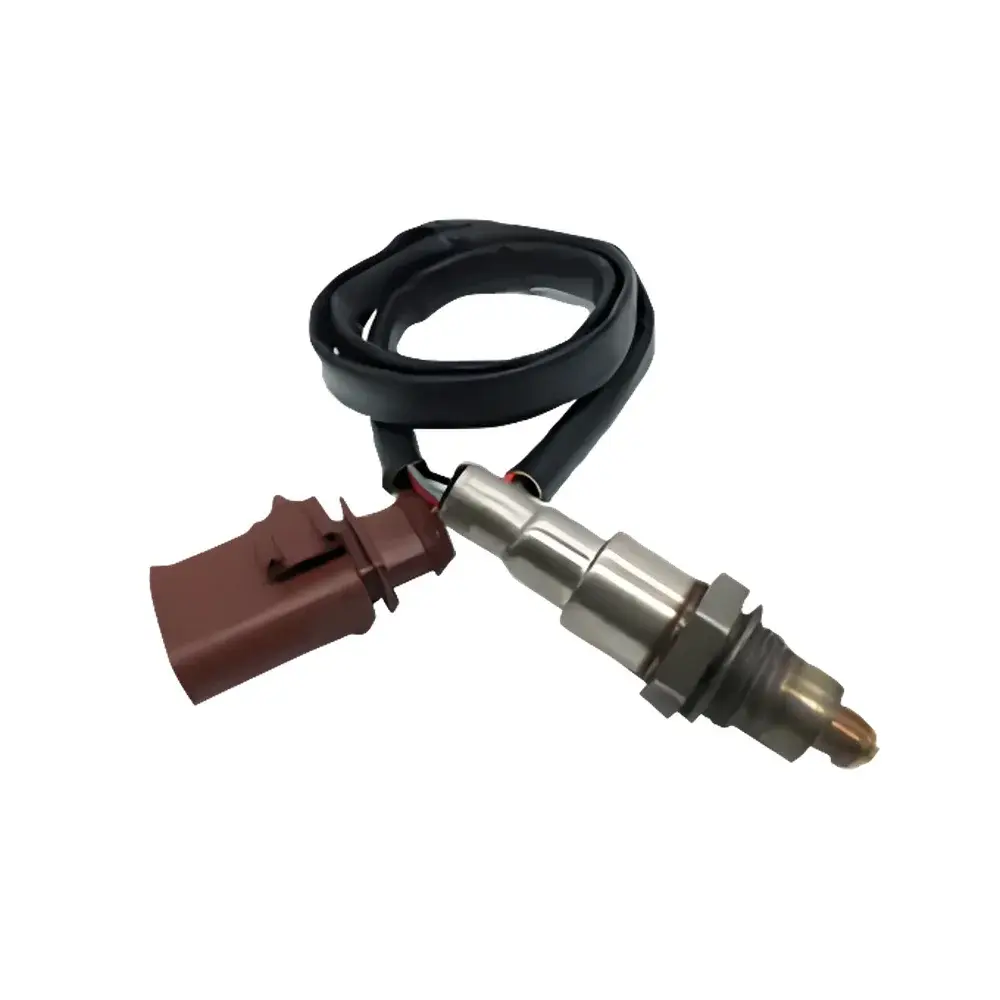
Cubic ZS-XF-01 Zirconia-Based Lambda Oxygen Sensor
| Brand | Cubic |
|---|---|
| Origin | Hubei, China |
| Model | LSF XFOUR |
| Detection Principle | Zirconia Solid Electrolyte (Nernst Principle) |
| Operating Temperature Range | 150–930 °C |
| Storage Temperature | −40 to 90 °C |
| Exhaust Gas Temperature Rating | Up to 850 °C |
| Output Voltage (λ = 0.93–0.97) | 1005 ± 40 mV |
| Output Voltage (λ = 1.05–1.10) | 190 ± 30 mV |
| Internal Resistance | ≤2.5 kΩ (at cold start), ≤0.5 kΩ (at 850 °C) |
| Response Time (700 mV ↔ 400 mV) | <100 ms (cold), <80 ms (hot) |
| Light-off Time | <12 s |
| Thread Size | M18 × 1.5 |
| Heater Integrated | Yes |
| Reference Air Supply | Pumped (electrochemical oxygen pumping) |
| Sensor Type | Limiting-current / Concentration-cell (switch-type) lambda sensor |
| Core Substrate | HTCC (High-Temperature Co-fired Ceramic) |
Overview
The Cubic ZS-XF-01 is a high-reliability, zirconia-based lambda oxygen sensor engineered for precise stoichiometric combustion monitoring in gasoline engine exhaust systems. It operates on the Nernst principle, leveraging a yttria-stabilized zirconia (YSZ) solid electrolyte to generate a voltage signal proportional to the oxygen partial pressure differential between exhaust gas and a pumped internal reference air chamber. Unlike conventional unheated thimble-type sensors, the ZS-XF-01 integrates a micro-heater and electrochemical oxygen pump within a monolithic HTCC (High-Temperature Co-fired Ceramic) chip architecture—enabling rapid light-off, stable operation across wide exhaust temperature gradients (150–930 °C), and immunity to condensation and hydrocarbon fouling. Its primary function is to detect the λ = 1 point—the stoichiometric air-fuel ratio—thereby enabling closed-loop feedback control of fuel injection by the engine control unit (ECU). This ensures optimal three-way catalyst (TWC) conversion efficiency for CO, HC, and NOx, while supporting fuel economy compliance under real-world driving emissions (RDE) test protocols.
Key Features
- Monolithic HTCC ceramic chip with integrated heater and electrochemical oxygen pump—ensures consistent reference air partial pressure and eliminates reliance on ambient air diffusion.
- Fast thermal response and light-off time (<12 s), meeting stringent cold-start emission requirements per Euro 6d and EPA Tier 3 standards.
- Robust mechanical design with M18 × 1.5 threaded mounting interface and high-temperature stainless steel housing rated for continuous exposure up to 850 °C exhaust gas temperature.
- Stable output voltage hysteresis: 1005 ± 40 mV at λ = 0.93–0.97 (rich) and 190 ± 30 mV at λ = 1.05–1.10 (lean), validated across thermal cycling from −40 °C to 90 °C storage conditions.
- Low internal resistance (≤0.5 kΩ at operating temperature), minimizing signal drift and improving ECU analog-to-digital conversion fidelity.
- Proven tolerance to exhaust condensate, oil ash, and sulfur-containing deposits—validated through 10,000 km simulated aging per ISO 22241-3 and SAE J1800 durability protocols.
Sample Compatibility & Compliance
The ZS-XF-01 is designed exclusively for gaseous exhaust streams in port-fuel-injected (PFI) and direct-injection (GDI) gasoline powertrains. It is incompatible with diesel, ethanol-flex, or hydrogen-fueled exhaust due to fundamental differences in oxygen concentration dynamics and catalytic surface interactions. The sensor complies with OEM-level functional safety requirements aligned with ISO 26262 ASIL-B for sensor signal integrity and fault detection. Its electrical interface meets ISO 11898-2 CAN physical layer specifications for diagnostic communication readiness. While not certified to IATF 16949 as a standalone component, its manufacturing traceability supports full PPAP Level 3 documentation for Tier 1 automotive suppliers. Calibration data is traceable to NIST-traceable reference gas mixtures (O2/N2) per ASTM D6348.
Software & Data Management
The ZS-XF-01 delivers analog voltage output only and requires integration into an existing ECU or external signal conditioning module (e.g., NI CompactRIO or dSPACE SCALEXIO). No embedded firmware or configurable parameters are present; thus, no proprietary software, drivers, or cloud connectivity are required or supported. However, raw voltage signals are fully compatible with standard OBD-II PID 0x05 (oxygen sensor voltage) and PID 0x06 (short-term fuel trim) logging frameworks. For validation and calibration workflows, the sensor’s output is interoperable with MATLAB/Simulink Real-Time, ETAS INCA, and Vector CANoe environments via standard analog input modules. All performance specifications—including response time, voltage thresholds, and resistance curves—are documented in the manufacturer’s AEC-Q200-compliant test report, which includes GLP-aligned audit trails for environmental stress testing (thermal shock, humidity soak, vibration).
Applications
- Closed-loop air-fuel ratio control in gasoline passenger vehicles and light-duty trucks (Euro 6, China 6b, U.S. Tier 3 compliant platforms).
- On-board diagnostics (OBD-II) readiness monitoring for catalyst efficiency and sensor degradation detection (MIL illumination logic per SAE J2012).
- Engine development and calibration labs performing transient bench testing (WLTC, RDE, FTP-75 cycles) where fast lambda step response is critical.
- Aftermarket ECU tuning modules requiring OEM-grade stoichiometric feedback under high-load, high-EGR conditions.
- Exhaust aftertreatment system validation for TWC aging studies and sulfur poisoning resistance assessment.
FAQ
Is the ZS-XF-01 compatible with diesel engines?
No. It is optimized for gasoline exhaust oxygen dynamics and lacks the wide-range linear output required for diesel lambda monitoring. Use dedicated wideband sensors (e.g., Bosch LSU 4.9) for diesel applications.
Does this sensor support digital communication (e.g., CAN or LIN)?
No. It provides only analog voltage output. Digital interface requires external signal conditioning and ADC conversion.
What is the recommended replacement interval?
Per OEM guidelines, typical service life exceeds 160,000 km under normal operating conditions. Replacement is triggered by diagnostic trouble codes P0130–P0135 or confirmed voltage deviation beyond ±50 mV at λ=1 during bench verification.
Can it be used in motorcycles or small-displacement engines?
Yes—provided exhaust gas temperature remains within 150–930 °C and mechanical mounting matches M18 × 1.5 thread geometry. Validation against ISO 16750-4 vibration profiles is recommended for two-wheeler applications.
Is calibration required before installation?
No field calibration is needed. The sensor is factory-calibrated using NIST-traceable gas standards and sealed in inert atmosphere. Zero-point drift is compensated dynamically by the ECU during closed-loop operation.