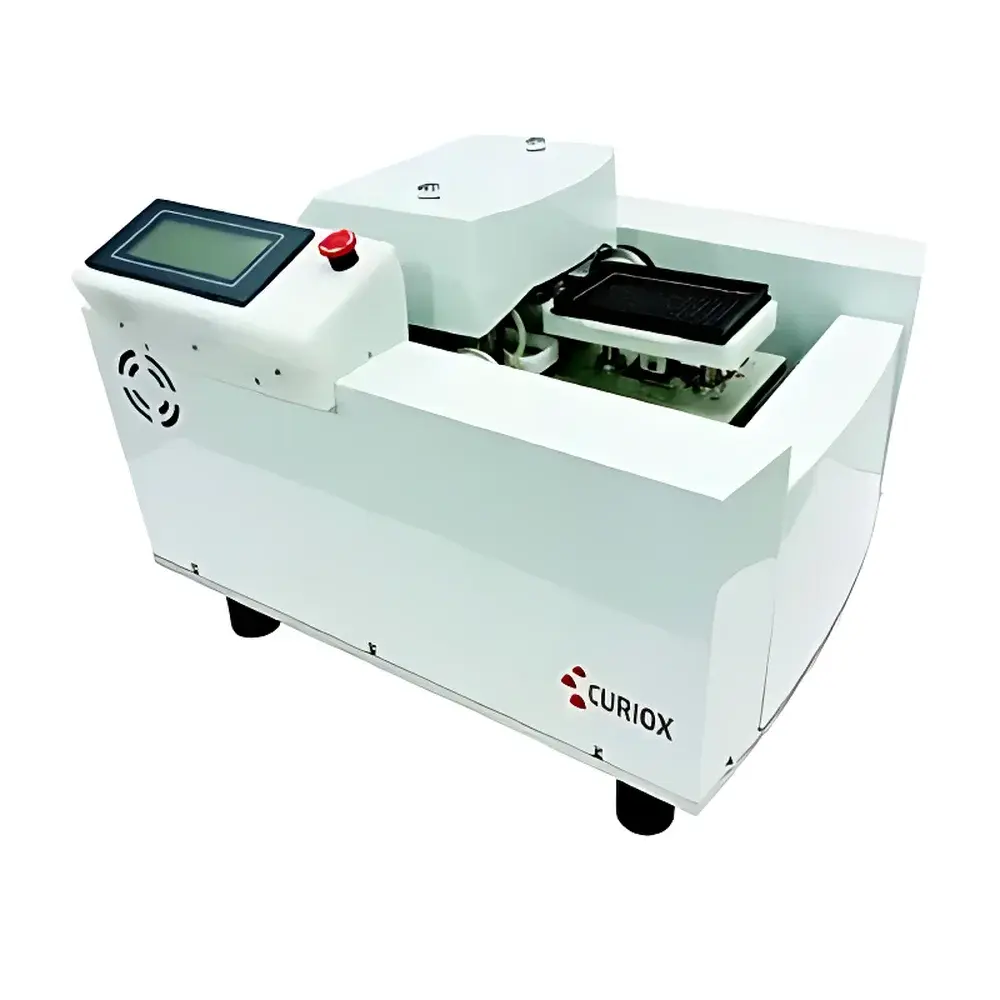
Curiox HT200 High-Throughput Microplate Washer
| Origin | USA |
|---|---|
| Manufacturer Type | Authorized Distributor |
| Origin Category | Imported |
| Model | HT200 |
| Pricing | Upon Request |
Overview
The Curiox HT200 High-Throughput Microplate Washer is an engineered platform designed for precise, low-volume liquid exchange in microplate-based life science assays—particularly those utilizing DropArray™ microplates (96-well and 384-well formats). Unlike conventional plate washers relying on vacuum aspiration or peristaltic pumping, the HT200 implements a patented drop-wise fluid exchange mechanism that minimizes cell detachment and preserves viability across adherent, semi-adherent, and suspension cell types. Its core architecture integrates a gradient piston pump with continuously variable stroke control, enabling programmable flow rates up to 420 mL/min while maintaining volumetric accuracy within ±5% across operational ranges. The system operates under ambient laboratory conditions (15–40 °C), with footprint dimensions of 50 × 40 × 40 cm (W × D × H) and net weight of 25 kg—optimized for integration into automated drug discovery workflows without requiring dedicated environmental enclosures.
Key Features
- DropArray-optimized fluidics: Enables ultra-low residual volume (< 0.2–0.5 µL/well) during wash cycles, reducing reagent consumption by 10–20× compared to standard wash protocols.
- Cell-sparing exchange: Engineered for minimal mechanical stress on primary patient-derived cells, immune cells (e.g., PBMCs, T cells), and sensitive adherent lines—validated for use with both coated and uncoated DropArray plates.
- Integrated error mitigation suite: Includes real-time overflow detection, positional regression sensing (auto-recovery to home position upon misalignment), and fault-triggered system halt to prevent cross-contamination or plate damage.
- Modular service design: All external covers are recyclable and tool-free removable; internal fluid paths support full-system automated cleaning cycles to prevent salt crystallization or protein residue buildup during extended idle periods.
- R2D (Robot-to-Device) interface: Standard RS-232 and TTL-compatible I/O ports enable bidirectional handshake with third-party automation systems—including high-content imagers (e.g., ImageXpress®, Operetta CLS™), robotic arms, and LIMS platforms—supporting end-to-end assay orchestration.
- Digital LED operator interface: Provides real-time status feedback, protocol progress tracking, and diagnostic alerts without dependency on external PCs or proprietary software clients.
Sample Compatibility & Compliance
The HT200 supports standardized SBS-format microplates (96- and 384-well), with mechanical stage calibration accommodating DropArray’s proprietary hydrophilic/hydrophobic surface patterning. It maintains compatibility with common biological buffers (PBS, HBSS), serum-containing media, and low-surface-tension reagents used in immunostaining, cytokine capture, and functional cell-based assays. While not certified as a medical device under FDA 21 CFR Part 820, the platform meets general laboratory equipment requirements per ISO/IEC 17025:2017 for method validation environments. Its error-detection architecture and audit-ready operation logs align with GLP/GMP-aligned lab practices where traceability of wash parameters (flow rate, dwell time, cycle count) is required for regulatory submissions.
Software & Data Management
The HT200 operates via embedded firmware with protocol storage capacity for ≥50 user-defined methods. Method parameters—including pump stroke profile, aspiration/dispense timing, and rinse cycle repetition—are editable via front-panel keypad or optional serial command-line interface (CLI). No proprietary software installation is required; however, ASCII-formatted log files (timestamped, comma-delimited) can be exported via USB port for integration into ELN systems or statistical analysis pipelines (e.g., R, Python pandas). Audit trail functionality records all user-initiated actions, system faults, and hardware events with UTC timestamps—meeting baseline data integrity expectations under ALCOA+ principles for non-clinical research settings.
Applications
- High-content screening (HCS) of therapeutic antibodies and bispecific constructs using primary human immune cells.
- Functional cytotoxicity assays (e.g., ADCC, CDC) requiring repeated media exchange without loss of effector/target cell integrity.
- Single-cell RNA-seq library prep workflows where low-input lysate volumes demand precise buffer exchange prior to lysis.
- CRISPR-Cas9 editing validation assays involving transient transfection followed by cytokine or surface marker readouts.
- Diagnostic development for rare disease biomarker panels using limited-volume patient-derived samples (e.g., ascites, CSF, fine-needle aspirates).
FAQ
What plate formats does the HT200 support?
It natively accommodates DropArray 96-well and 384-well plates, with mechanical adaptability for standard ANSI/SBS-compliant microplates when used with optional carrier inserts.
Can the HT200 be integrated into a fully automated screening line?
Yes—via its R2D interface, it synchronizes with robotic handlers and imaging systems using industry-standard trigger signals and status polling protocols.
Is validation documentation available for GxP environments?
IQ/OQ templates are provided for installation and operational qualification; PQ protocols must be developed in-house per assay-specific acceptance criteria.
What maintenance is required beyond routine cleaning cycles?
Annual calibration of pump displacement volume and positional encoder alignment is recommended; no consumable parts require scheduled replacement within first 24 months of typical usage.
Does the system comply with electrical safety standards for international deployment?
It carries CE marking per EN 61010-1:2010 and UL 61010-1 certification for North America, with dual-voltage input (100–240 VAC, 50/60 Hz).