
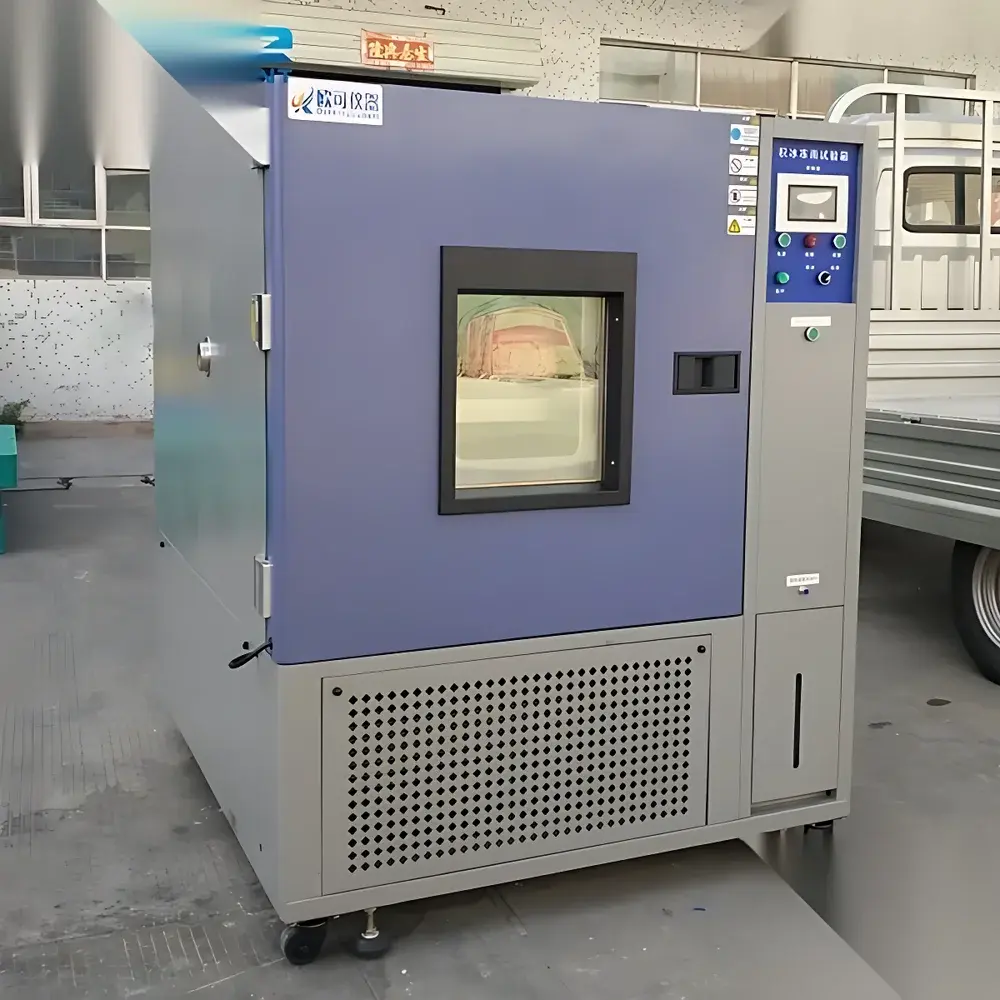
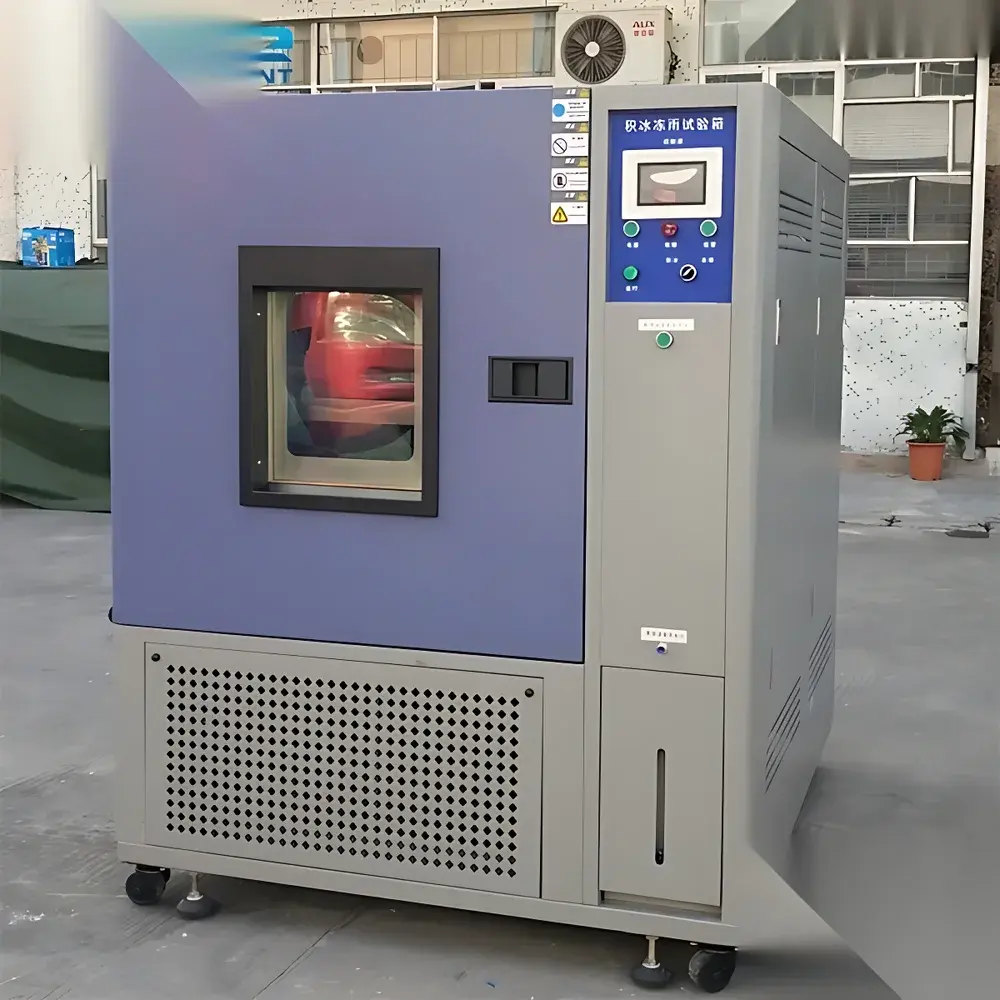
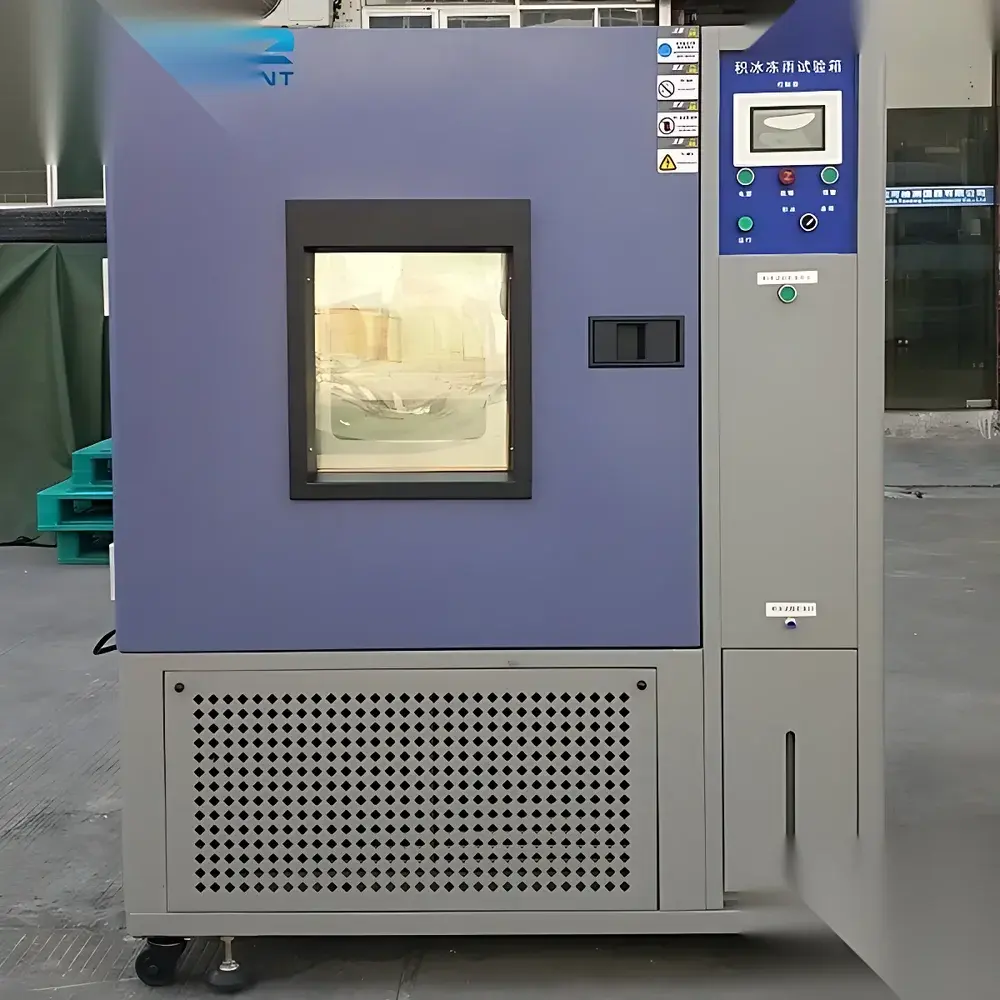
Custom-Built Icing and Freezing Rain Test Chamber
| Key | Brand: Other Brands |
|---|---|
| Origin | Imported |
| Manufacturer Type | General Distributor |
| Price | USD 14,000 (approx.) |
| Temperature Range | −20 °C to +80 °C (customizable) |
| Temperature Uniformity | ±2.0 °C |
| Temperature Fluctuation | ±0.5 °C |
| Rainfall Intensity | 25 mm/h |
| Droplet Aperture | Ø0.4 mm |
| Droplet Diameter | 1.0–1.5 mm |
| Ice Accretion Thickness Options | 6 mm, 13 mm, 37 mm, 75 mm |
| Ice Density Range | 0.2–0.9 g/cm³ |
| Water Temperature Control | 0–5 °C |
| Inner Chamber Material | SUS304 Stainless Steel |
| Outer Chamber Material | Galvanized Steel with Powder Coating or Optional SUS304 |
| Controller | 5.7″ TFT Color LCD Touchscreen (Bilingual: English/Chinese) |
| Refrigeration System | Hermetically Sealed Compressor (Tecumseh, France) |
| Heating System | Spiral Nichrome Heater with Ceramic Insulation Mounts |
| Humidification | Embedded Nichrome Electric Humidifier |
| Power Supply | AC 220 V ±5%, 50 Hz ±0.5 Hz, Single-Phase Three-Wire |
| Ambient Operating Conditions | 5–35 °C, RH ≤85% |
| Internal Dimensions (L×W×H, mm) | 500×600×500 / 600×700×600 / 800×900×700 / 1000×1000×1000 |
| External Dimensions (L×W×H, mm) | 1000×1750×1100 / 1100×1900×1100 / 1300×1900×1300 / 1500×2000×1600 |
Overview
The Custom-Built Icing and Freezing Rain Test Chamber is an engineered environmental simulation system designed specifically for laboratory-based evaluation of equipment performance under controlled icing and freezing rain conditions. It operates on the principle of precise thermodynamic and hydrodynamic replication of natural atmospheric ice accretion phenomena—including supercooled liquid water droplet impingement, surface nucleation, and dynamic ice growth—enabling rigorous assessment of structural integrity, functional reliability, and de-icing system efficacy. This chamber complies with the test methodology defined in GJB 150.22A–2009 (Military Standard for Environmental Testing of Equipment, Part 22: Icing and Freezing Rain Testing), and supports validation protocols aligned with MIL-STD-810, RTCA DO-160 Section 22 (Environmental Conditions and Test Procedures for Airborne Equipment), and relevant portions of ASTM D3574 and ISO 22196 for cold-climate material behavior. The system accommodates full-scale or sub-scale hardware-in-the-loop testing of aerospace components, unmanned aerial systems (UAS), wind turbine blades, power transmission hardware, maritime sensors, and military ground vehicles.
Key Features
- Multi-zone temperature control architecture enabling simultaneous stabilization of chamber ambient, spray water, and specimen surface thermal profiles within ±0.5 °C fluctuation and ±2.0 °C uniformity across the working volume.
- Precisely calibrated freezing rain generation subsystem featuring stainless steel nozzles with Ø0.4 mm orifices, delivering monodisperse droplets (1.0–1.5 mm diameter) at a reproducible intensity of 25 mm/h—consistent with operational definitions of freezing drizzle and light freezing rain per WMO guidelines.
- Configurable ice accretion thickness settings (6 mm, 13 mm, 37 mm, and 75 mm) achieved via programmable dwell time, droplet temperature modulation (0–5 °C), and real-time chamber humidity feedback—supporting both glaze and rime ice density ranges (0.2–0.9 g/cm³).
- Robust thermal management system integrating hermetically sealed Tecumseh compressors (France-sourced), spiral nichrome heating elements mounted on ceramic insulators, and embedded electric humidifiers—all monitored and coordinated by a field-proven 5.7″ bilingual touchscreen controller with data logging capability.
- Modular chamber construction with SUS304 stainless steel inner walls and either powder-coated galvanized steel or optional full SUS304 outer enclosure—ensuring corrosion resistance, long-term dimensional stability, and compatibility with high-humidity, saline-mist-prone test cycles.
- Standardized interface provisions including one Ø50 mm cable port and a load-rated adjustable shelf assembly, facilitating integration with external data acquisition systems, power supplies, and telemetry hardware during live functional testing.
Sample Compatibility & Compliance
This test chamber supports specimens up to 1000 mm × 1000 mm × 1000 mm (interior volume: 1 m³), accommodating full-size avionics bays, rotorcraft sensor arrays, radar housings, and marine-grade enclosures. All configurations meet electromagnetic compatibility (EMC) shielding prerequisites for concurrent EMI/EMC testing per MIL-STD-461G. The system’s operational envelope satisfies Class II environmental qualification requirements under MIL-STD-810H Method 521.4 (Icing) and provides traceable calibration paths compliant with ISO/IEC 17025:2017. Documentation packages include factory calibration certificates, uncertainty budgets for temperature and rainfall metrics, and verification reports against GJB 150.22A–2009 Annex B test sequence fidelity.
Software & Data Management
The embedded controller records time-stamped temperature, humidity, spray status, compressor duty cycle, and heater output at user-selectable intervals (1–60 s). Exported CSV files are structured for direct import into MATLAB, Python Pandas, or LabVIEW environments. Audit trails include operator login timestamps, parameter change logs, and alarm event histories—supporting GLP/GMP-aligned documentation workflows. While native software does not implement FDA 21 CFR Part 11 electronic signature functionality, third-party SCADA integration (e.g., Ignition SCADA or Siemens Desigo CC) enables full electronic record retention, role-based access control, and automated report generation upon test completion.
Applications
- Verification of aircraft wing anti-ice system response latency and thermal distribution under simulated flight-critical icing scenarios.
- Functional endurance testing of offshore wind turbine pitch control actuators exposed to sea-spray-induced rime accumulation.
- Validation of UAV battery thermal management under freezing rain ingress conditions per RTCA DO-160G Section 22.3.2.
- Material-level investigation of polymer coating adhesion loss on composite substrates following repeated ice accretion/de-icing cycles.
- Performance benchmarking of infrared camera housings used in Arctic surveillance platforms under combined low-temperature and moisture-laden exposure.
FAQ
Does this chamber support automated cycling between dry cold soak, freezing rain, and de-icing phases?
Yes—the controller supports multi-step program sequences with independent setpoints for temperature, spray duration, water temperature, and dwell time. Up to 99 segments can be chained per test profile.
Can the droplet size distribution be verified independently?
Yes—standardized PIV (Particle Image Velocimetry) and phase Doppler interferometry (PDI) calibration ports are available as optional add-ons for third-party droplet characterization.
Is NIST-traceable calibration included with delivery?
Factory calibration is performed using NIST-traceable reference probes (Fluke 1524, PT100 class A); full calibration certificates with measurement uncertainty statements are provided.
What maintenance intervals are recommended for the refrigeration system?
Compressor oil and filter replacement is recommended every 12 months or 2000 operating hours—whichever occurs first—using original Tecumseh service kits.
Are custom internal fixtures or mounting rails available?
Yes—customer-supplied CAD models are accepted for fabrication of bespoke support structures, thermal shunts, or airflow baffles compatible with the chamber’s structural mounting points.



