
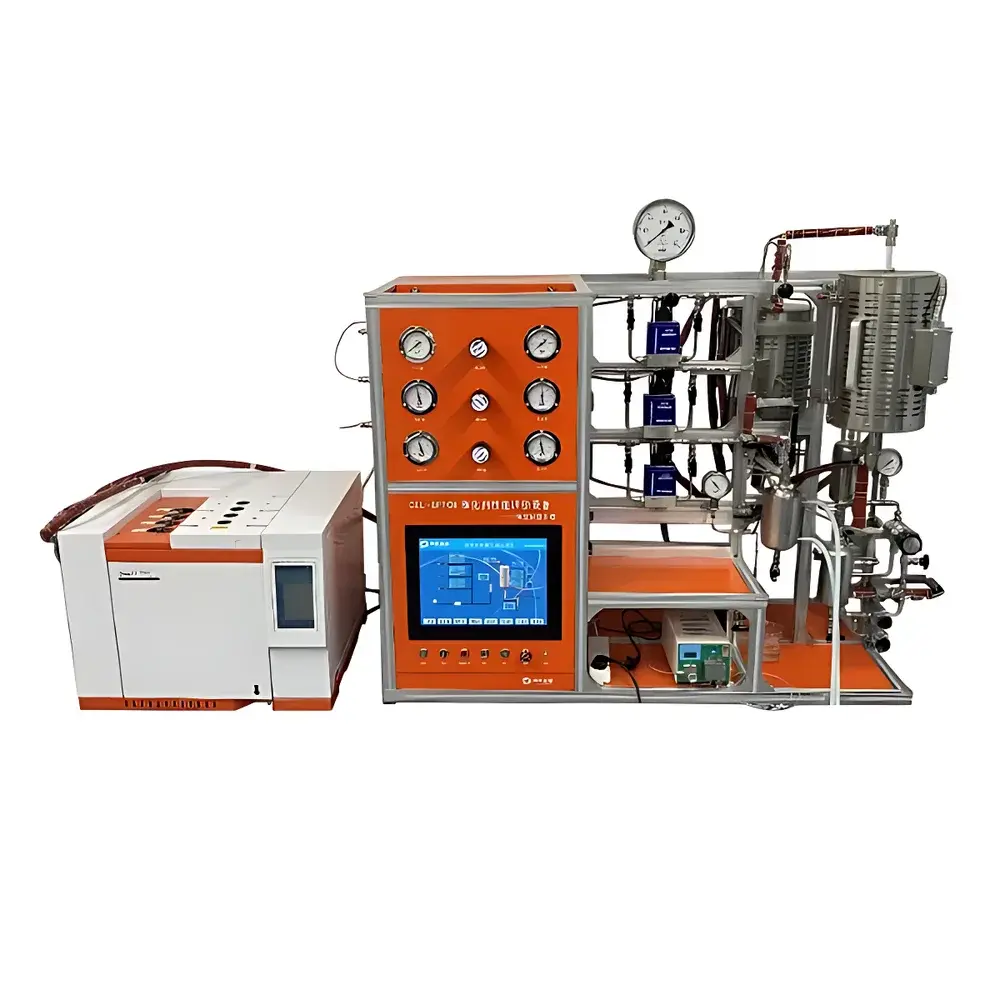
Custom Catalyst Evaluation System by CAVI (Zhongjiao Jinyuan)
| Brand | CAVI (Zhongjiao Jinyuan) |
|---|---|
| Origin | Beijing, China |
| Manufacturer Type | OEM/ODM Manufacturer |
| Regional Classification | Domestic (China) |
| Model | Custom Catalyst Evaluation System |
| Pricing | Available Upon Technical Consultation |
Overview
The Custom Catalyst Evaluation System by CAVI (Zhongjiao Jinyuan) is an engineered platform for controlled, reproducible assessment of heterogeneous and homogeneous catalytic performance under precisely regulated thermal, pressure, and reactive gas/liquid environments. Built upon modular flow reactor architecture—typically incorporating fixed-bed, trickle-bed, or fluidized-bed configurations—the system enables kinetic studies, stability testing, deactivation analysis, and selectivity profiling across temperature ranges up to 1,100 °C and pressures up to 30 MPa (configurable). Its core measurement methodology relies on real-time online gas chromatography (GC), mass spectrometry (MS), or Fourier-transform infrared (FTIR) coupled with calibrated mass flow controllers (MFCs), high-precision pressure transducers, and multi-zone furnace control. Designed for fundamental research and process development, the system supports reaction engineering workflows aligned with ASTM D3241 (catalyst activity testing), ISO 18253 (catalyst characterization), and IUPAC-recommended protocols for turnover frequency (TOF) and apparent activation energy (Ea) determination.
Key Features
- Modular reactor design accommodating multiple configurations: microreactor (<1 mL catalyst volume), bench-scale fixed-bed (1–50 mL), and pilot-scale trickle-bed (up to 500 mL)
- Integrated high-temperature furnace with ±1 °C zone stability and programmable ramping (0.1–20 °C/min)
- Multi-channel gas/liquid feed system with certified MFCs (accuracy ±0.8% FS), back-pressure regulators (BPR), and vaporization units for liquid precursors
- Real-time effluent analysis interface supporting GC-TCD/FID, QMS, or FTIR with automated sampling valves and data synchronization
- Redundant safety architecture including pressure relief valves, H2/O2 leak detection, emergency shutdown (ESD) logic, and SIL2-compliant interlocks
- Full ASME BPVC Section VIII Div. 1 compliance for pressure components; all wetted parts constructed from SS316, Inconel 600/625, or Hastelloy C-276 per application requirements
Sample Compatibility & Compliance
The system accommodates solid catalysts (powders, extrudates, pellets, monoliths), supported metal nanoparticles, zeolites, MOFs, and liquid-phase homogeneous catalysts. It supports co-feeding of gaseous reagents (H2, CO, CO2, CH4, NH3, O2, syngas), vapors (water, alcohols, amines), and pressurized liquids (e.g., aqueous solutions, organic solvents). All designs adhere to national and international regulatory frameworks including GB/T 150 (Chinese pressure vessel standard), PED 2014/68/EU, and ATEX Directive 2014/34/EU for hazardous area classification. Documentation packages include FAT/SAT reports, material traceability certificates (MTRs), and calibration records traceable to NIST standards—supporting GLP/GMP audit readiness and FDA 21 CFR Part 11–compliant electronic record retention when paired with optional validated software modules.
Software & Data Management
CAVI’s proprietary CatalystControl™ software provides integrated control of temperature, pressure, flow rates, and analytical instrument triggering via OPC UA and Modbus TCP protocols. The system logs time-stamped process variables at ≥1 Hz resolution, with automatic alignment to chromatographic peak integration and stoichiometric conversion calculations. Raw datasets are exported in HDF5 or CSV formats, compatible with MATLAB, Python (Pandas/NumPy), and Aspen Custom Modeler for kinetic modeling. Optional 21 CFR Part 11 add-ons deliver role-based user access, electronic signatures, full audit trails, and immutable data archiving—meeting requirements for regulated pharmaceutical and fine chemical R&D environments.
Applications
- Petroleum refining: hydrodesulfurization (HDS), hydrocracking, reforming catalyst screening
- Carbon capture & utilization: CO2 hydrogenation to methanol, CO2-to-olefins, dry/wet methane reforming
- Renewable fuels: biomass pyrolysis oil upgrading, fatty acid deoxygenation, lignin depolymerization
- Electrocatalyst precursor evaluation: ex-situ thermal activation studies under inert/reducing atmospheres
- Pharmaceutical catalysis: asymmetric hydrogenation, C–N coupling, continuous-flow Suzuki–Miyaura reactions
- Environmental catalysis: VOC abatement, NOx reduction, chlorinated hydrocarbon decomposition
FAQ
Can the system be configured for corrosive feedstocks such as HCl-containing syngas or HF-based alkylation streams?
Yes—reactor internals, valves, and instrumentation can be upgraded to corrosion-resistant alloys (e.g., Hastelloy B-3, Inconel 825) with fluoropolymer-sealed actuators and quartz-lined sampling lines.
Is third-party analytical instrumentation (e.g., Agilent GC, Thermo Q Exactive GC-MS) supported?
Yes—CAVI provides hardware interface kits and API-level integration support for major OEM analyzers via Ethernet, RS-232, or analog I/O.
What level of documentation is provided for regulatory submissions?
Standard delivery includes IQ/OQ protocols, calibration certificates, P&IDs, loop diagrams, and material compliance declarations. Full GMP validation packages are available upon request.
Do you offer remote commissioning and operator training?
Yes—virtual FAT, cloud-based system monitoring, and instructor-led online workshops are included in the service scope.



