
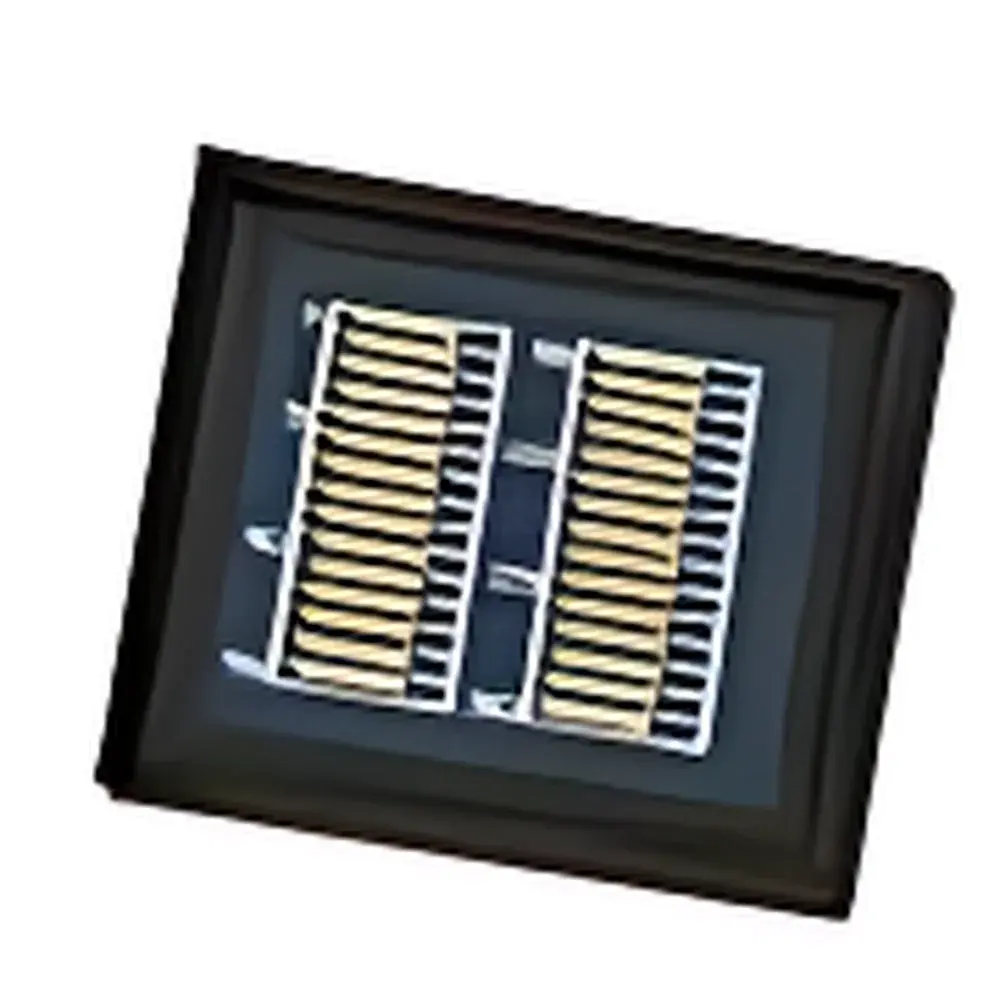
Cutting Edge Optronics (CEO) Unmounted Diode Bars & Hermetically Sealed High-Power Laser Diodes
| [Brand | Cutting Edge Optronics (CEO) |
|---|---|
| Origin | USA |
| Manufacturer Type | Authorized Distributor |
| Product Category | Imported |
| Cooling Options | Conductive Cooling, Water Cooling, Microchannel Cooling |
| Core Components | Semiconductor Laser Diode Bars and Packaged Modules |
| Wavelength Range | 790–1550 nm (Standard Bands: 780–815 nm, 875–890 nm, 935–945 nm, 965–975 nm) |
| CW Output Power | Up to 100 W/bar (60–600 W/module, depending on configuration) |
| QCW Output Power | Up to 300 W/bar (up to 29 kW total system-level output) |
| Packaging Formats | G-Series, Cs-Series, Derringer, Shooter, E2, A-Series, HDS Arrays |
| Compliance | Designed for MIL-STD-810G, RoHS-compliant materials, hermetic sealing per MIL-STD-883 Method 1014] |
Overview
Cutting Edge Optronics (CEO), a Northrop Grumman business unit, is a globally recognized supplier of high-reliability semiconductor laser diode components engineered for demanding photonic systems. This product line comprises unmounted diode bars and hermetically sealed packaged laser diodes—core pump sources for solid-state lasers, fiber laser pumping, directed energy systems, medical laser systems, and industrial material processing. These devices operate on the principle of stimulated emission in AlGaAs/GaAs or InP-based heterostructures, with epitaxial designs optimized for high quantum efficiency, low thermal resistance, and long-term operational stability under high-current drive conditions. Each diode bar is fabricated using proprietary wafer processes and tested to stringent performance specifications across temperature, current, and optical power domains. The modular architecture supports integration into DPSS gain modules, lamp-pumped replacement systems, and custom laser engine assemblies.
Key Features
- Two primary operational modes: Continuous Wave (CW) and Quasi-Continuous Wave (QCW), configurable per application duty cycle and thermal budget requirements
- Multiple thermal management options: conductive cooling (HDS, G-, Cs-, A-series), water cooling (E2, Derringer, Shooter), and microchannel cooling (MCS) for ultra-high power density applications
- Hermetic packaging with integrated 10 kΩ thermistors for real-time junction temperature monitoring; optional custom sensor integration available
- Standard wavelength bands aligned with Nd:YAG (808 nm), Nd:YLF (885 nm), Yb-doped fiber (915/976 nm), and Er/Yb co-doped systems (940/1480 nm)
- Scalable array configurations—from single-bar modules to stacked arrays supporting up to 96 bars (Shooter-12) with total QCW output exceeding 29 kW
- High-power density capability: HDS arrays achieve ≥25 W/cm²; MCS platforms enable >100 W/bar sustained operation with sub-1°C thermal gradient control
Sample Compatibility & Compliance
CEO diode products are designed for compatibility with industry-standard optical mounts, collimation optics (fast-axis and slow-axis correction), and driver electronics compliant with IEC 61000-4 electromagnetic immunity requirements. All hermetically sealed packages meet MIL-STD-883 Method 1014 for seal integrity verification and undergo burn-in testing per MIL-STD-883 Method 1015. Materials comply with RoHS Directive 2011/65/EU and REACH Regulation (EC) No. 1907/2006. For regulated environments—including FDA-regulated medical laser systems and DoD acquisition programs—CEO modules support traceable lot documentation, full test reports (including L-I-V, spectral width, and far-field divergence), and can be supplied with GLP-aligned calibration records upon request.
Software & Data Management
While CEO diode bars and packaged modules are hardware-only components, they are fully compatible with third-party laser system controllers and OEM driver platforms that support analog/digital modulation interfaces (0–5 V, TTL, RS-485). Integration-ready firmware drivers are available for common laser controller families (e.g., ILX Lightwave, Newport LDC-37xx, and custom FPGA-based systems). All production units include serialized traceability data stored in ASCII-formatted .csv files, including wafer ID, bar position, test date, threshold current, slope efficiency, and spectral centroid at rated operating point. Optional extended data packages include thermal imaging maps and accelerated life-test extrapolation reports per Telcordia GR-468-CORE.
Applications
- Pumping of Nd:YAG, Nd:YVO₄, Yb:YAG, and Tm:YAG solid-state lasers in industrial marking, cutting, and welding systems
- Side-pumping of slab and rod amplifiers in high-energy laser (HEL) architectures and defense-grade directed energy platforms
- Fiber laser pump combiners and multi-kilowatt pump modules for telecommunications and sensing applications
- Medical laser systems requiring stable, low-noise pump sources for dermatology, ophthalmology, and dental procedures
- R&D environments requiring flexible, field-replaceable pump sources with known spectral and spatial characteristics for prototype laser development
- LIDAR transmitter modules and active illumination systems where pulse fidelity, rise time (<100 ns), and peak power scalability are critical
FAQ
What is the difference between unmounted diode bars and hermetically sealed packaged diodes?
Unmounted bars require integration into custom heat sinks and optical mounts by the end-user, offering maximum design flexibility. Hermetically sealed packages (e.g., G-Series, Derringer, Shooter) include integrated thermistors, standardized electrical interfaces, and environmental protection—ideal for rapid prototyping and production deployment.
Can CEO diodes be customized for non-standard wavelengths or beam parameters?
Yes. CEO offers custom epitaxial design services for wavelengths from 790 nm to 1550 nm, including narrow-linewidth variants and tailored spectral bandwidths. Custom fast-axis collimation, FAC lens integration, and polarization-maintaining output configurations are available under NDA.
What thermal interface materials are recommended for conductive-cooled packages?
Indium foil (25–50 µm), silver-filled epoxy (e.g., EPO-TEK H20E), or phase-change thermal pads meeting ASTM D5470 thermal impedance specifications are recommended. Thermal resistance from junction to heatsink base must remain ≤0.25 °C/W for rated CW operation.
Are CEO diodes qualified for spaceflight or aviation applications?
While not inherently space-qualified, CEO diodes have been incorporated into flight-certified subsystems under customer-led qualification programs (e.g., MIL-STD-750 Test Method 1020 for vibration, Method 2042 for shock). Full QML-Q or QML-V qualification requires additional screening and documentation per SAE AS9100 requirements.
Do you provide lifetime reliability data or MTTF projections?
Yes. Accelerated life-test data is available for standard configurations, with typical median time-to-failure (MTTF) exceeding 20,000 hours at 25°C case temperature and 80% rated current. Projections follow Arrhenius-based models validated against Telcordia GR-468-CORE and IEC 62047-17 standards.





