
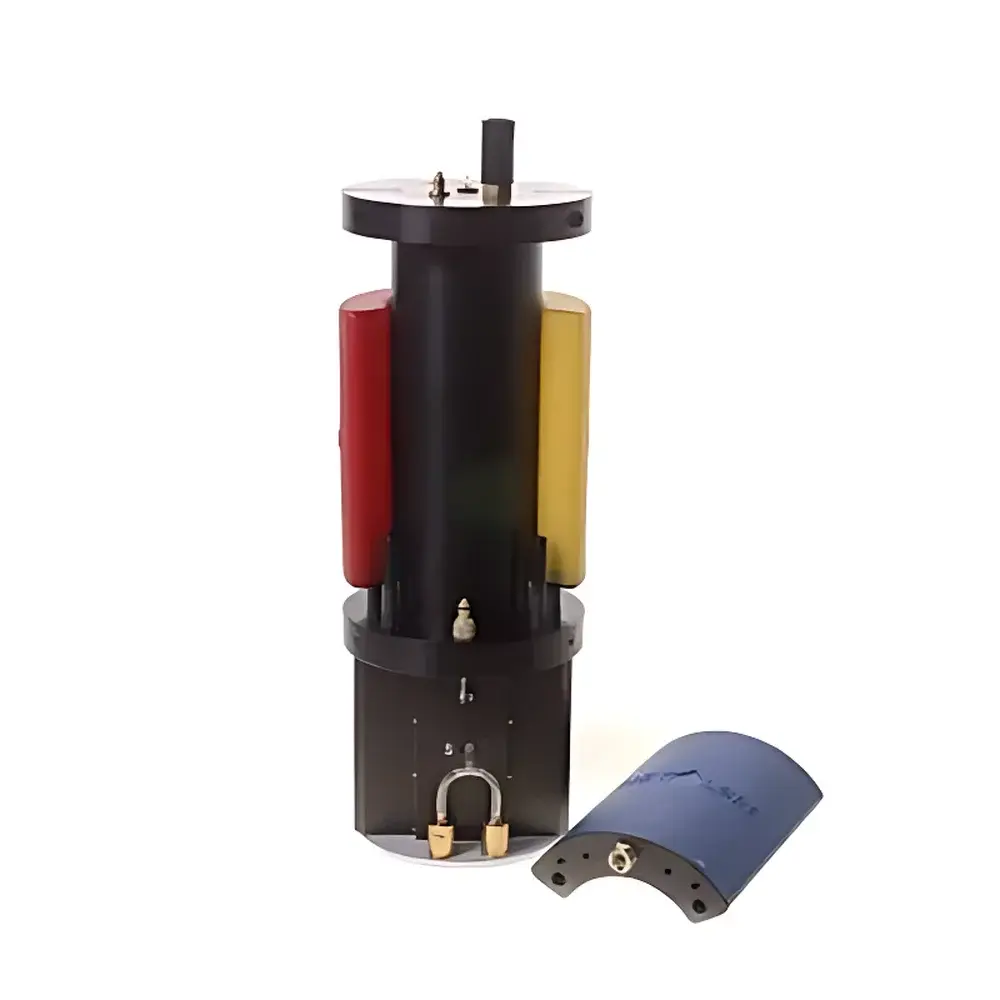
CYCLE-PO4 Submersible In Situ Online Phosphate Analyzer by WET Labs
| Origin | USA |
|---|---|
| Manufacturer Type | Authorized Distributor |
| Origin Category | Imported |
| Model | CYCLE-PO4 |
| Pricing | Available Upon Request |
| Height | 56 cm |
| Width | 18 cm |
| Weight | 6.8 kg |
| Light Source | 880 nm LED |
| Optical Path Length | 5 cm |
| Linearity (R²) | ≥0.95 |
| Power Supply | 9.5–18 V DC, Max Current: 2.0 A |
| Output Interface | RS-232 with MCBH-6MP connector |
| Sampling Interval | 30 minutes |
| Onboard Memory | 1 GB |
| Accuracy | ±50 nM |
| Measurement Range | 0–10 µM |
| Detection Limit | Sub-nanomolar resolution |
| Housing Material | Titanium alloy |
| Operational Duration | Up to 3 months unattended in field deployment |
Overview
The CYCLE-PO4 Submersible In Situ Online Phosphate Analyzer is a precision environmental monitoring instrument engineered by WET Labs for continuous, real-time quantification of dissolved reactive phosphate (DRP) in aquatic environments. It integrates standardized colorimetric chemistry—based on the molybdenum blue method—with high-stability optical detection to deliver laboratory-grade accuracy under field conditions. Unlike grab-sample or lab-based analysis, the CYCLE-PO4 performs fully autonomous in situ measurements without sample extraction, preserving temporal integrity and eliminating transport-induced artifacts. Its design adheres to established principles of wet chemical analysis validated under ASTM D515-18 and ISO 15681-1 for orthophosphate determination, ensuring traceable compliance in regulatory and research-grade water quality programs. The analyzer operates via a reagent-driven flow-through manifold housed within a pressure-rated titanium enclosure, enabling direct deployment at depths up to 600 meters (optional configuration), and is optimized for long-term stability in variable salinity, temperature, and biofouling-prone settings.
Key Features
- Titanium alloy pressure housing rated for full-ocean-depth deployments (standard configuration: 300 m; optional: 600 m), providing corrosion resistance and mechanical robustness in estuarine, marine, and freshwater environments.
- Modular reagent cartridge system with pre-filled, factory-calibrated standards and reagents—minimizing field handling, reducing consumables volume by >40% compared to bulk-reagent systems, and supporting rapid module replacement in under 5 minutes.
- Sub-50 nM measurement accuracy and sub-nanomolar resolution enabled by dual-beam photometry at 880 nm, temperature-compensated detector electronics, and a fixed 5 cm optical pathlength cuvette with R² ≥ 0.95 linearity across the 0–10 µM dynamic range.
- Low-power embedded architecture consuming <1.2 W average during sampling cycles—enabling 3-month autonomous operation on standard lithium-thionyl chloride battery packs or integration with solar-hybrid power systems.
- Intelligent adaptive sampling logic that triggers measurement only upon stable thermal equilibrium and flow confirmation, reducing unnecessary reagent use and extending maintenance intervals.
- RS-232 serial interface compliant with NMEA 0183 framing conventions, supporting direct integration with WET Labs’ WQM multiparameter platform or third-party data loggers (e.g., Campbell Scientific CR6, Sea-Bird Electronics SBE-37) without protocol translation.
Sample Compatibility & Compliance
The CYCLE-PO4 is validated for direct immersion in natural waters spanning 0–40 PSU salinity, −2 °C to +35 °C ambient temperature, and turbidity up to 1000 NTU. It measures dissolved reactive phosphate (orthophosphate, PO₄³⁻) exclusively—excluding organic phosphorus, condensed phosphates, or particulate-bound forms—ensuring alignment with US EPA Method 365.3, ISO 15681-1, and APHA Standard Method 4500-P E. All wetted components are constructed from chemically inert materials (e.g., PEEK, FFKM, sapphire optics) to prevent leaching or catalytic interference. The system supports GLP-compliant audit trails when interfaced with WET Labs’ CYCLOPS software, including timestamped calibration logs, reagent lot tracking, and raw absorbance spectra storage—meeting FDA 21 CFR Part 11 requirements for electronic records when deployed in regulated monitoring frameworks.
Software & Data Management
Instrument configuration, calibration, and diagnostics are managed via CYCLOPS Desktop Software (v4.2+), a Windows-based application supporting both local USB connection and remote telemetry over Iridium Short Burst Data (SBD) or cellular modems. All onboard data—including raw voltage outputs, temperature-corrected absorbance values, calculated concentration time series, and system health metrics—are stored in binary-packed .DAT files with embedded metadata (UTC timestamps, pressure, conductivity if co-deployed). Export formats include CSV, NetCDF4, and OGC SensorML-compliant XML for ingestion into environmental data infrastructures such as IOOS, EMODnet, or national water information systems. Firmware updates are delivered via signed binary packages with SHA-256 verification to ensure integrity and traceability.
Applications
- Long-term eutrophication monitoring in oligotrophic lakes and reservoirs, supporting early detection of phosphorus loading shifts preceding cyanobacterial bloom initiation.
- Coastal hypoxia studies where phosphate flux dynamics at pycnocline interfaces inform nitrogen:phosphorus stoichiometry modeling.
- Regulatory compliance monitoring under EU Water Framework Directive (WFD) Article 8 and US Clean Water Act Total Maximum Daily Load (TMDL) programs.
- Integration into moored observatories (e.g., Ocean Networks Canada, LEO-15) and autonomous platforms (gliders, profilers) for synoptic spatial mapping of phosphate gradients.
- Validation of satellite-derived ocean color algorithms (e.g., VIIRS, Sentinel-3 OLCI) through coincident in situ ground-truthing at fixed stations.
FAQ
What is the recommended calibration frequency for routine deployments?
Calibration is required prior to deployment and every 30 days thereafter; however, drift correction can be performed in situ using the integrated standard reference module without interrupting continuous operation.
Can the CYCLE-PO4 operate in ice-covered freshwater systems?
Yes—its titanium housing and low-temperature electronics (-2 °C minimum operating point) support winter deployments beneath seasonal ice cover, provided the mounting structure accommodates ice movement and the intake remains unobstructed.
Is acid digestion capability included for total dissolved phosphorus (TDP) analysis?
No—the CYCLE-PO4 is configured exclusively for dissolved reactive phosphate (DRP); TDP measurement requires external digestion upstream of the analyzer and is not supported natively.
How is biofouling mitigated during extended deployments?
The instrument employs a combination of copper-free antifouling coating on the optical window, programmable ultrasonic transducer pulses (50 kHz, 50 ms duration every 6 hours), and a hydrodynamically optimized inlet geometry to minimize settling and microbial adhesion.
Does the system meet cybersecurity requirements for networked environmental infrastructure?
While the RS-232 interface is inherently isolated, optional Ethernet or LTE modules support TLS 1.2 encryption, role-based access control, and syslog forwarding—fully compatible with NIST SP 800-82 guidelines for industrial control systems.
Related Products







