
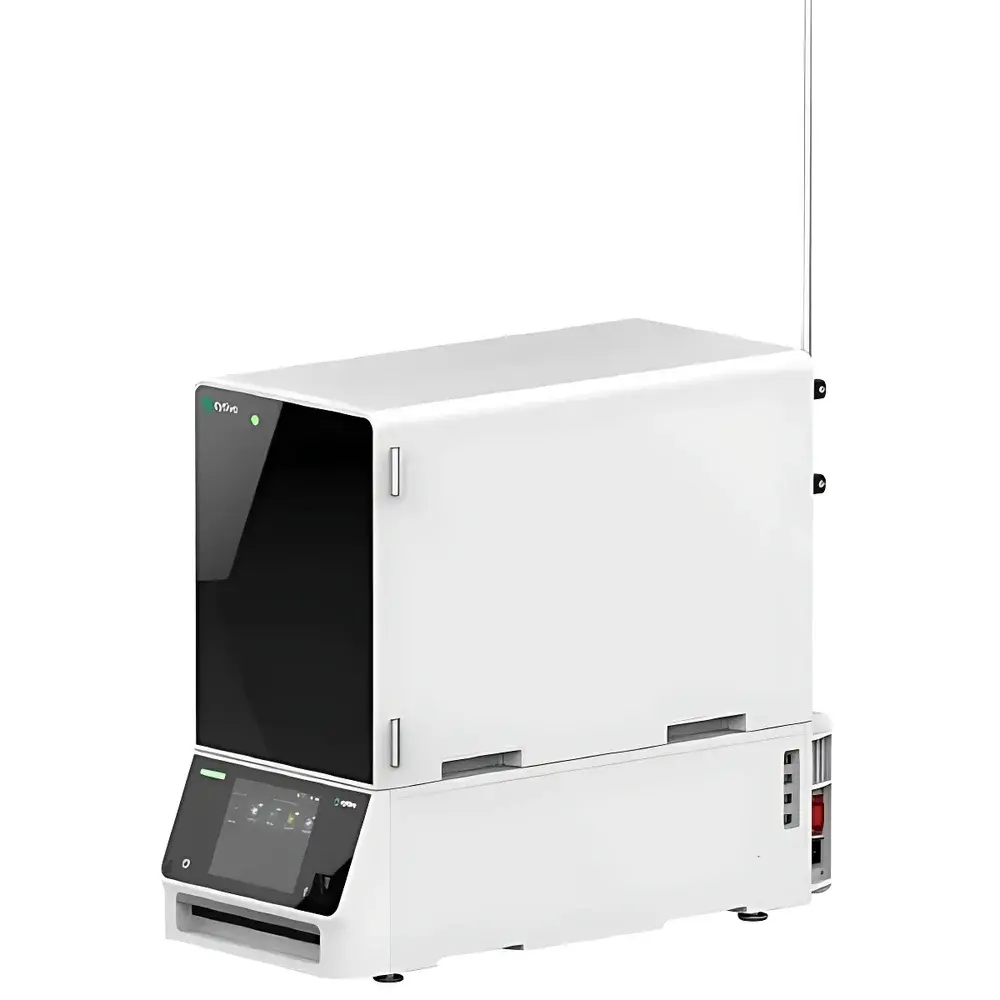
Cytiva Sefia™ Automated Cell Expansion System
| Brand | Cytiva |
|---|---|
| Origin | Switzerland |
| Type | Fully Automated |
| Model | Sefia™ Automated Cell Expansion System |
| Compliance | CE-marked (2006/42/EC), IEC 61010, IEC 61326, ICES-001 Class A, China RoHS SJ/T11364-2014 |
| Software Compliance | Chronicle™ Viewer validated per GAMP™5 and FDA 21 CFR Part 11 |
| Operating Environment | 15–25°C, 20–80% RH (non-condensing), 840–1060 mbar, indoor use only, max. altitude 2000 m |
| Consumables | Single-use FEP or silicone-based disposable kits (e.g., Cat. No. 29716713, 29739346) |
| Integration | Compatible with Chronicle™ Viewer for audit-trail-enabled data management and real-time process monitoring |
Overview
The Cytiva Sefia™ Automated Cell Expansion System is an integrated, closed, single-use platform engineered for the robust, reproducible, and compliant manufacturing of cell therapy products under current Good Manufacturing Practice (cGMP) conditions. Designed around core bioprocess principles—including sterile fluid handling, precise environmental control, and real-time parameter monitoring—the system executes three sequential, critical unit operations in autologous and allogeneic cell therapy workflows: T-cell activation, viral vector-mediated genetic modification (e.g., lentiviral or retroviral transduction), and controlled ex vivo expansion. Its architecture implements a combination of peristaltic pumping, pinch valves, and solenoid-controlled gas delivery to manage reagents, cells, media, sampling streams, and sterile air—ensuring aseptic integrity throughout processing. Temperature is regulated via dual-zone heating (bottom plate + top heater), with independent liquid and incubation chamber temperature sensors, while CO₂ concentration is actively monitored and maintained using an integrated CO₂ controller and sensor array. A dedicated fan ensures uniform gas distribution within the process chamber. Mass sensing via load cells in both the process and media storage units enables gravimetric process control, supporting accurate feeding, harvesting, and volume tracking across batch, fed-batch, and perfusion modes.
Key Features
- Fully automated, closed-system operation minimizing manual intervention and operator-dependent variability
- Single-use, pre-sterilized disposable kits (FEP or silicone variants) eliminating cross-contamination risk and reducing cleaning validation burden
- Real-time process monitoring with embedded sensors for pressure, temperature, CO₂, mass, and fluid flow—supported by visual LED status indicators and configurable alarm notifications
- Touchscreen-driven embedded process automation software enabling execution of standardized protocols for activation, transduction, and expansion—with customizable parameters for cell density, feed timing, gas setpoints, and harvest criteria
- Modular hardware design comprising Process Unit, Media Storage Unit, and Status Indicator—each CE-marked per Machinery Directive 2006/42/EC and compliant with IEC 61010-1 (safety) and IEC 61326-1 (EMC)
- Native integration with Chronicle™ Viewer Enterprise Edition—a 21 CFR Part 11–compliant, GAMP™5-validated software platform delivering electronic batch records, audit trails, role-based access control, and long-term data archiving
Sample Compatibility & Compliance
The Sefia™ system is compatible with widely adopted clinical-grade reagents, including anti-CD3/CD28 activation beads, serum-free and xeno-free expansion media (e.g., TexMACS™, X-VIVO™, OpTmizer™), and commercial lentiviral and retroviral vectors. It supports static culture in gas-permeable, single-use cultivation chambers with defined surface area-to-volume ratios. The platform has been functionally verified across multiple cell types, including primary human T lymphocytes and NK cells, with initial inoculum ranging from 5 g to 250 g and final harvest masses up to 1200 g. All consumables are manufactured under ISO 13485 quality management systems and supplied with full traceability documentation. The system meets regulatory expectations for GxP environments: hardware complies with IEC 61010-1 (electrical safety), IEC 61326-1 (EMC), and Canadian ICES-001 Class A emission limits; software validation follows GAMP™5 lifecycle methodology and satisfies FDA 21 CFR Part 11 requirements for electronic records and signatures.
Software & Data Management
Process execution is governed by an embedded, deterministic automation engine running validated application modules—including Generic Activation, Viral Transduction, and Expansion (Batch/Fed-Batch/Perfusion). Each module includes configurable setpoints, interlock logic, and failure-handling routines (e.g., automatic waste diversion, kit disconnection without process interruption). Diagnostic tools enable automated functional verification of pumps, valves, sensors, and heaters, generating pass/fail reports with timestamps and user attribution. All process data—including sensor readings, actuator states, alarms, and user actions—are streamed in real time to Chronicle™ Viewer Enterprise Edition. This server-based application provides secure, role-based access, electronic signature capability, full audit trail retention, and export functionality compliant with ALCOA+ principles. Data exports support CSV, PDF, and XML formats for regulatory submissions and internal quality reviews. Chronicle™ Viewer is qualified for use in GLP, GMP, and clinical trial settings, with independent third-party validation confirming conformance to 21 CFR Part 11 Subpart B and EU Annex 11.
Applications
The Sefia™ system is deployed in process development, clinical manufacturing, and commercial-scale production of CAR-T, TCR-T, and other genetically modified cell therapies. It supports end-to-end workflows from leukapheresis-derived mononuclear cell activation through transduction and expansion to final formulation-ready product. Its flexibility accommodates varying expansion strategies: batch culture for rapid turnaround, fed-batch for enhanced viability and yield, and perfusion for prolonged culture durations (>10 days) with continuous nutrient replenishment and metabolite removal. The system also enables process troubleshooting via dedicated diagnostic and recovery applications—such as Purge & Troubleshoot, which safely evacuates cells from the culture chamber during off-nominal events without compromising sterility. Additional utilities include Kit Disconnection Mode (for safe peripheral manipulation mid-process) and Instrument Diagnostics (for preventive maintenance scheduling).
FAQ
What regulatory standards does the Sefia™ system meet?
The hardware carries CE marking per 2006/42/EC and complies with IEC 61010-1 (safety) and IEC 61326-1 (EMC); Chronicle™ Viewer is validated per GAMP™5 and FDA 21 CFR Part 11.
Can the system integrate with existing laboratory information management systems (LIMS)?
Yes—Chronicle™ Viewer supports standard data export formats (CSV, XML) and can be interfaced with enterprise LIMS or MES platforms via secure API or file transfer protocols.
Are consumables supplied with lot-specific certificates of analysis and conformance?
Yes—each disposable kit is accompanied by CoA, CoC, and bioburden/endotoxin test reports aligned with ISO 10993 and USP /.
What service and qualification support is available for GMP implementation?
Cytiva’s OptiRun™ service portfolio includes IQ/OQ/RQ execution, preventive maintenance, calibration, software revalidation, and lifecycle support—including remote diagnostics, on-site engineering, and digital training modules.
Does the system support perfusion mode for extended culture durations?
Yes—perfusion operation is fully supported via programmable feed/waste cycles, real-time mass-based feedback control, and integrated gas exchange management.



