
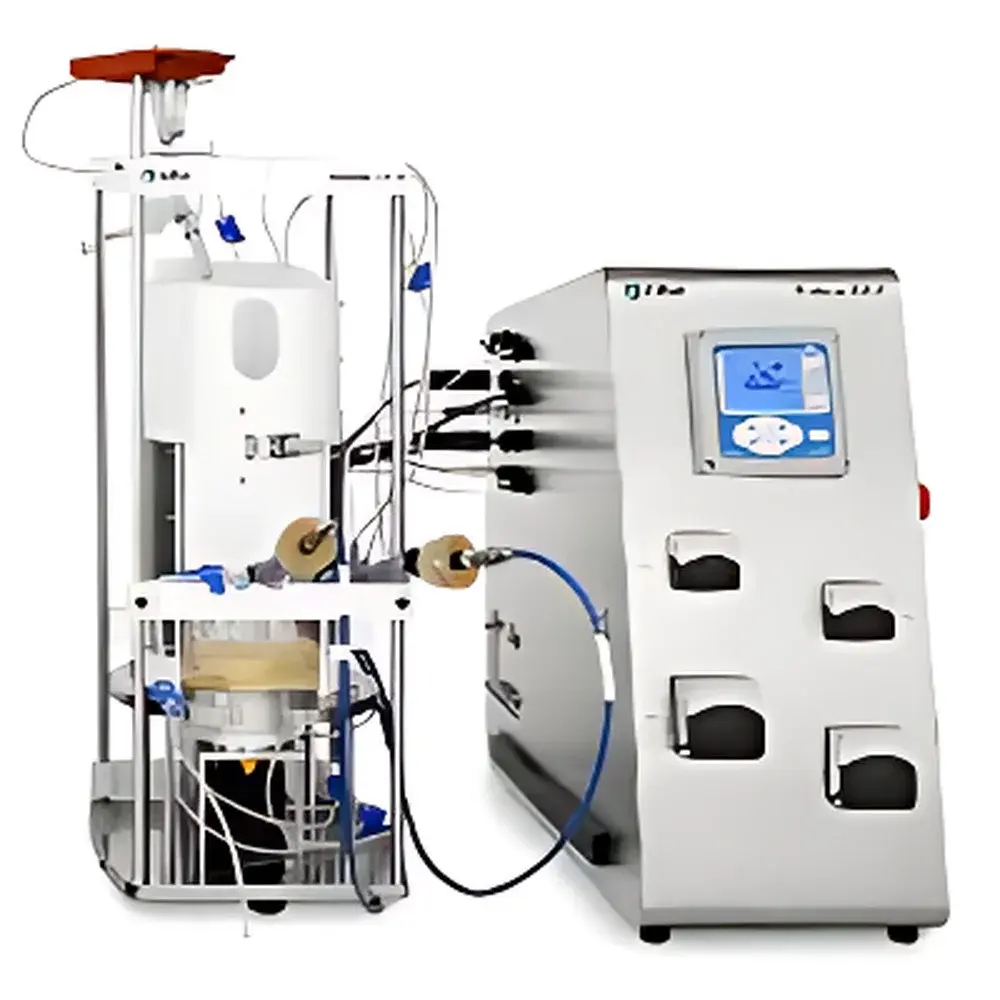
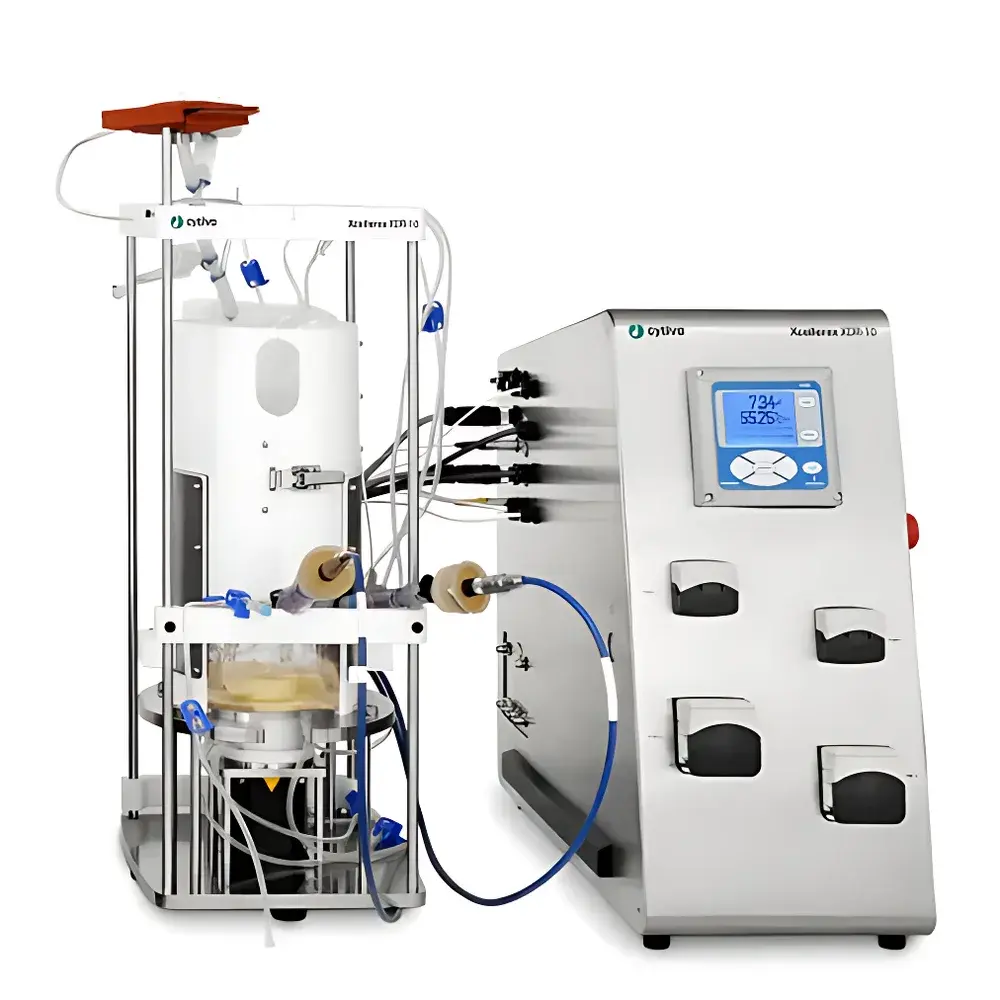
Cytiva Xcellerex XDR-10 Single-Use Stirred-Tank Bioreactor System
| Brand | Cytiva |
|---|---|
| Origin | USA |
| Configuration | Single-Vessel System |
| Working Volume | 4.5–10 L |
| Contact Materials | USP Class VI Low-Density Polyethylene (LDPE) |
| Compliance | cGMP-Compatible Design for Clinical & Commercial Biomanufacturing |
| Scalability | Direct Fluid Dynamic & Control Parity with Xcellerex XDR-50, XDR-200, XDR-500, XDR-1000, and XDR-2000 Systems |
| Impeller Type | Low-Shear, High-Power Magnetic Coupling Impeller with Integrated Sparger |
| Automation Architecture | Smart Process Control with Integrated Data Logging and Audit Trail Capability |
Overview
The Cytiva Xcellerex XDR-10 is a rigorously engineered single-use stirred-tank bioreactor system designed for robust process development, small-scale GMP-compliant manufacturing, and root-cause investigation in mammalian, microbial, and hybrid cell culture applications. Operating on the foundational principles of controlled hydrodynamics, gas mass transfer, and precise environmental regulation—temperature, pH, dissolved oxygen (DO), and agitation—the XDR-10 employs a magnetically coupled impeller driven by an external motor head, eliminating mechanical seals and associated contamination risks. Its design directly inherits fluid dynamic characteristics, sensor placement logic, control algorithms, and contact-material specifications from Cytiva’s full-scale Xcellerex platform (XDR-50 through XDR-2000), enabling quantitative scale-up based on dimensionless numbers (e.g., Reynolds number, power input per unit volume, kLa) rather than empirical correlation alone. This architectural continuity ensures reproducible mixing profiles, consistent shear environments, and predictable oxygen transfer rates across scales—critical for accelerating tech transfer from stainless steel to single-use platforms and de-risking clinical batch campaigns.
Key Features
- Working volume range of 4.5–10 L, optimized for seed train expansion, clone screening, media optimization, and early-phase clinical lot production.
- USP Class VI-certified LDPE single-use bag with integrated bottom-mounted magnetic impeller and sparger assembly—ensuring sterile integrity, chemical compatibility, and low extractables profile per ICH Q5A and Q5D guidelines.
- Low-shear, high-torque impeller geometry engineered to maintain suspension of shear-sensitive mammalian cells while delivering sufficient power input (P/V) for high-density cultures without foaming or excessive bubble-induced damage.
- Modular frame architecture supporting rapid bag installation, calibration, and validation; compatible with optional accessories including perfusion manifolds, harvest ports, and inline sensors (pH/DO).
- Embedded process controller with preconfigured PID loops, real-time trending, and configurable alarm thresholds—fully compliant with ISA-88 and ISA-95 operational models.
Sample Compatibility & Compliance
The XDR-10 accommodates a broad spectrum of bioprocess-relevant cell lines—including CHO, HEK293, PER.C6, CAP-T, and E. coli—across fed-batch, perfusion, and batch modes. All wetted materials conform to USP <788>, USP <87>, USP <88>, and EP 3.1.9 standards. The system supports qualification under ISO 13485 and is routinely deployed in facilities operating under FDA 21 CFR Part 11, EU Annex 11, and ICH GCP/GMP frameworks. Documentation packages include IQ/OQ templates aligned with ASTM E2500-13 and user requirement specification (URS) traceability matrices. Sterility assurance is validated per ISO 11137 for gamma-irradiated bags (25–40 kGy), with endotoxin levels ≤0.25 EU/mL confirmed post-sterilization.
Software & Data Management
The XDR-10 integrates with Cytiva’s Allegro™ Connect software suite, providing secure, role-based access control, electronic signature support, and automated audit trail generation compliant with 21 CFR Part 11 Subpart B. All process parameters—including agitation speed (rpm), gas flow rates (sLPM), temperature setpoints (°C), pH (unitless), DO (% air saturation), and weight changes—are timestamped, encrypted, and stored in a relational database with configurable retention policies. Data export adheres to ASTM E2892-13 (Standard Guide for Biopharmaceutical Process Data Exchange) and supports CSV, PDF, and ASAM-ODS formats for third-party analytics platforms (e.g., SIMCA, JMP, Python-based PLS models).
Applications
- Process characterization studies for comparability assessments between legacy stainless steel and next-generation single-use systems.
- Accelerated stability testing and formulation screening under varied shear and mass transfer conditions.
- Investigation of process deviations—e.g., unexpected viability loss, metabolic shift, or titer decline—via controlled parameter perturbation (DoE-enabled).
- Training platform for operators transitioning to larger XDR systems or Allegro STR platforms, leveraging identical HMI layout and alarm logic.
- cGMP-compliant production of Phase I–II clinical material for monoclonal antibodies, viral vectors, and recombinant proteins.
FAQ
Is the XDR-10 suitable for perfusion culture?
Yes—the system supports continuous perfusion via integrated pump-driven harvest and feed lines, with optional density gradient separation modules and real-time viable cell density monitoring using inline capacitance probes.
Can the XDR-10 be qualified for commercial manufacturing?
While primarily deployed for process development and clinical supply, the XDR-10 has been successfully included in BLA submissions as part of a multi-scale platform strategy; qualification must follow site-specific validation protocols aligned with ICH Q5A and regulatory agency expectations for single-use systems.
What documentation is provided for regulatory submissions?
Cytiva supplies material compliance certificates (MCCs), extractables and leachables data packages (per USP <1663>/<1664>), and vendor qualification dossiers supporting risk-based assessment of single-use components.
How is sensor calibration performed?
pH and DO sensors are factory-calibrated and verified using NIST-traceable standards; in situ calibration is supported via two-point pH buffer verification and air-saturated water DO checks prior to each run.
Does the system support remote monitoring and alarm notification?
Yes—Allegro Connect enables secure web-based access, SMS/email alerts for critical alarms, and integration with enterprise MES/LIMS via OPC UA or RESTful API endpoints.




