
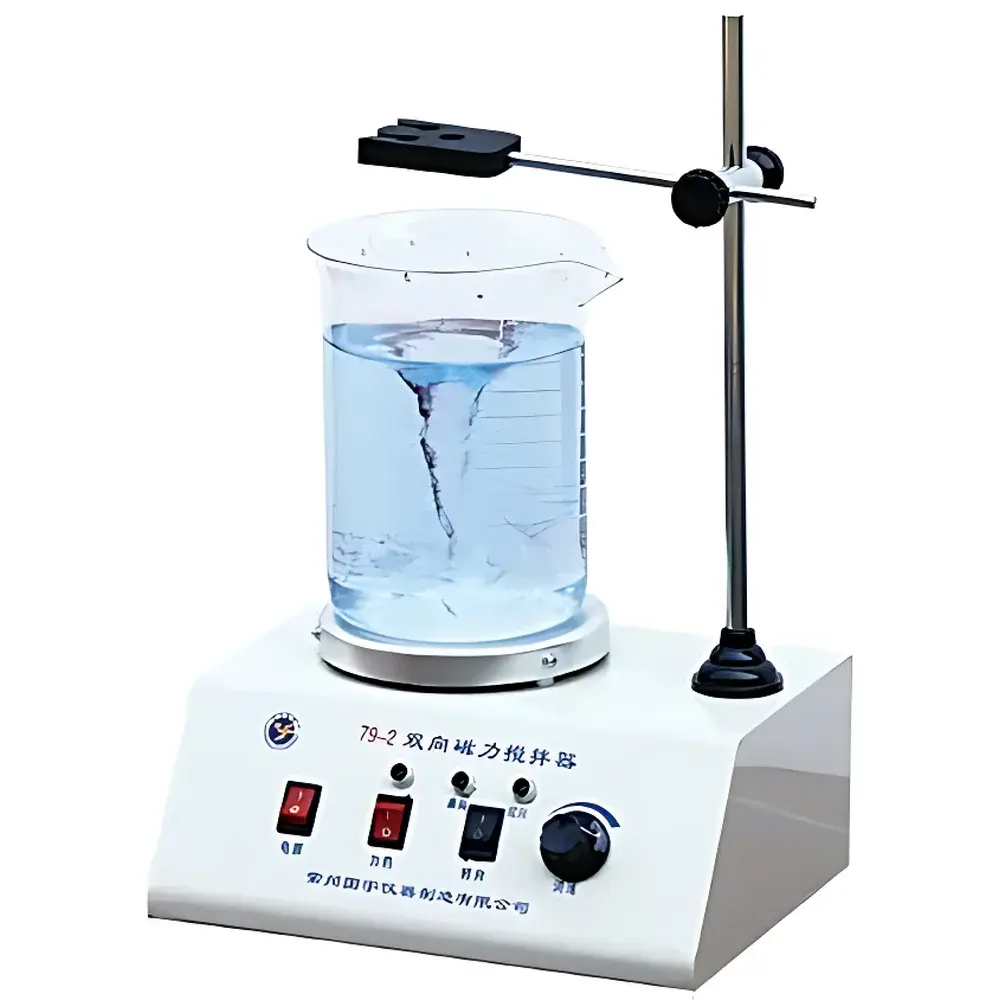
CZGY 78-2 Dual-Direction Magnetic Hotplate Stirrer
| Brand | CZGY |
|---|---|
| Origin | Jiangsu, China |
| Manufacturer Type | Direct Manufacturer |
| Model | 78-2 |
| Instrument Type | Magnetic Stirrer |
| Max Stirring Volume | 1 L |
| Speed Range | 0–1600 rpm |
| Heating Temperature Range | Ambient to 100 °C |
| Power | Motor 40 W / Heater 200 W |
| Bidirectional Cycle | 30 s per direction |
| Input | AC 220 V ±10 V, 50 Hz |
| Safety | Grounded operation required |
Overview
The CZGY 78-2 Dual-Direction Magnetic Hotplate Stirrer is an electromechanically integrated laboratory instrument engineered for precise, low-noise mixing and controlled thermal activation of liquid samples. It operates on the principle of magnetic coupling: a rotating permanent magnet beneath a thermally conductive ceramic-coated aluminum plate induces synchronous rotation of a PTFE- or glass-coated magnetic stir bar immersed in the sample vessel. Unlike single-direction stirrers, the 78-2 incorporates an automatic polarity-switching circuit that alternates motor rotation every 30 seconds—enabling bidirectional agitation to minimize vortex formation, reduce sedimentation at vessel walls, and improve homogeneity in viscous or heterogeneous suspensions. Designed for routine benchtop use in academic teaching labs, environmental testing facilities, and QC/QA environments, it supports reproducible sample preparation under defined thermal and mechanical conditions without requiring external controllers or complex calibration.
Key Features
- Dual-directional stirring cycle (30 s forward / 30 s reverse) enhances mixing uniformity in high-viscosity or particulate-laden solutions
- Continuously variable speed control from 0 to 1600 rpm via analog rotary knob—no digital interface required, minimizing electromagnetic interference in sensitive setups
- Integrated heating element with fixed-setpoint temperature control (ambient to 100 °C); no PID regulation or temperature feedback loop—suitable for applications where approximate thermal stabilization suffices
- Low-power consumption architecture: 40 W motor + 200 W resistive heater enables stable operation on standard laboratory circuits (220 V ±10 V, 50 Hz)
- Robust mechanical design featuring chrome-plated support rod, cross-joint clamp assembly, and rubber-tipped gripping head for secure flask positioning
- No audible gear noise or mechanical vibration due to brushless DC motor drive and optimized magnetic coupling geometry
- Grounded chassis construction compliant with IEC 61010-1 safety requirements for laboratory electrical equipment
Sample Compatibility & Compliance
The 78-2 accommodates standard borosilicate glass vessels—including beakers (up to 1000 mL), Erlenmeyer flasks, and crystallizing dishes—when placed centrally on its 130 mm diameter heated plate. Stir bar selection (included: two standard 30 mm × 8 mm rods) must match solution viscosity and container geometry to ensure torque transmission without slippage. While not certified to ISO/IEC 17025 or GLP audit standards as a standalone unit, its consistent mechanical output and thermal repeatability support method validation under internal SOPs aligned with ASTM D1298 (density of liquids) or USP (dissolution apparatus verification protocols). The absence of programmable temperature control limits compliance with FDA 21 CFR Part 11 for regulated GMP environments; however, manual operation remains suitable for non-GxP preparatory steps such as buffer equilibration, reagent dissolution, or catalyst suspension.
Software & Data Management
This instrument operates entirely in standalone mode with no embedded microcontroller, firmware, or data logging capability. All operational parameters—speed setting and heating activation—are manually adjusted and visually confirmed via front-panel LED indicators. No USB, RS-232, or Bluetooth connectivity is provided. Consequently, it generates no electronic records, requires no software installation, and imposes zero cybersecurity or validation overhead. This analog architecture ensures deterministic behavior across decades of service life and eliminates firmware obsolescence risks common in digitally managed lab hardware.
Applications
- Preliminary dissolution testing of pharmaceutical excipients prior to HPLC analysis
- Homogenization of aqueous polymer solutions (e.g., PVA, CMC) in materials science labs
- Preparation of calibration standards for ICP-OES and AAS instrumentation
- Mixing of microbial growth media in teaching microbiology laboratories
- Controlled heating and agitation during titration endpoint development studies
- Supporting ASTM D937 (penetration of petroleum waxes) sample conditioning protocols
- Environmental lab use for pH adjustment and coagulant dispersion in wastewater simulants
FAQ
Does the 78-2 support temperature setpoint programming or digital readout?
No. It features a fixed-heating mode only—temperature rises passively with applied power and stabilizes based on ambient conditions, vessel mass, and solution thermal capacity.
Can the bidirectional timing interval be modified?
No. The 30-second forward/reverse cycle is hardwired into the control circuit and not user-adjustable.
Is the unit compatible with corrosive solvents such as concentrated acids or organic halides?
Only when used with chemically inert stir bars (e.g., PTFE-encapsulated) and acid-resistant glassware; the heater plate surface is aluminum with ceramic coating—avoid direct contact with strong oxidizers or molten alkalis.
What maintenance is required for long-term reliability?
Periodic cleaning of the plate surface with isopropyl alcohol; inspection of stir bar integrity before each use; and verification of grounding continuity annually per institutional EHS policy.
Does CZGY provide calibration certificates or traceable metrology documentation?
Not included by default. Calibration of speed and plate temperature must be performed externally using NIST-traceable tachometers and surface thermometers per user-defined SOPs.



