
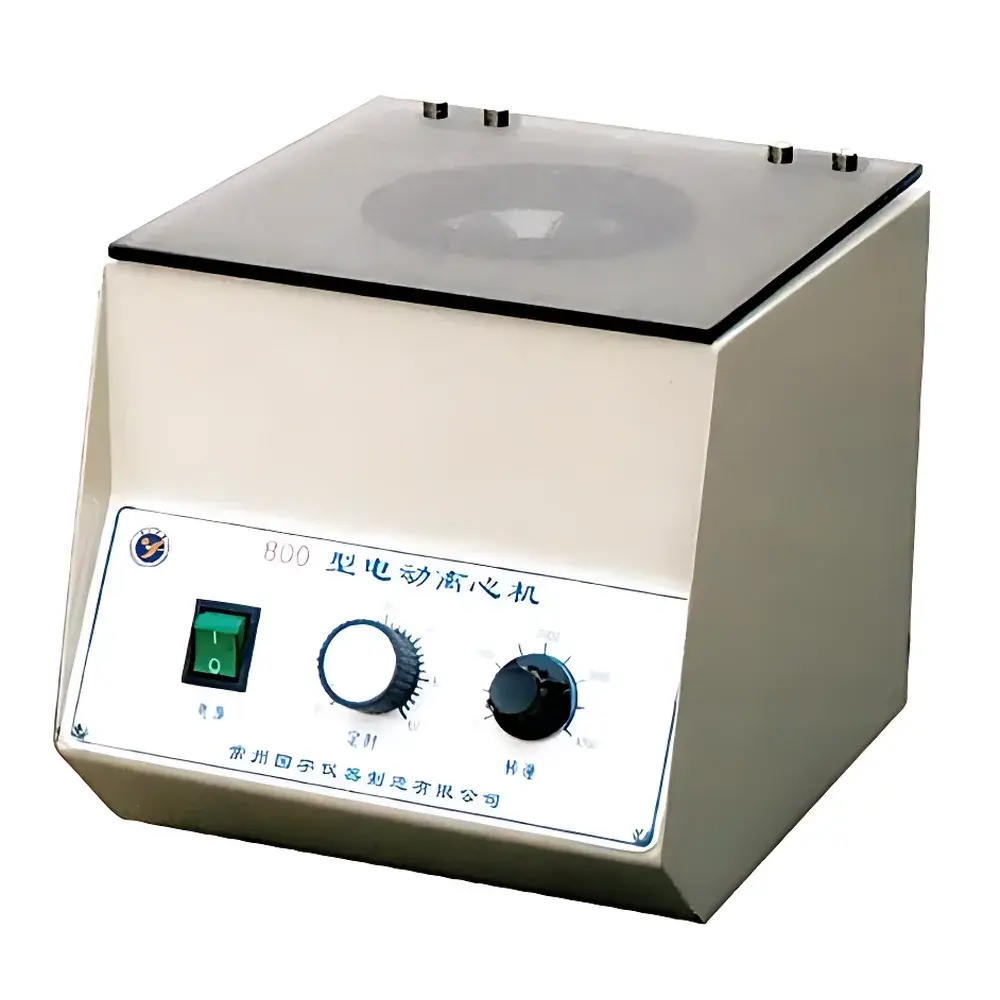
CZGY 800 Benchtop Electric Centrifuge
| Brand | CZGY |
|---|---|
| Origin | Jiangsu, China |
| Manufacturer | Yes |
| Type | Domestic |
| Model | 800 |
| Price | USD 80 (approx.) |
| Centrifugation Class | General-Purpose |
| Max Capacity | 6 × 20 mL |
| Max Speed | 4000 rpm |
| Dimensions | 235 × 280 × 240 mm |
| Power Supply | 220 V, 50 Hz |
| Timer Range | 0–60 min |
| Rated Power | 40 W |
| Speed Control | 0–4000 rpm |
| RCF (max) | 1960 × g |
| Weight | ~12 kg (estimated) |
| Safety | Grounded operation required |
| Lid | Polycarbonate transparent cover |
| Tube Balance Tolerance | ≤3 g per rotor position |
Overview
The CZGY 800 is a compact, general-purpose benchtop electric centrifuge engineered for routine separation tasks in clinical diagnostics, biomedical research, and quality control laboratories. It operates on the principle of sedimentation under centrifugal force—accelerating particle separation based on density, size, and shape differences within liquid suspensions. With a maximum rotational speed of 4000 rpm and a peak relative centrifugal force (RCF) of 1960 × g, the unit delivers reproducible pelleting of erythrocytes, leukocytes, serum, plasma, bacterial cells, and precipitated reagents. Its robust brushed DC motor, integrated timer, and stepwise analog speed control enable precise, repeatable operation without microprocessor-based complexity—making it especially suitable for resource-constrained labs, teaching environments, and field-deployable diagnostic units where reliability and ease of maintenance are prioritized over ultra-high-speed capability.
Key Features
- Benchtop footprint (235 × 280 × 240 mm) optimized for limited lab space without compromising stability or capacity
- 6-place rotor accommodating standard 20 mL conical or round-bottom centrifuge tubes (e.g., Falcon 20 mL, Corning 20 mL)
- Analog speed dial with continuous 0–4000 rpm adjustment and visual RPM scale for intuitive manual control
- Mechanical timer (0–60 minutes) with audible end-of-cycle alert and automatic shut-off
- Polycarbonate safety lid with interlock mechanism—operation disabled unless fully latched
- Grounded metal chassis and dedicated earth terminal to meet IEC 61010-1 electrical safety requirements
- Low-noise brush motor design (<65 dB at 4000 rpm), minimizing acoustic interference in shared lab spaces
- Thermal protection circuitry prevents coil overheating during extended use or overload conditions
Sample Compatibility & Compliance
The CZGY 800 supports common disposable polypropylene (PP) and polycarbonate (PC) tubes rated for ≥2000 × g. It is routinely employed for blood fractionation (serum/plasma isolation), urine sediment concentration, vaccine adjuvant clarification, and cell pellet harvesting in non-GMP academic or clinical screening workflows. While not certified for ISO 13485 or FDA 21 CFR Part 11 compliance out-of-the-box, its mechanical timer and analog controls provide inherent auditability—start time, duration, and approximate speed settings are directly observable and manually recordable, supporting GLP-aligned documentation practices. Tube balancing tolerance (≤3 g per position) aligns with ISO 21501-4 recommendations for routine centrifuge validation.
Software & Data Management
This model does not incorporate digital connectivity, firmware, or software interfaces. All operational parameters—including timer setting, speed selection, and power state—are controlled and monitored via physical dials and indicators. This architecture eliminates cybersecurity vulnerabilities, firmware update dependencies, and calibration drift associated with embedded electronics. User logs (time, speed, sample type, operator ID) are maintained externally using paper-based or LIMS-integrated electronic notebooks—ensuring full traceability without proprietary software lock-in. No data export, remote monitoring, or electronic signature functionality is provided, consistent with its classification as a Class I electromechanical laboratory device under IVD regulatory frameworks.
Applications
- Routine serum and plasma separation from whole blood specimens in hospital core labs and point-of-care clinics
- Concentration of urinary sediments for microscopic analysis per CLSI GP17-A4 guidelines
- Pelleting of E. coli, S. cerevisiae, or mammalian suspension cells prior to lysis or cryopreservation
- Clarification of crude antigen preparations and adjuvant suspensions in vaccine R&D
- Removal of particulates from buffer stocks, enzyme solutions, and tissue homogenates
- Teaching centrifugation principles—including RCF calculation, sedimentation kinetics, and rotor imbalance effects—in undergraduate life science curricula
FAQ
What is the maximum relative centrifugal force (RCF) achievable with this centrifuge?
The maximum RCF is 1960 × g, calculated at 4000 rpm with a rotor radius of 100 mm (standard for 6 × 20 mL configuration).
Can this centrifuge be used for infectious samples?
Yes—provided biosafety level-appropriate tube sealing (e.g., capped conical tubes) and post-run decontamination (70% ethanol wipe-down) are performed; however, it lacks sealed rotor or aerosol-tight containment features.
Is rotor imbalance detection built into the unit?
No—imbalance must be manually verified before operation by ensuring mass deviation between opposing tubes is ≤3 g; excessive vibration triggers automatic shutdown via mechanical safety cutout.
Does the centrifuge include a rotor or tubes?
The standard configuration includes one fixed-angle 6-position rotor compatible with 20 mL tubes; tubes are sold separately.
What maintenance is required?
Monthly cleaning of the chamber and lid seal with isopropyl alcohol; annual inspection of motor brushes and timer contact points by qualified service personnel.



