
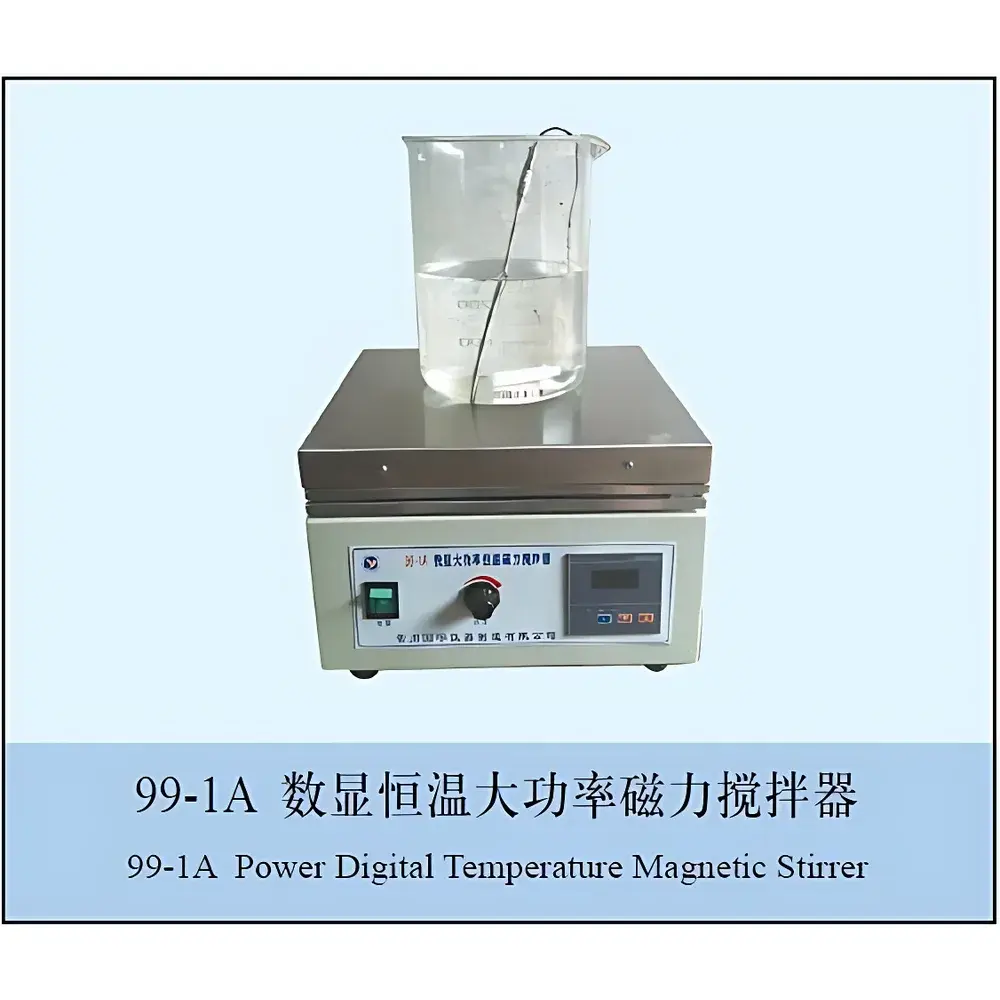
CZGY 99-1A Digital Display High-Power Magnetic Stirrer with Integrated Heating
| Key | Brand: CZGY |
|---|---|
| Origin | Jiangsu, China |
| Manufacturer Type | Direct Manufacturer |
| Model | 99-1A |
| Stirring Capacity | 30 L |
| Speed Range | 0–2000 rpm |
| Temperature Control Range | Ambient to 100 °C |
| Motor Power | 40 W |
| Heating Power | 600 W |
| Platform Dimensions | 30 × 30 cm |
| Platform Material | Stainless Steel 304 |
| Temperature Resolution | 1 °C |
| Control Method | PID with Adjustable P/E/T Parameters |
| Safety Features | Grounding Terminal, Overheat Protection, Dry-run Interlock |
Overview
The CZGY 99-1A Digital Display High-Power Magnetic Stirrer with Integrated Heating is an engineered solution for laboratories requiring simultaneous precise temperature control and robust mechanical agitation of large-volume samples. Based on the principle of magnetic coupling—where a rotating permanent magnet beneath the platform induces torque on a PTFE- or glass-coated stir bar immersed in the sample—the instrument delivers contactless, spark-free mixing ideal for flammable, corrosive, or sterile applications. Unlike conventional hotplate stirrers with limited thermal uniformity, the 99-1A integrates a high-efficiency 600 W resistive heating element directly beneath a 30 × 30 cm stainless steel (SS304) work surface, enabling rapid thermal response and stable setpoint maintenance across volumes up to 30 L. Its brushless DC motor ensures low-noise operation, extended service life, and consistent torque delivery from startup (0 rpm) to full speed (2000 rpm), making it suitable for viscous media, polymer solutions, and heterogeneous suspensions common in environmental analysis, pharmaceutical formulation development, and materials synthesis.
Key Features
- High-power dual-function design: 40 W variable-speed stirring + 600 W independent heating—engineered for concurrent thermal and mechanical processing
- Digital PID temperature controller with user-adjustable proportional band (P), integral time (I), derivative time (D), and overshoot suppression parameter (E) for optimized thermal stability under dynamic load conditions
- Stainless steel 304 platform resistant to chemical corrosion and thermal deformation; smooth, non-porous surface facilitates cleaning and prevents residue accumulation
- Stepless speed regulation via rotary encoder with real-time rpm display—supports gradual acceleration to prevent stir bar slippage or vortex instability
- Integrated Pt100-compatible temperature probe with internal mounting; probe must remain fully immersed during operation to ensure accurate feedback and prevent heater runaway
- Safety interlocks: automatic heater cutoff when stirring is disabled, grounding terminal compliance per IEC 61010-1, and dry-run protection logic preventing heating without active agitation
Sample Compatibility & Compliance
The 99-1A accommodates standard laboratory glassware—including beakers (up to 5000 mL nominal capacity), Erlenmeyer flasks, and custom reaction vessels—provided base geometry ensures stable placement and uniform magnetic coupling. It supports aqueous, organic, and mildly acidic/basic solutions but is not rated for halogenated solvents or strong oxidizers without supplemental containment. While not certified to UL/CSA or CE for standalone medical device use, its electrical architecture complies with IEC 61010-1 Edition 3 for laboratory equipment safety. The digital interface meets basic data integrity expectations for non-GxP environments; however, it does not support audit trail, electronic signatures, or 21 CFR Part 11 compliance out-of-the-box. For GLP/GMP-aligned workflows, users are advised to document setpoints, duration, and observed behavior manually or via external data loggers.
Software & Data Management
The 99-1A operates via embedded firmware with no external software dependency. All configuration—including temperature setpoint, PID parameters (P/E/T), and operational mode—is managed through a front-panel keypad with LED numeric display. Parameter changes are retained after power cycling. No USB, RS-232, or Ethernet connectivity is provided; therefore, remote monitoring, automated reporting, or integration into LIMS or SCADA systems requires third-party hardware interfaces (e.g., analog voltage output adapters or relay-triggered data acquisition modules). The unit logs no internal event history, nor does it timestamp operations—consistent with its role as a benchtop utility instrument rather than a regulated analytical platform.
Applications
- Preparation of calibration standards and reference solutions in environmental testing labs (e.g., EPA Method 200.7, ISO 11885)
- Controlled dissolution studies during early-phase pharmaceutical development where temperature-dependent solubility kinetics must be monitored
- Homogenization of catalyst slurries prior to filtration or centrifugation in catalysis research
- Heating and mixing of culture media in microbiology and molecular biology workflows prior to sterilization or dispensing
- Accelerated aging experiments in polymer science, where simultaneous thermal exposure and shear stress simulate long-term degradation mechanisms
- Sample conditioning for ICP-OES, AAS, or titration assays requiring matrix homogeneity and thermal equilibration
FAQ
What is the maximum recommended continuous operating time at full speed?
At 2000 rpm, continuous operation should not exceed 4 hours to maintain motor thermal stability and bearing longevity. At speeds ≤1200 rpm, uninterrupted use up to 8 hours is permissible.
Can the instrument heat without stirring?
No. The firmware enforces a hardware-level interlock: heating is disabled unless a valid stirring signal is detected. This prevents thermal damage to vessels or samples during static heating.
Is the temperature probe calibrated traceable to NIST standards?
The integrated probe is factory-calibrated at 25 °C and 100 °C. NIST-traceable recalibration requires disassembly and third-party metrology services; CZGY does not supply calibration certificates with standard units.
What stir bar size is optimal for 30 L volume?
For volumetrically uniform agitation at scale, a dual-magnet elliptical stir bar ≥80 mm in length with PTFE encapsulation is recommended. Smaller bars may fail to generate sufficient torque or induce laminar flow zones.
Does the stainless steel platform support autoclaving or direct steam exposure?
No. The platform is not designed for sterilization cycles. Exposure to saturated steam or repeated thermal shock exceeding 120 °C risks weld seam fatigue and sensor drift.



